
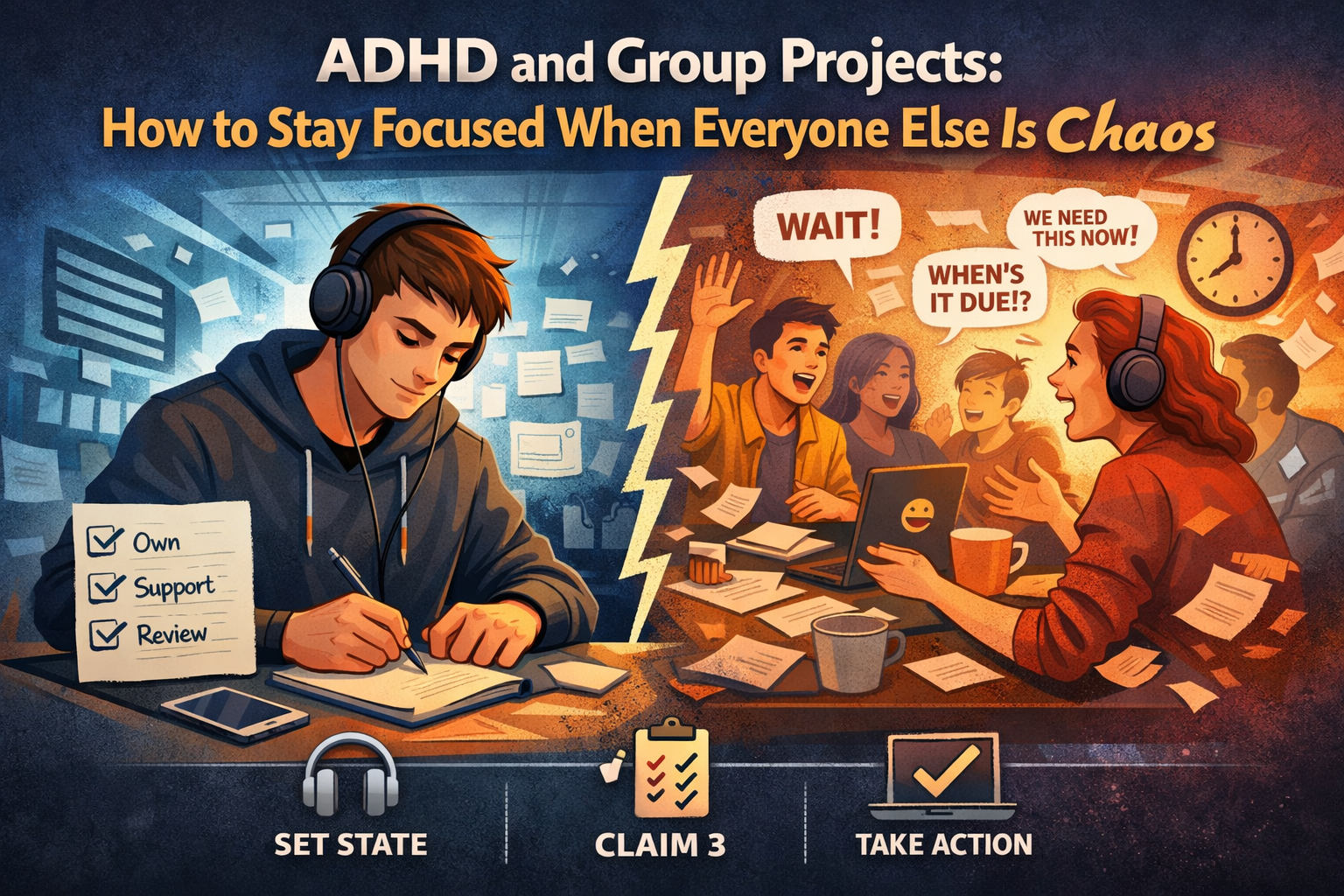
Group projects can feel like attention warfare.
Everyone is talking. Nobody is deciding. The meeting drifts, the work stays fuzzy, and then suddenly the deadline is on fire.
If you have ADHD, that environment can hit fast:
- overstimulation
- zoning out
- interrupting because your brain is moving faster than the room
- frustration when nobody gets to the point
- that drained, mentally cooked feeling after a meeting that somehow produced nothing
This is not medical advice. It is a practical system for protecting your focus, reducing chaos, and getting real work done.
The real problem: group meetings create attention debt
Most group projects do not fail because people are lazy.
They fail because the meeting ends with too many open loops:
- no clear owner
- no clear next step
- no clear deadline
That is a bad setup for anyone. For ADHD brains, it is worse.
Unclear tasks stay mentally open. Your attention keeps circling back. You leave the meeting scattered instead of directed.
The goal is not to “try harder.”
The goal is to leave with less cognitive drag.
The 3-part system for surviving group work
1) Set your state before the meeting
Take two minutes before the meeting starts.
Do this:
- put your headphones on
- run a steady sound loop
- take 3 slow breaths: inhale for 4, exhale for 6
Do not aim for perfectly calm.
Aim for steady.
That matters more. Steady gives you a baseline you can return to when the group gets noisy, messy, or unfocused.
2) In the meeting, claim exactly 3 deliverables
ADHD gets worse when your role is vague.
So make your role concrete. Every meeting should end with your clear 3:
- one thing you own
- one thing you support
- one thing you review
Write them down before the meeting ends.
If nobody is taking control, stop waiting and propose the structure yourself:
“I can own X, you take Y, and you handle Z. Does that work?”
That single sentence does two things:
- It forces decisions
- It gives your brain a clean map
Clarity protects focus.
3) Reset after the meeting, then do one micro-action immediately
Do not go straight from a chaotic meeting into vague intentions.
Reset first:
- run a steady sound loop for 3 minutes
- write the first micro-action
- do it immediately
Not later. Not tonight. Right then.
Examples:
- open the doc
- write the heading
- message the team
- build the outline
- start the first paragraph
This is how you convert scattered energy into momentum.
A small action closes the gap between “we talked about it” and “the project actually moved.”
Where High Frequency Highway High Frequency Headphones fit
A lot of students wear headphones during group work, but the real value is not just blocking sound.
It is creating a state boundary.
High Frequency Highway’s High Frequency Headphones can help reduce competing noise, lower overstimulation, and give you a consistent focus rail before and after meetings.
Used that way, they become more than background audio. They become a repeatable cue that tells your brain: now we focus.
The social advantage nobody talks about
This system does more than help you concentrate.
It changes how people experience you.
You become the person who:
- turns messy meetings into decisions
- creates clarity when everyone else is rambling
- ships work instead of talking about work
- keeps the project moving when the group loses momentum
That is not just a school skill.
That is a career skill.
Group projects do not have to wreck your attention.
Use state boundaries. Claim clear ownership. Take one immediate micro-action before your brain can drift.
Less chaos. Less mental residue. More output.
And usually, better grades too.
Never forget this: Try High Frequency Highway
Share:
ADHD and Group Projects: How to Stay Focused When Everyone Else Is Chaos
ADHD in College Isn’t a Character Flaw. It’s a Training Problem.