
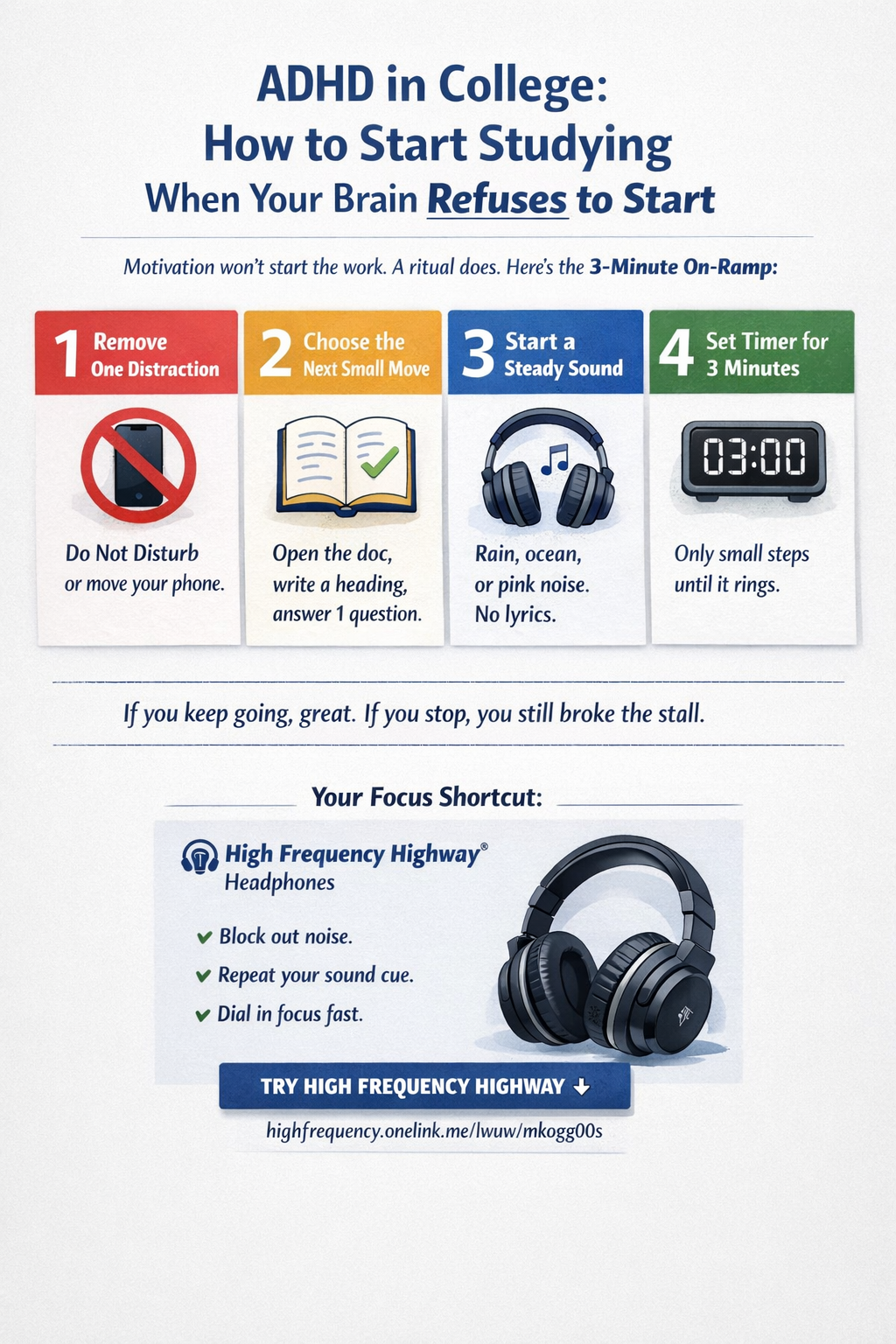
If you have ADHD, you already know the hardest part of studying is not the workload.
It is the start.
You sit down. You open the laptop. You know what needs to get done.
And your brain still does not move.
That gap is where most students lose the day. Not because they are lazy. Not because they do not care. Because starting a task can feel like pushing a car uphill with one hand.
This is not medical advice, and it is not a replacement for professional support. It is a practical system for cutting the friction between “I should start” and “I actually started.”
Why starting feels so hard with ADHD
ADHD is not a lack of focus. More often, it is focus that does not lock in on command.
To begin studying, your brain has to do several things at once:
-
decide what to do first
-
ignore easier distractions
-
hold the task in working memory
-
tolerate the discomfort of getting into it
That is a heavy lift before the real work even begins.
So the fix is not “try harder.” The fix is to make the first move so small and so clear that your brain has less room to resist.
Stop building marathon plans. Build an on-ramp.
When you are stuck, do not aim for:
-
three hours of studying
-
finishing the chapter
-
catching up on everything tonight
Aim for three minutes of movement.
That is enough to change the internal dialogue from “I cannot do this” to “I am already doing it.”
Momentum matters more than ambition in the first five minutes.
The 3-Minute On-Ramp
Use this every time you feel frozen.
1) Remove one source of chaos
Take 15 seconds and do one thing:
-
put your phone on Do Not Disturb
-
put your phone in your bag
-
close social tabs
-
clear one visual distraction off your desk
Do not optimize your whole life. Remove one obstacle.
2) Choose the smallest next action
Not “study chemistry.”
Pick something your brain cannot argue with:
-
open the document
-
write the heading
-
paste the assignment prompt
-
make a three-bullet outline
-
answer one practice question
-
read one paragraph and underline two lines
The smaller the step, the better. Your goal is not progress yet. Your goal is ignition.
3) Turn on a steady sound
A lot of ADHD brains struggle with silence because silence leaves room for novelty-seeking.
A steady sound gives your attention something consistent to sit on.
Good options:
-
rain
-
ocean
-
pink noise
-
soft ambient sound
Skip lyrics. Words compete with working memory.
4) Set a timer for three minutes
Now do only the tiny next step until the timer ends.
That is it.
If you keep going, great.
If you stop after three minutes, that still counts.
Because the win is not “I studied for hours.” The win is “I broke the standstill.”
Why sound helps
Sound is not a magic fix. It is a tool.
Used well, it can help because it:
-
covers random background noise
-
reduces environmental unpredictability
-
gives your brain controlled stimulation instead of chaotic stimulation
That matters in a dorm, a library, a coffee shop, or anywhere your attention keeps getting pulled sideways.
Where headphones fit into the system
Most students already use headphones. The difference is whether they use them casually or as part of a repeatable focus ritual.
That is where High Frequency Highway’s High Frequency Headphones can help.
They are built for a clean, immersive listening experience, which makes it easier to:
-
block dorm or library noise
-
run the same focus soundtrack every session
-
create a reliable cue that tells your brain, “We are starting now”
If you want one simple tool to make your study on-ramp easier to repeat, start here:
Try High Frequency Highway
A realistic goal for this week
Do not try to become a different person by Sunday.
For the next seven days, run the 3-Minute On-Ramp once a day.
Track one thing only:
How long did it take me to start?
That number matters more than how perfect the session felt.
If your start time drops, the system is working.
ADHD studying gets easier when you stop waiting to feel ready.
Use a ritual. Remove one distraction. Pick one tiny action. Turn on steady sound. Start for three minutes.
Small starts are not weak starts. They are what get the work moving.
Share:
The CIA “Stargate Project” Document: What It Actually Says—and the Real Lesson About Focus
ADHD + Dorm Life: How to Build a Focus Bubble When Your Room Is Chaos