Most focus advice quietly assumes you’ll feel motivated at the right time.
That’s the failure point.
What works better: a repeatable start cue your brain recognizes instantly.
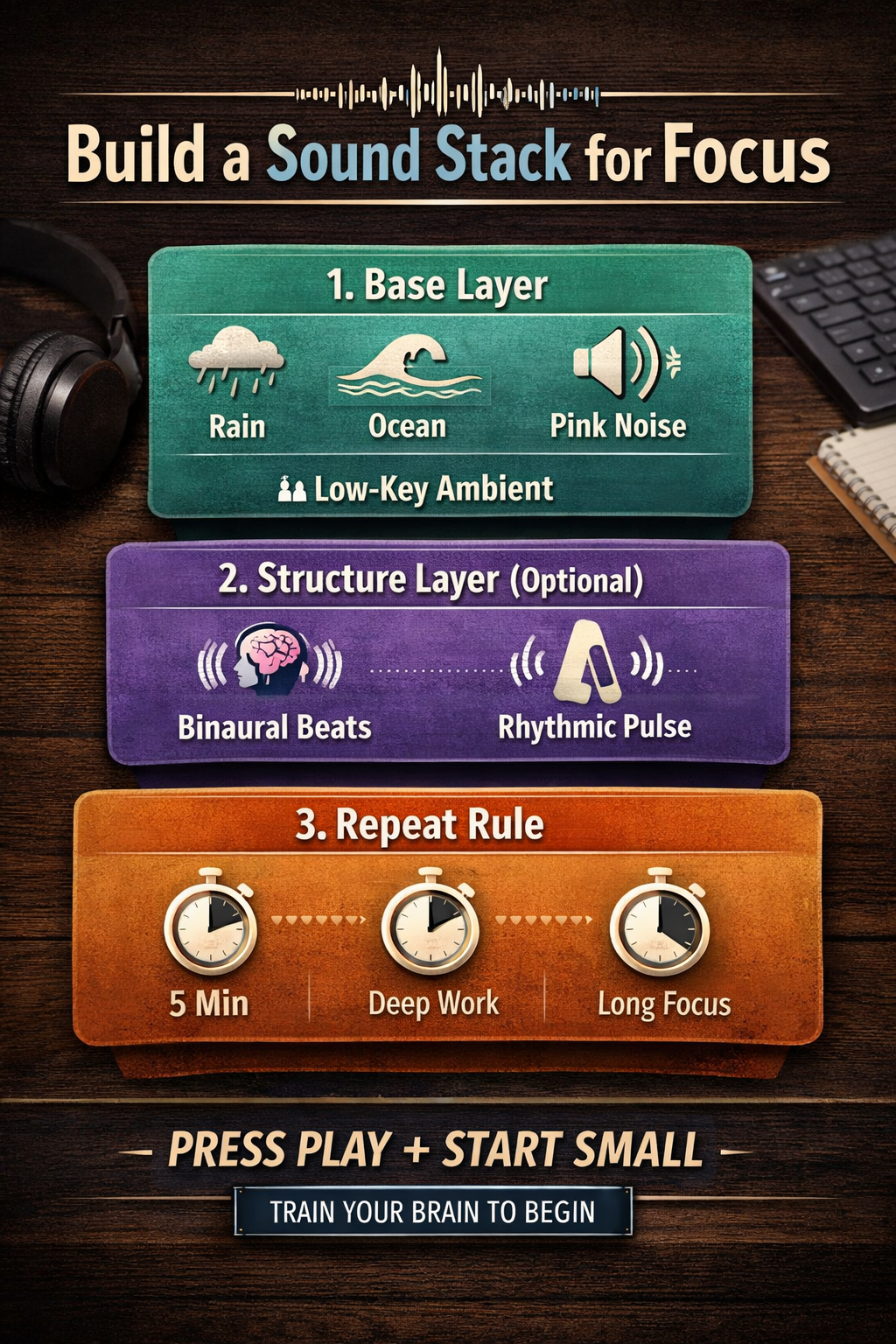
A sound stack is just three parts:
-
Base layer (your audio environment)
-
Optional structure layer (subtle pulse or binaural tone)
-
Repeat rule (loop length tied to your work block)
Keep it simple, pleasant, and consistent. That’s the whole game.
1) Pick one focus target first
Don’t build five stacks on day one. Pick one mode you use most:
-
Writing
-
Coding/building
-
Studying
-
Reading
-
Admin cleanup
Different tasks need different energy. Start with the one you do most often.
2) Choose your base layer
Your base layer should lower distraction without demanding attention.
Good starting points:
-
Rain or ocean → calm, steady masking
-
Pink noise → smoother than white noise for many people
-
Low-key ambient → minimal melody, low cognitive pull
Usually avoid:
-
Lyrics (language competes with language-heavy work)
-
Big cinematic tracks (too much emotional lift/shift)
Think of base audio as “environment in headphones,” not entertainment.
3) Add structure only if it helps
This is where people overbuild.
Two clean options:
-
Want subtle support? Add a light binaural layer under the base.
-
Want stronger pacing? Add a gentle rhythmic pulse.
Fast rule: if it irritates you within 60 seconds, replace it.
Don’t “push through” annoying audio and call it discipline.
4) Set volume correctly
Volume decides whether your stack helps or distracts.
Use this test:
-
Loud enough to cover ambient interruptions
-
Quiet enough to fade into the background
If you keep noticing the audio, it’s probably too loud.
5) Lock your loop length
Looping is the behavior lever. It turns sound into ritual.
Use one default:
-
3–7 min → startup reset
-
25 min → classic deep-work block
-
45–60 min → long build session
No track hunting. No mid-session switching.
Hit play, start work.
6) Run a 2-minute warm start
Before any block:
-
Start your stack
-
Open only the files/tabs you need
-
Write the first tiny action (one sentence, one function, one bullet)
-
Execute immediately
The sound is the cue.
The tiny action kills hesitation.
7) Track one metric for 7 days
Don’t track everything. Pick one signal:
-
Minutes-to-start (how long from intention to first action)
-
Context switches per hour
-
Block completion (yes/no)
Goal: not perfect focus.
Goal: easier starts and more finished blocks.
8) Copy these starter stacks
Stack A — Calm Writing
-
Base: rain
-
Structure: subtle binaural
-
Loop: 25 minutes
Stack B — Build Mode
-
Base: pink noise
-
Structure: minimal pulse
-
Loop: 45 minutes
Stack C — 3-Minute Reset
-
Base: ocean
-
Structure: none
-
Loop: 3 minutes
The only rule that matters
The best sound stack is the one you return to tomorrow.
Simple beats clever.
Pleasant beats perfect.
Repeated beats random.
Never forget this: Try High Frequency Highway
Share:
Binaural Beats vs Isochronic Tones: What’s the Difference (and Which Should You Use)?
Sound as Technology: A Short History of Rhythm, Frequency, and Ritual