Most people try to calm their nervous system the hard way.
They push.
They “try to relax.”
They add more discipline on top of an already overloaded mind.
That’s backwards.
Your nervous system doesn’t respond to effort.
It responds to patterns.
The fastest way to create calm isn’t willpower—it’s automatic cues.
That’s what loop listening is.
It removes decision fatigue.
It stops asking your brain to choose calm 12 times a day.
It quietly turns calm into the default.
What Loop Listening Actually Is
Loop listening is simple:
You repeat the same sound or frequency stack long enough that your nervous system begins to associate it with a specific state—calm, focus, or wind-down.
No mysticism.
No “raise your vibration” language required.
This is basic conditioning.
Just like your body learns:
-
the feeling of your bed means sleep
-
a certain song brings back a memory
-
the gym smell means “time to work”
Your nervous system learns through repetition + context.
Loop listening uses that exact mechanism—on purpose.
Why Looping Works (Plain English, Real Science)
Your nervous system is not logical.
It’s predictive.
It’s always asking:
“What usually happens next when this cue appears?”
When a sound stays consistent, your system stops scanning for danger and starts shifting faster.
That’s why novelty is stimulating—but consistency is calming.
Looping works because it:
-
reduces uncertainty
-
removes choice
-
shortens the time it takes to enter a regulated state
Over a few days, your body stops waiting for calm.
It recognizes the cue and moves there automatically.
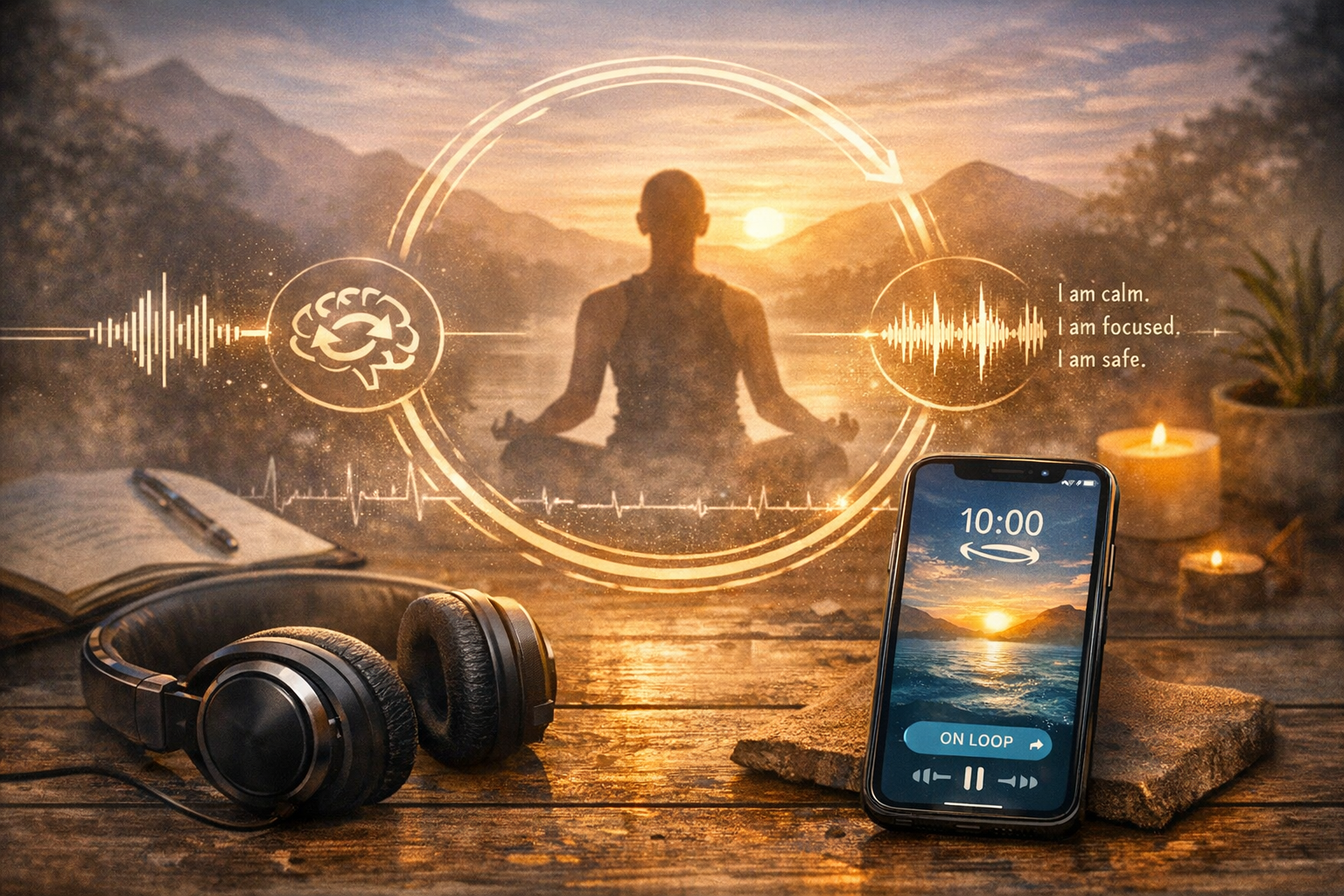
That’s why the listen-on-loop feature matters.
It turns regulation into a set-and-forget system.
The 10-Minute Protocol (Do This for 5 Days)
This isn’t about perfection.
It’s about patterning.
Step 1: Choose One Target State
Pick one:
-
Calm reset
-
Calm focus
-
Wind-down
Don’t stack goals. One state trains faster.
Step 2: Build a Simple Stack
-
One soundscape (rain, ocean, brown noise)
-
Optional: a frequency layer that feels good (keep it subtle)
If you notice yourself thinking about it, it’s too loud.
Step 3: Loop It
-
10 minutes a day
-
Same time if possible
-
No multitasking for the first 90 seconds
Those first 90 seconds are where the association forms.
After that, let it run.
Step 4: Track One Number
Before and after, rate:
“How calm do I feel?” (1–10)
That’s it.
No journaling required.
No analysis paralysis.
In five days, your nervous system will tell you if the stack works.
The Upgrade: Regulate the Body and the Story
Looped audio calms the body.
But the mind has its own loop—the internal narrative.
That’s where AI meditation or affirmations come in.
Use them to regulate the story while the sound regulates the state.
Try this prompt:
“Create a 3-minute affirmation track for calm confidence. Keep it grounded, not cringe. Focus on safety, clarity, and forward motion.”
Play it once.
Then loop your calm stack underneath.
You’re not forcing change.
You’re teaching your system what “safe and steady” feels like.
The Bigger Picture
Most people don’t need more motivation.
They need fewer decisions.
Loop listening isn’t about doing more—it’s about designing your environment so regulation happens automatically.
That’s the High Frequency Highway approach:
less effort,
more alignment,
and systems that work with your nervous system instead of against it.
Calm isn’t something you chase.
It’s something you condition.
Download the free High Frequency Highway app (iPhone + Android): https://highfrequency.onelink.me/lwuw/mkogg00s
Share:
Why Is HFH The Best Way To Listen To Binaural Beats
Binaural Beats vs Isochronic Tones: What’s the Difference (and Which Should You Use)?