
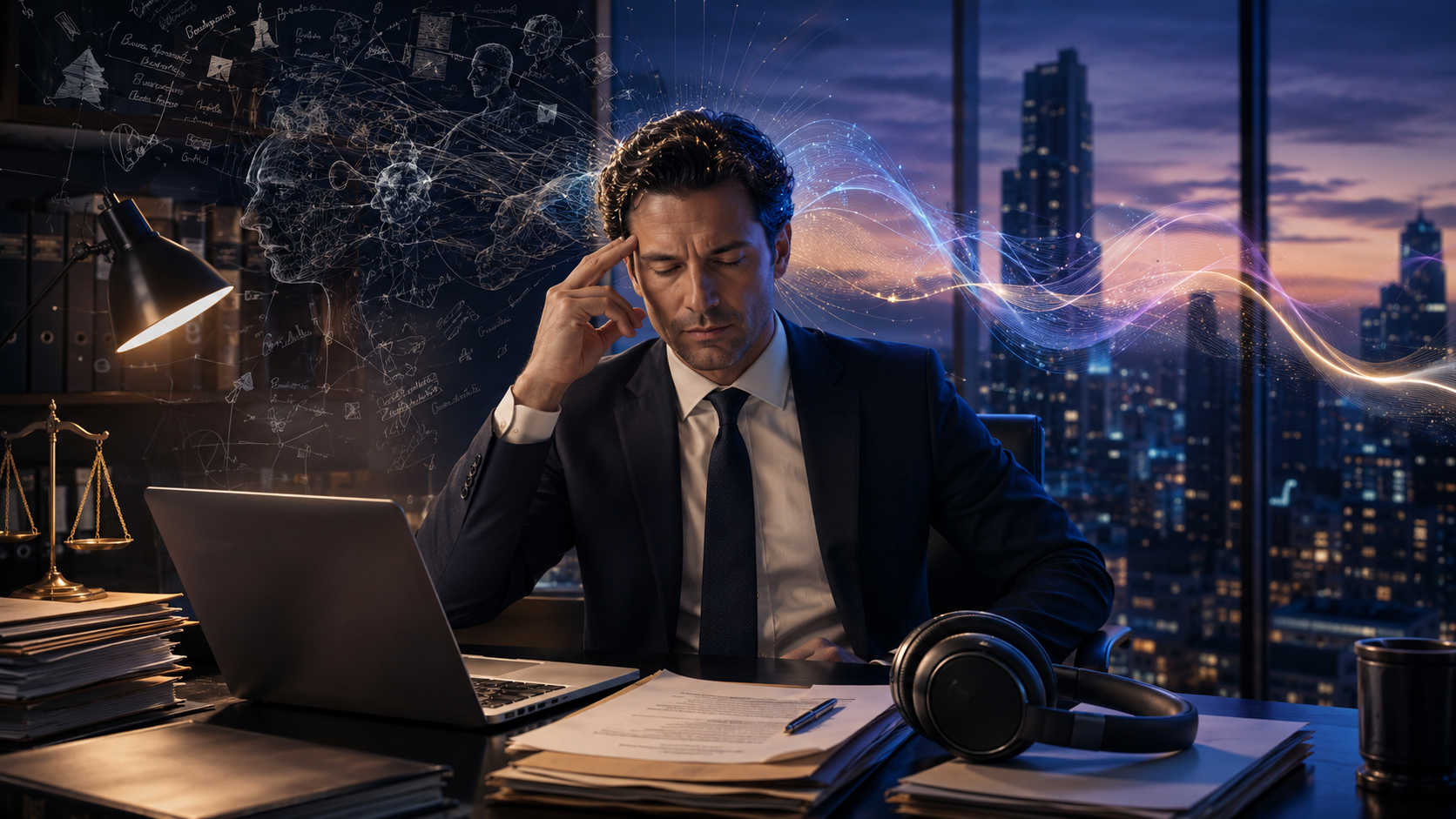
A lawyer’s brain is trained to catch what everyone else misses.
The weak clause.
The hidden risk.
The argument that might come next.
The client concern that has not been said out loud yet.
That kind of thinking is powerful in the courtroom, in negotiation, in drafting, and in strategy.
But after hours?
It can become brutal.
Because the same brain that helps you anticipate risk all day does not always know when the case is over, the laptop is closed, and your body is supposed to recover.
So you go home, but your mind keeps working.
You replay the conversation with opposing counsel.
You rewrite the email you already sent.
You think about tomorrow’s filing.
You imagine the client’s reaction.
You mentally prepare for five different outcomes, none of which are happening right now.
This is why stress relief for lawyers has to be more specific than generic advice like “just relax” or “set better boundaries.”
Legal stress is not just busyness.
It is cognitive load plus pressure plus responsibility plus constant threat detection.
And the legal profession is feeling it. ABA-published commentary cites recent survey data showing high levels of anxiety and depression among attorneys, while the ABA’s National Task Force on Lawyer Well-Being has warned that too many lawyers and law students experience chronic stress, depression, and substance use concerns.
That does not mean every lawyer is broken.
It means the profession asks the nervous system to perform at a high level for too long, with too few clean transitions.
Why legal work keeps the brain in threat-detection mode
Law rewards vigilance.
You are paid to find the flaw.
Spot the exposure.
Prepare for the objection.
Protect the client from the consequence no one else saw coming.
That skill has value.
But the brain does not always separate “professional vigilance” from “personal safety.”
If your workday is built around conflict, deadlines, consequences, client urgency, and adversarial thinking, your system can stay activated long after the actual work is done.
That is why lawyers often feel tired but not calm.
The body wants recovery.
The mind is still preparing.
This is the hidden cost of legal work: the brain becomes excellent at scanning for danger, then struggles to stop scanning when danger is no longer present.
The problem with bringing argument-mode home
Argument-mode is useful at work.
It helps you test ideas.
Challenge assumptions.
Prepare for pushback.
Stay sharp under pressure.
But argument-mode does not belong everywhere.
At home, it can turn into impatience.
In bed, it can turn into rumination.
During rest, it can turn into mental noise.
In relationships, it can turn into cross-examination when connection is what is actually needed.
The issue is not that lawyers think too much.
The issue is that their brain does not always get a clear signal that the workday has ended.
Most people stop work by closing the laptop.
Lawyers often need something stronger.
A real transition.
A cue that tells the brain: analysis is done for now.
Why rumination feels productive but drains recovery
Rumination is tricky because it often feels responsible.
You tell yourself you are preparing.
You are staying ahead.
You are being thorough.
You are protecting the client.
You are avoiding mistakes.
Sometimes that is true.
But after a certain point, rumination stops being preparation and becomes repetition.
The same thought keeps looping without producing a decision, action, or resolution.
Research on work-related stress and sleep has found that work stress can predict more rumination and lower detachment, and that rumination can partially mediate the relationship between work stress and reduced sleep quality. In plain English: the more your mind keeps chewing on work after hours, the harder recovery can become.
For lawyers, this matters because the mind can mistake rumination for discipline.
But recovery is not negligence.
Recovery is what keeps your judgment clean.
A tired, activated, over-rehearsing brain is not always a sharper brain.
Sometimes the strongest professional move is learning how to downshift.
Sound as a cognitive downshift, not escapism
Sound-based recovery is not about pretending stress does not exist.
It is not about zoning out.
It is not a cure for burnout.
It is not a replacement for therapy, workload changes, sleep, exercise, or professional support.
It is a practical state-shifting tool.
That matters because many lawyers do not need another complicated wellness routine.
They need something they can actually use between calls, after court, before drafting, or before sleep.
This is where rhythmic audio, binaural beats, and frequency-based listening become interesting.
The research should be framed honestly. Systematic reviews suggest binaural beats and music-based auditory interventions may support anxiety reduction, sleep, stress physiology, mood regulation, and cognitive performance in some settings, but the evidence is still mixed and study designs vary.
That is the right level of promise.
Not magic.
Support.
Not a cure.
A cue.
For lawyers, sound can become a deliberate “courtroom to calm” transition.
A way to tell the brain: you do not have to keep arguing the case in your head all night.
Gamma and beta for focus. Alpha and theta for recovery.
Different states require different support.
A lawyer preparing a motion does not need the same internal state as a lawyer trying to fall asleep.
That is why frequency use should be matched to the moment.
For focused drafting, reviewing, research, and deep work:
Beta and gamma-oriented sessions are commonly associated with alertness, focus, and cognitive activation. They make the most sense when paired with one task, one window, and one clear objective.
For after-work decompression:
Alpha and theta-oriented sessions are better suited for downshifting. Alpha is commonly linked with relaxation, while theta is often associated with meditative and sleep-adjacent states.
The goal is not to force the brain into a perfect state.
The goal is to stop using the same gear all day.
Legal professionals need access to focus.
But they also need access to recovery.
A legal professional’s frequency schedule
Here is a simple way to use High Frequency Highway without turning your day into a wellness project.
Before opening email:
Use a calm focus session for 5 to 10 minutes.
Goal: start steady instead of reactive.
Before deep drafting or research:
Use a focus-oriented session.
Goal: one document, one argument, one mental lane.
After court, calls, or client pressure:
Use a short reset session.
Goal: clear the emotional residue before moving into the next demand.
At the end of the workday:
Use an alpha or theta-style decompression session.
Goal: create a real boundary between legal analysis and personal life.
Before sleep:
Use a slower evening session.
Goal: reduce cognitive momentum so the mind is not still litigating at midnight.
The key is repetition.
Not intensity.
A 10-minute transition you actually repeat is more useful than a 60-minute routine you avoid.
Why this matters for lawyer burnout
Lawyer burnout is not only about hours.
It is about sustained activation.
When the brain never gets a clean off-ramp, everything starts to blur.
Work follows you into dinner.
Client pressure follows you into sleep.
Conflict follows you into your relationships.
Tomorrow’s risk follows you into today’s rest.
That is not sustainable.
And it is not the standard high-performing legal professionals should accept.
The better question is not:
“How do I stop caring?”
The better question is:
“How do I recover well enough to keep caring without burning out?”
That is the real lane for sound-based recovery.
It gives lawyers a repeatable way to move between mental states instead of living in constant analysis mode.
FAQ
What frequency is best for rumination after work?
For after-hours rumination, alpha and theta-oriented sessions are usually the better starting point because they support a slower, more relaxed state. The goal is not to erase thoughts. The goal is to reduce the loop enough for the body to recover.
Can binaural beats help lawyers focus while drafting?
They may help some people create a stronger focus ritual, especially when paired with one task and fewer distractions. Reviews suggest music-based and binaural-beat interventions may support aspects of cognition and anxiety, but results vary by protocol and person.
Should lawyers use sound before sleep?
Yes, if it helps create a consistent sleep transition. Work-related rumination is linked with poorer sleep quality, so a repeatable wind-down cue can be useful, especially for lawyers who struggle to mentally detach after demanding workdays.
Is sound-based recovery a replacement for therapy or medical care?
No. It should be used as a supportive wellness tool, not a replacement for professional care, workload changes, or treatment for anxiety, depression, insomnia, or burnout.
The real win: stop taking the courtroom home
The lawyer’s brain is built for precision.
But precision without recovery becomes pressure.
You do not need to stop being analytical.
You do not need to care less.
You do not need to become a different person after work.
You need a cleaner transition.
High Frequency Highway frequency headphones give legal professionals a practical way to shift from analysis mode to recovery mode, using sound, binaural beats, and frequency-based sessions designed for focus, calm, and sleep support. The product page positions the headphones as connecting with the HFH app and using soundscapes and binaural beats to guide focus, calm, or flow.
Because the goal is not to escape the work.
The goal is to stop letting the work own your nervous system after the day is done.
Try High Frequency Highway Frequency Headphones and build a smarter transition from courtroom to calm.
Share:
The Caregiver Burnout No One Sees: How Sound Can Help You Reset When You’re Always On Call
Perimenopause, Brain Fog, and Sleep Struggles: Can Sound Help You Feel More Like Yourself?