
If you have an ADHD-style brain, you’ve probably been handed advice that translates to: white-knuckle it.
That framing fails because attention isn’t only willpower. It’s systems + environment.
This isn’t medical advice, and it’s not claiming to treat ADHD. It’s a practical explanation of why a lot of people feel an immediate difference when they put on headphones—especially with steady sound, and sometimes with a subtle frequency layer like binaural beats.
The issue isn’t “no attention.” It’s steering
Many ADHD folks don’t lack attention. They lack attention control.
So you get patterns like:
-
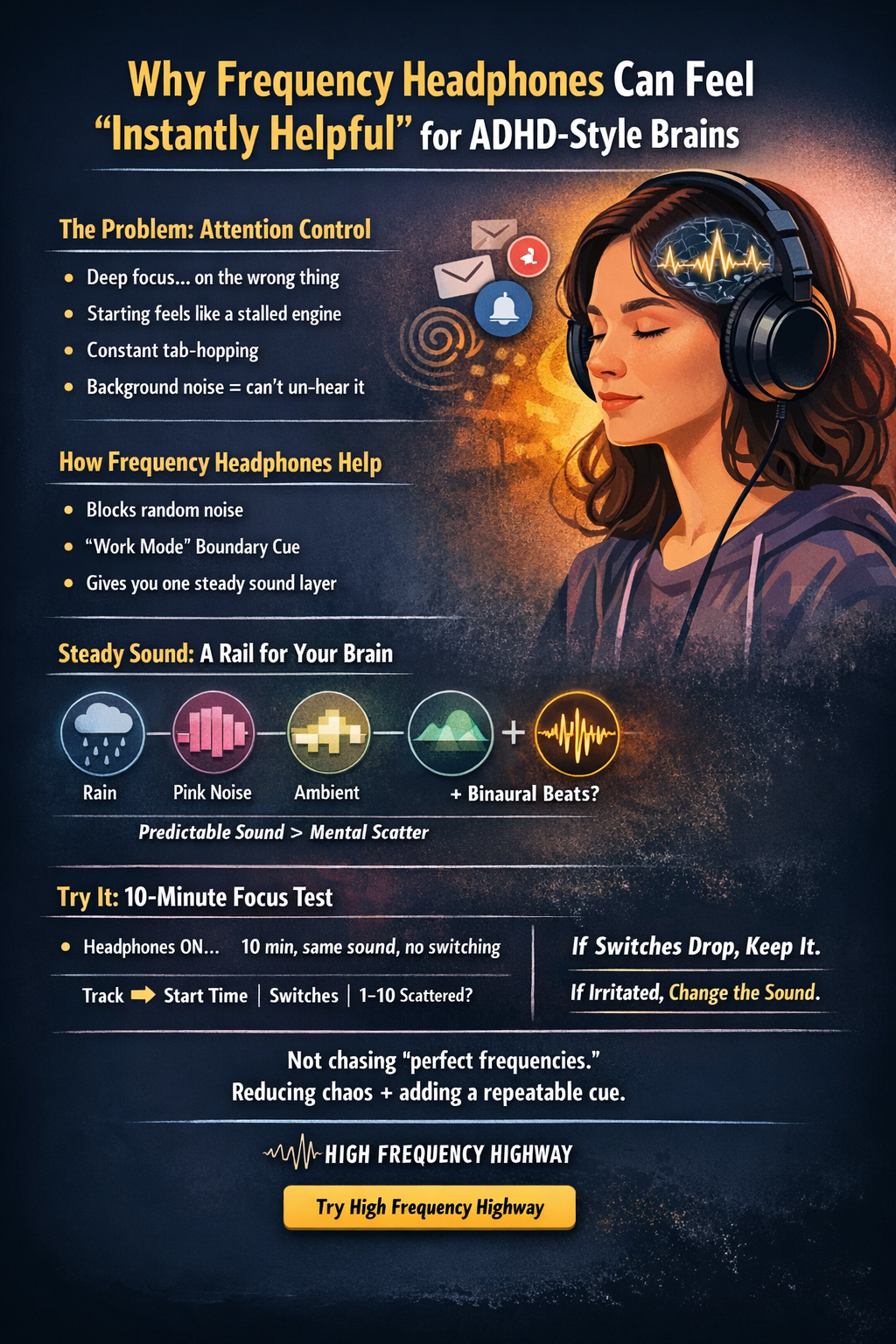
Deep focus… on the wrong thing
-
Starting feels like pushing a stalled car uphill
-
Switching is frictionless (email → tab → thought → doomscroll)
-
Background noise turns into “I can’t un-hear that”
The useful question isn’t “How do I force focus?”
It’s: How do I make the right thing easier to stay with?
Why headphones help before we even talk “frequencies”
Headphones often create an immediate lift because they do three high-leverage things fast:
-
Cut the interrupt rate
Less random sound = fewer micro-orienting reactions. -
Create a boundary cue
Headphones become a ritual: “I’m in work mode now.” -
Replace noisy variety with one predictable layer
Instead of 40 sensory inputs competing, you get 1 steady channel.
That alone reduces the “start-up cost” of a task.
The “sound anchor”: a rail your brain can ride
Silence isn’t silent for a lot of ADHD brains. The mind fills it instantly:
-
thoughts
-
urges
-
scanning
-
worry
-
curiosity spikes
A steady soundscape acts like a sound anchor—a predictable layer your attention can lightly hold while you work.
Not magic. Predictability. Less hunting for stimulation.
Where binaural beats fit (plain English)
Binaural beats are a perception effect:
-
you play two close tones
-
one to the left ear, one to the right
-
the brain perceives a third “beat” equal to the difference between them
Example:
-
Left: 200 Hz
-
Right: 210 Hz
-
Perceived beat: 10 Hz
Research suggests binaural beats may influence brain activity and mental state, but results vary a lot by protocol, duration, and what people are doing while listening.
The best framing for ADHD-style focus isn’t “this frequency fixes me.”
It’s: a subtle structure layer can reduce mental scatter—especially during task start.
The real win: a better stimulation level
A common ADHD loop is swinging between:
-
Understimulated → bored, drifting, procrastinating
-
Overstimulated → scattered, tense, reactive
Steady audio can land you in a more usable middle zone:
-
enough input to keep the brain engaged
-
not so much that it steals attention
That’s why people often reach for:
-
rain / ocean
-
pink/brown noise
-
soft ambient textures
-
instrumental music (no lyrics)
And sometimes a low-volume binaural layer underneath.
“Focus frequencies” (useful labels, not religion)
You’ll see these ranges discussed in playlists and attention-training circles:
-
Alpha (8–12 Hz): relaxed alertness
-
SMR / low beta (12–15 Hz): often used in attention training contexts
-
Beta (15–20 Hz): active focus
-
Gamma (30–40 Hz): high engagement (can feel intense)
Important: people respond differently, and the evidence is mixed across studies. Treat these as starting points, not promises.
If you want this experience as a repeatable, portable tool, by using frequency headphones by High Frequency Highway, you’re essentially giving your brain a consistent sound environment it can return to—especially when the outside world is noisy.
A 10-minute experiment to see if this actually helps you
Do this 3 times this week:
-
Pick one task (writing, admin, reading)
-
Put on headphones
-
Choose one soundscape you can tolerate on loop
-
Run it for 10 minutes (no switching tracks)
-
Track:
-
time to start (minutes)
-
number of task-switches (rough count)
-
scattered feeling (1–10)
-
If switching drops, it’s working. If you feel irritated or sleepy, change the sound—not your character.
Frequency headphones can feel instantly helpful for ADHD-style brains because they:
-
reduce auditory interruptions
-
create a repeatable focus cue
-
provide steady stimulation instead of chaos
-
optionally add subtle structure (binaural beats) for some listeners
The win isn’t the “perfect frequency.”
The win is a repeatable environment where attention stays on one rail more often.
Never forget this: Try High Frequency Highway
Sources (for readers who want depth):
-
Binaural beats definition + cognition/EEG discussion (Sudre et al., 2024, PLOS ONE / PMC).
-
Systematic review of binaural beat stimulation research (Ingendoh, 2023).
-
Small case-report style study adding binaural beats to noise/music (Krasnoff et al., 2023; note: very small sample).
Share:
Binaural Beats for Sports Performance? A No-Hype Guide for Coaches
An ADHD-Friendly Focus Protocol Using Sound (No Motivation Required)