
People ask this all the time:
- Which brainwave is best for productivity?
- Should I use alpha or beta for focus?
The most honest answer is simple: it depends on what kind of work you’re doing.
“Productivity” is not one mental state. Planning, creating, reading, writing, and pushing through a hard problem do not require the same kind of attention. That is where most people get this wrong.
Brainwave bands are linked to broad mental states. They are not magic buttons. They do not guarantee performance. They are just a useful framework for matching the right kind of focus to the right kind of task.
This is not medical advice. It is a practical way to think about focus.
The 3 brainwave bands most people care about
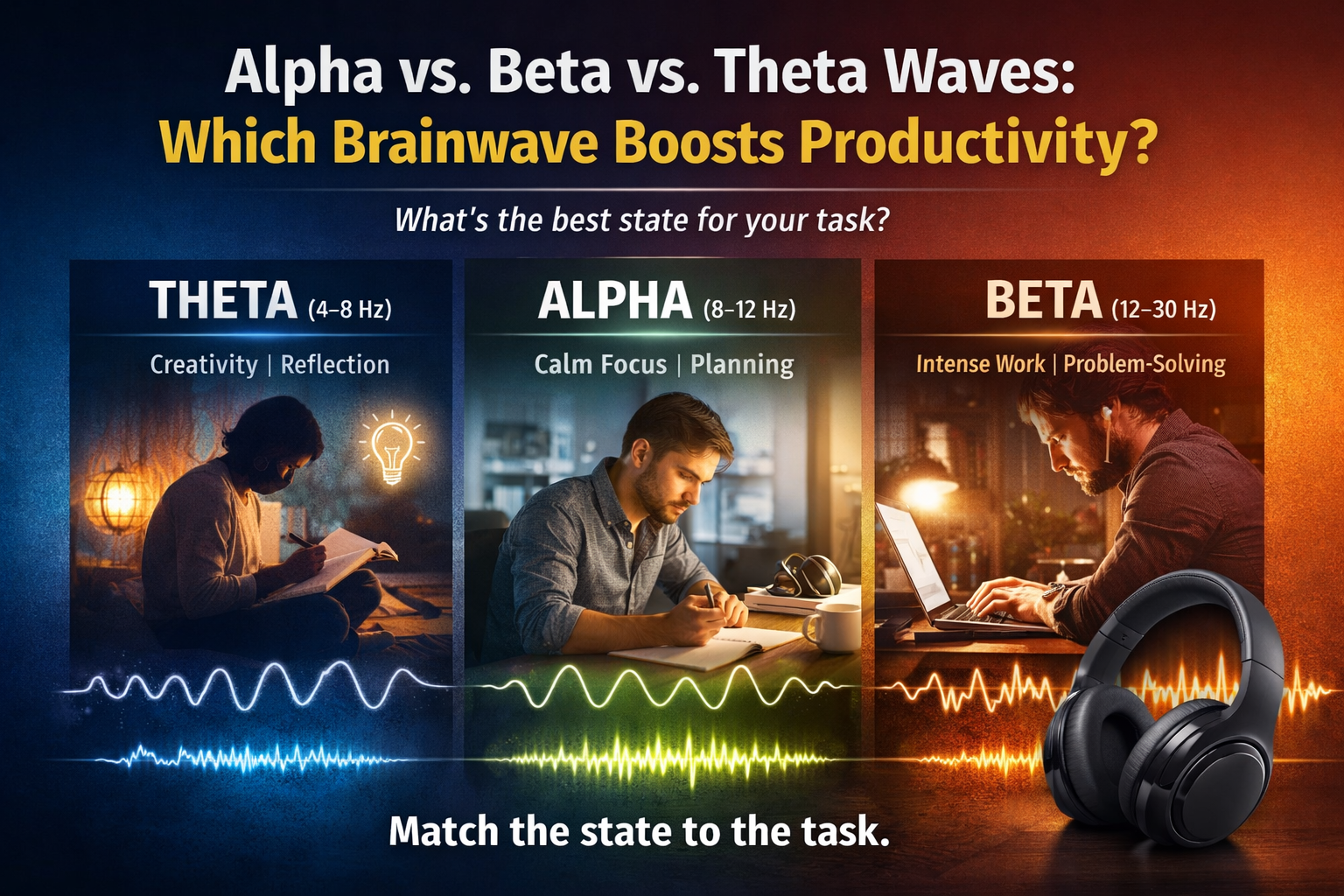
Theta (4–8 Hz)
Theta is commonly associated with drowsiness, light sleep, meditation, and inward attention.
In practical terms, theta is often better for:
- brainstorming
- journaling
- reflection
- winding down
It can help when you want looser thinking and fewer mental brakes. It is usually not the best fit for hard execution work.
Alpha (8–12 Hz)
Alpha is the zone of relaxed alertness. Calm, clear, steady.
This is often the best place to start when:
- you feel overstimulated
- your mind is scattered
- you need to plan
- you want smooth, sustainable focus
Alpha is less about intensity and more about reducing internal noise so you can actually begin.
Beta (12–30 Hz)
Beta is associated with active thinking and task engagement.
That range is broad, so it helps to split it up:
Low beta / SMR-ish range (around 12–15 Hz) often fits:
- reading
- coding
- writing
- sustained desk work
It tends to feel steady and functional.
Higher beta can be useful for:
- short sprints
- problem-solving
- fast-paced mental work
But for some people, it can also feel tense, edgy, or mentally sharp in the wrong way.
So which one is best for productivity?
The better question is: productive for what?
Here is the practical breakdown:
- Need calm clarity? Start with alpha.
- Need steady execution? Low beta is often the better fit.
- Need ideas, reflection, or creative drift? Theta can help.
The mistake is looking for one “best” state for everything. Real productivity is state-matching. You want the right internal environment for the job in front of you.
The bigger point: protocol beats labels
Most people over-focus on the label and under-focus on the routine.
The real gains usually come from:
- reducing context switching
- using the same start cue each time
- working in timed blocks
- repeating a focus ritual until it becomes automatic
That is where sound can be useful.
Not because it forces your brain into some guaranteed state.
Because it helps create a repeatable environment that lowers friction and makes focus easier to access.
Where High Frequency Highway fits
High Frequency Highway’s High Frequency Headphones are built for exactly that kind of routine.
Whether you prefer calmer alpha-like textures or more active focus structures, the goal is the same: create a stable, repeatable sound environment that helps you get into work faster and stay there longer.
That is the real win.
Not chasing a perfect frequency.
Building a system you can trust.
FAQ
Do I need to feel something immediately?
No. A better test is whether it becomes easier to start, easier to stay with the task, and easier to avoid switching.
What if I do not like binaural beats?
That is fine. Use soundscapes only. Consistency matters more than forcing a format that does not work for you.
Share:
How to Build a Deep Work Culture in a Distracted World
The ROI of Focus: What Distraction Actually Costs Your Business