
You don’t have a discipline problem. You have a start + switching problem.
Sometimes you want to work—then your brain refuses to ignite. Or it ignites and immediately chases 12 shinier things.
This isn’t medical advice. It’s a practical workflow: build a sound container—one consistent audio “rail” your attention can lock onto while you start.
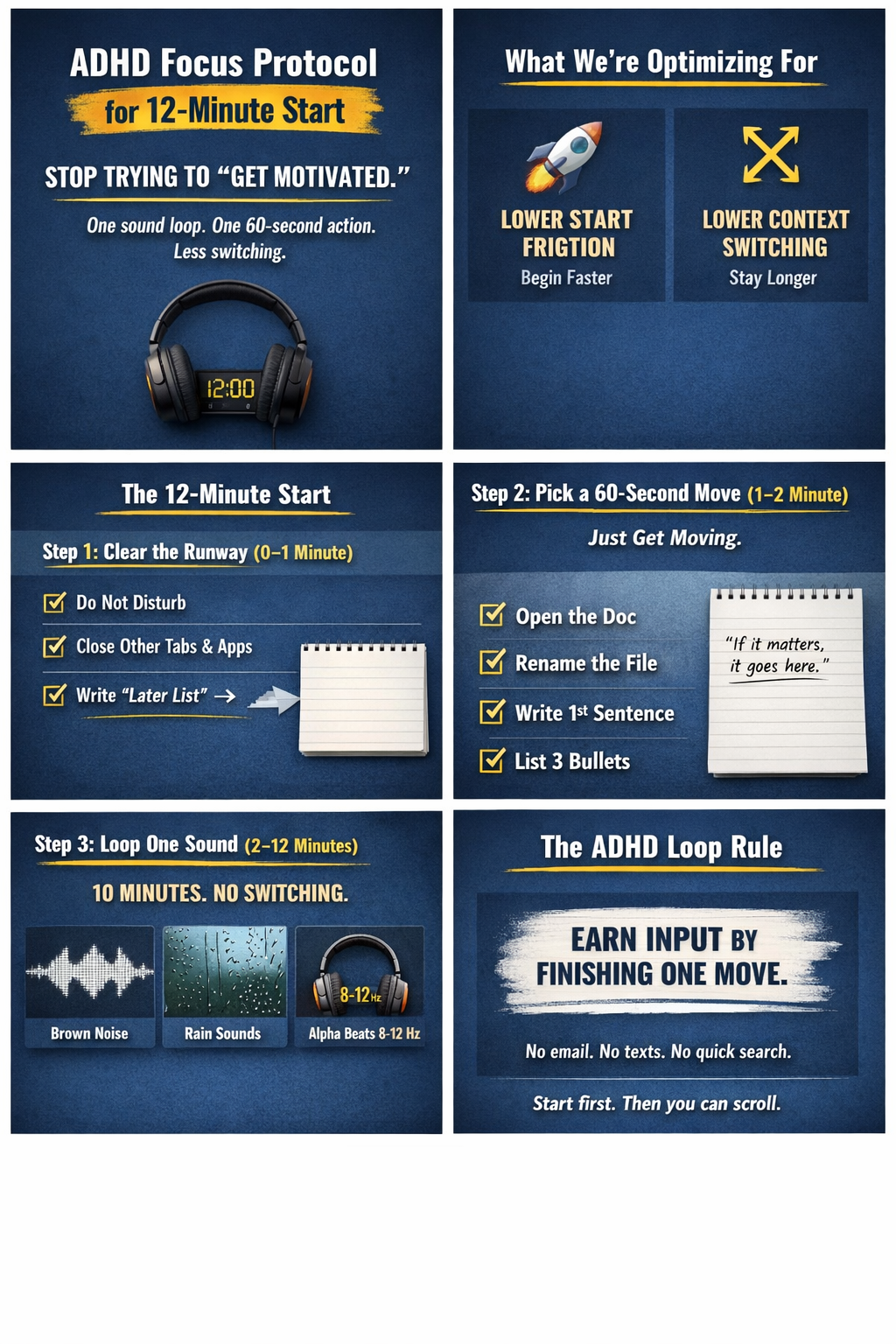
What we’re optimizing for
Most productivity tips assume your brain likes linear effort. If you have ADHD-style attention, that assumption breaks.
So we optimize for two outcomes only:
-
Lower start friction (you begin faster)
-
Lower context switching (you stay longer)
Everything below is designed to hit those two levers.
The 12-Minute Start (the whole protocol)
Set one timer. Keep it short. You’re not trying to “finish.” You’re trying to begin.
Minute 0–1: Clear the runway
-
Phone → Do Not Disturb
-
Close every tab/app that isn’t the task
-
Open a “Later List” and write one line:
Later List: If it matters, it goes here—not in my head.
This keeps “don’t forget” thoughts from hijacking you.
Minute 1–2: Choose the smallest next action
Not “finish the project.” Not “make progress.”
Pick a step you can complete in ~60 seconds:
-
open the doc
-
rename the file
-
write the first sentence (ugly is fine)
-
list 3 bullets
-
paste the prompt / outline
-
create the folder
This micro-action is the bridge. You’re building momentum, not proving worth.
Minute 2–12: Turn on the sound container (and don’t change it)
Put on headphones. Choose one steady sound and loop it for 10 minutes.
Rules:
-
Same sound for all 10 minutes
-
No track switching
Why this works: switching audio is a socially acceptable way to switch tasks. Your brain treats it as permission to wander.
Good sound-container options:
-
brown noise / pink noise
-
rain / fan / train / café hum (consistent, not “eventful”)
-
a simple ambient bed with no lyrics
Optional: if you like binaural beats, layer them subtly under the soundscape. If you don’t, skip them. The container matters more than the tech.
Frequency “presets” (use as experiments, not gospel)
No prescription here—just starting points. People respond differently, and the evidence base is mixed, so treat this like tuning a workspace lamp.
If you’re scattered but not stressed
Try a slightly more “structured” feel:
-
Low beta / SMR-like range (12–15 Hz)
If you’re anxious or overstimulated
Try softer support under a calm soundscape:
-
Alpha-like range (8–12 Hz)
If you’re sleepy
Some prefer a bit more push (avoid cranking volume):
-
Mid beta (15–18 Hz)
Safety + sanity rules:
-
Keep volume moderate (you should still hear a knock)
-
If a sound makes you tense, ditch it immediately
-
Test one preset for 3 sessions before judging it
The cue that makes this repeatable
In practice, by using frequency headphones by High Frequency Highway, you’re creating a consistent auditory environment and a repeatable cue—so your brain has one “rail” to stay on while you work.
That line matters because repeatability is the point: you’re training a start ritual your brain recognizes.
The rule that changes everything: the ADHD Loop Rule
If you want this to work long-term, adopt one hard rule:
No new input until the first micro-action is complete.
No email. No texts. No “quick search.” No “I’ll just check one thing.”
Your first micro-action is the toll booth. Pay it, then you can drive.
Most people don’t fail because they can’t focus. They fail because they never fully start.
Upgrade: the 2-Track System (variety without the spiral)
ADHD boredom is real. Don’t fight it—contain it.
Pick exactly two audio tracks:
-
Track A: Start (10 minutes)
-
Track B: Continue (25 minutes)
That’s enough novelty to stay engaged without turning your focus session into an audio audition.
Repeat pattern: A → B → (break) → A → B
Troubleshooting (fast fixes)
-
You keep switching tracks: pre-choose A and B, pin them, full screen, no browsing.
-
You keep grabbing your phone: put it across the room; the protocol dies at arm’s reach.
-
You feel “stuck” at minute 3: your micro-action was too big—halve it until it’s almost stupid.
-
You’re restless: add movement before you start (30 seconds of pacing / stretches), then sit back down and hit Track A.
This works because it’s not a pep talk. It’s a system:
-
predictable sound
-
tiny actions
-
fewer switches
-
repeatable loops
If you start faster and switch less, focus stops being a moral issue and becomes a setup issue.
Never forget this: Try High Frequency Highway
Reference (general binaural beat background):
Share:
Why Frequency Headphones Can Feel “Instantly Helpful” for ADHD-Style Brains
ADHD, Noise, and the Need for Stimulus: Why Sound Can Make Focus Easier