
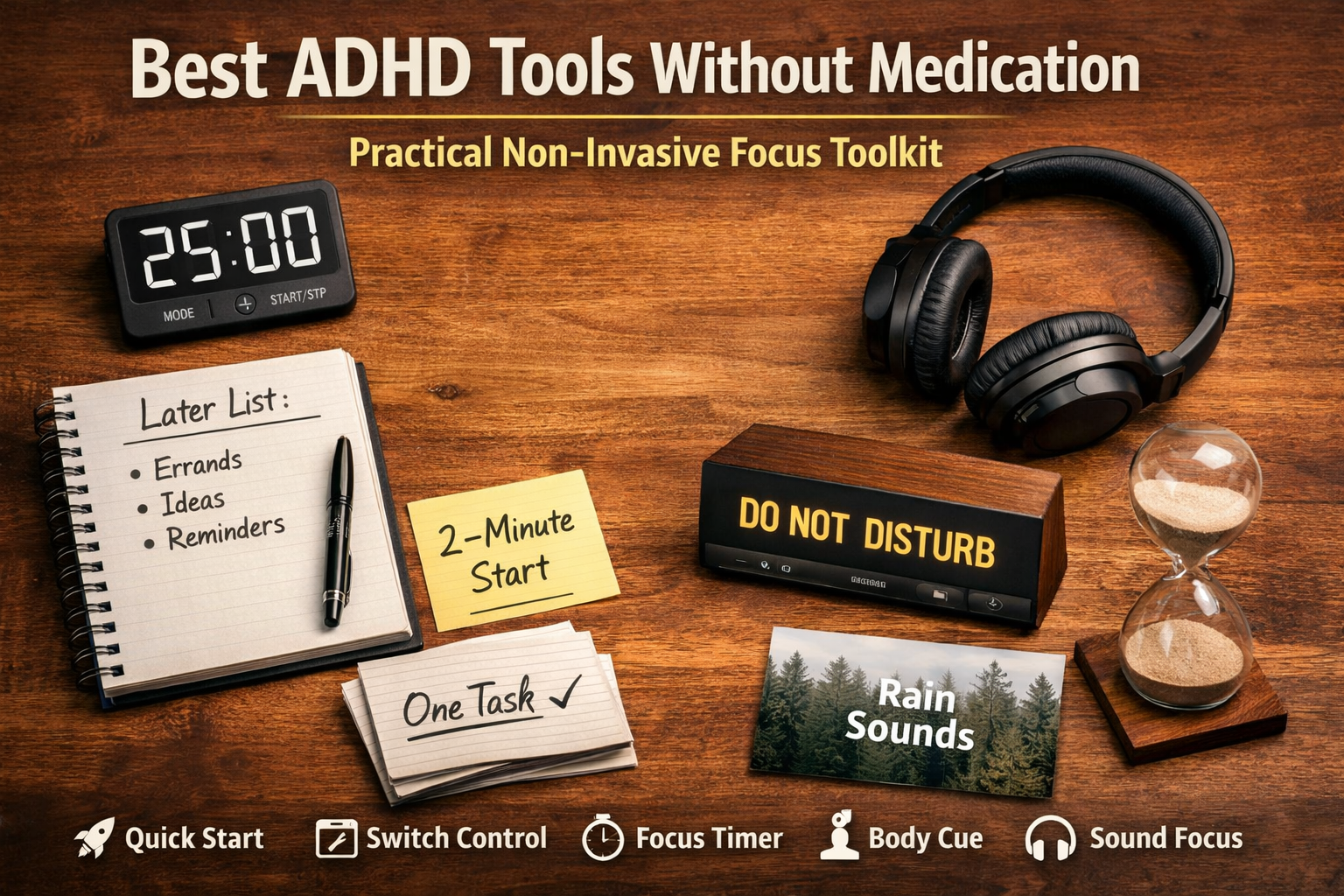
If you’re looking for ADHD tools outside medication, you’re in good company.
Some people cannot take medication. Some choose not to. Some use it and still need better systems for weekends, evenings, or specific work blocks.
This is not medical advice. It is a practical toolkit: simple, non-invasive ways to make focus easier to start and easier to hold.
The 6 levers that matter most
Most people do not need more hacks. They need a few reliable inputs they can repeat.
1) Reduce start friction
For a lot of ADHD brains, the hardest part is not the work. It is the start.
Make the entry point so small your brain has nothing to argue with.
Try this:
-
use a 2-minute start ritual
-
name the smallest next action
-
open only the one file or tab you need
-
begin before you feel “ready”
Examples:
-
not “write the report,” but “open doc and draft the first 3 lines”
-
not “clean the kitchen,” but “clear the counter for 2 minutes”
Momentum is easier to build than motivation.
2) Build a switching firewall
Attention gets shredded by context switching.
Every time you check a notification, open another tab, or follow a random impulse, you pay a restart cost. That cost adds up fast.
Use a simple firewall:
-
turn on Do Not Disturb
-
keep a one-tab rule during focus blocks
-
write stray thoughts on paper instead of acting on them
-
keep a “later list” nearby for impulses, errands, and ideas
The goal is not perfect discipline. The goal is fewer exits.
3) Use time containers
Attention works better when it has edges.
Open-ended work invites drift. Short containers create urgency without overwhelm.
Start with:
-
10 minutes to begin
-
25 minutes to work
-
5 minutes to reset
That is enough structure to lower resistance without making the session feel heavy.
If 25 feels too long, cut it to 15. If 10 feels too easy, use it anyway. The best timer is the one you actually start.
4) Give your body a focus cue
Focus is not just cognitive. It is physical.
A small body reset can tell your system: we are working now.
Use one cue:
-
sit upright
-
plant both feet
-
unclench your jaw
-
take 3 slow breaths
-
try inhale for 4, exhale for 6
You are not trying to become calm in a perfect, meditative way. You are trying to shift your state just enough to begin.
5) Control your stimulus—especially sound
Sound can either scatter attention or anchor it.
For many people with ADHD, a steady sound layer makes it easier to stay with one task because it reduces the noise competition around them.
Useful options:
-
rain
-
pink noise
-
low-key ambient sound
-
instrumental loops with no sharp transitions
The key is consistency. Pick one sound profile and reuse it often enough that your brain starts to associate it with focus.
6) Choose consistency over novelty
One small protocol you repeat beats ten clever tricks you forget.
You do not need a complicated system. You need a short sequence you can trust.
A simple protocol might look like this:
-
put phone on DND
-
put on sound
-
set a 25-minute timer
-
do the smallest next action
-
write down any impulse instead of switching
That is enough. Keep it boring. Boring is repeatable.
Where High Frequency Highway fits
Sound works best when it becomes a stable cue, not a random extra.
That is where High Frequency Highway can fit into this toolkit.
Not as a cure. Not as a substitute for treatment. As a repeatable focus signal.
If controlled sound helps you work, using High Frequency Highway as part of the same routine each time can help create a more consistent environment: less competing noise, less decision-making, and a clearer transition into work.
Think of it as a focus uniform:
-
put it on
-
run your chosen loop
-
start the task before you negotiate with yourself
Used this way, the value is not magic. It is repeatability.
A weekly plan you can actually follow
Do less. Repeat more.
Try this:
-
Monday / Wednesday / Friday: one 25-minute focus block with your sound cue
-
Tuesday / Thursday: a 10-minute start ritual and a later list
-
Saturday / Sunday: one 5-minute reset block to downshift, tidy up, or plan the next week
Do not build a perfect system. Build a system you will still use when your energy is low.
The best non-medication ADHD tools are usually not dramatic. They are small, external, and repeatable.
Reduce start friction. Protect your attention. Use time boundaries. Give your body and your environment a clear cue.
Then repeat the same sequence until it feels automatic.
That is how focus gets easier.
Try High Frequency Highway: High Frequency Highway
Share:
ADHD and the Attention Span Epidemic: Why Overstimulation Makes Focus Harder
The CIA “Stargate Project” Document: What It Actually Says—and the Real Lesson About Focus