
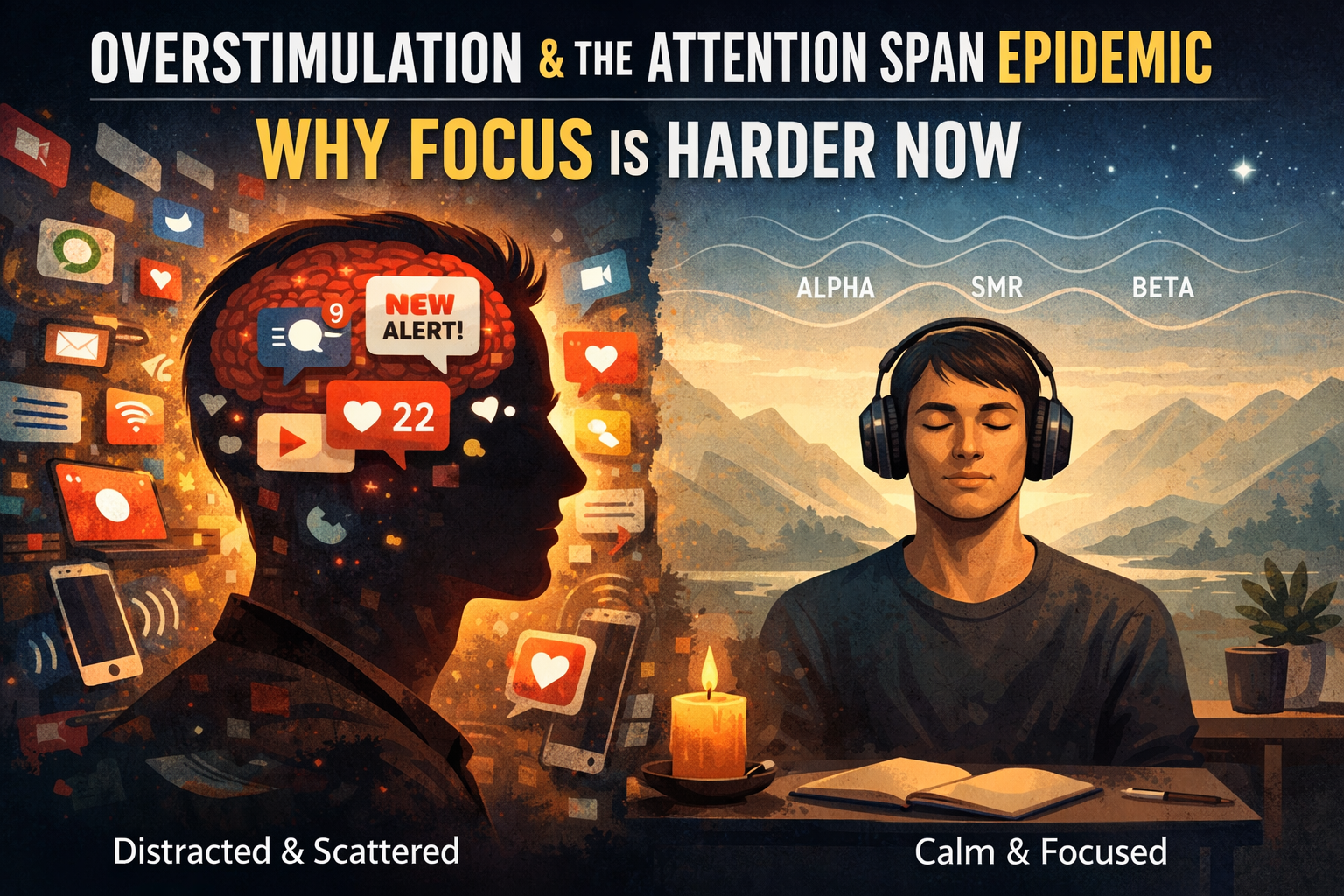
A lot of people feel their attention is getting worse.
Not just people with a diagnosis. People who used to read for an hour now check their phone every six minutes. People who could finish one task now bounce between tabs, messages, and half-done work.
That is why the idea of an “ADHD epidemic” keeps gaining traction. Some of it reflects real diagnosis. Some of it reflects something simpler and broader: modern life is conditioning our brains to switch constantly.
This is not a diagnosis tool or medical advice. It is a practical guide to reducing overstimulation and rebuilding attention in a world designed to fracture it.
Overstimulation can look like ADHD
When your brain is overloaded, the symptoms can look familiar:
-
you cannot start
-
you cannot stay with one task
-
you keep switching
-
you feel restless
-
you crave novelty
-
you finish the day mentally busy but with little done
ADHD can be one reason. It is not the only one.
Similar patterns can also come from:
-
sleep debt
-
anxiety
-
chronic stress
-
burnout
-
nonstop notifications
-
high-stimulation environments
The cause matters. But the first layer of the solution is often the same: reduce switching.
The real attention killer: micro-dopamine switching
Most focus problems do not begin with one giant distraction. They begin with tiny ones.
A scroll. A ping. A new tab. A quick check. A background video. A text you answer “for a second.”
Each switch teaches your brain the same lesson: novelty is rewarding, and sustained focus is effort.
Do that often enough, and deep work starts to feel unnatural. Not impossible. Just unfamiliar.
That matters, because attention is not only something you have. It is something you train.
If you repeatedly train interruption, you get better at interruption.
If you repeatedly train return, you get better at focus.
The 3-part attention rebuild system
You do not rebuild attention by waiting to “feel focused.”
You rebuild it by changing the conditions around your brain.
1) Lower the noise floor
Make focus easier before you ask for discipline.
Start here:
-
turn on Do Not Disturb
-
keep one tab open
-
clear your desk
-
put your phone out of reach
-
remove background media that competes for attention
This sounds basic because it is basic. It also works.
A chaotic environment forces your brain to keep scanning. A quieter environment lets it settle.
2) Use predictable cues
Attention improves when the environment becomes more stable.
That is where sound can help.
A steady sound loop gives your brain fewer surprises to react to. Instead of competing voices, random noise, and abrupt shifts, you get one consistent sensory layer.
That consistency matters. Predictability reduces friction. Less friction means fewer excuses to switch.
3) Build return reps
This is the part most people miss.
Focus is not the absence of distraction. Focus is the act of returning.
Every time you notice your mind drift and bring it back, you complete a rep.
That rep counts.
Not because it felt smooth, but because it strengthens the exact skill you need: noticing the pull to switch without obeying it.
The goal is not perfect concentration. The goal is faster recovery.
Where High Frequency Headphones fit
If you want a non-invasive focus tool, sound is one of the fastest ways to change your environment.
High Frequency Headphones by High Frequency Highway can help create a more consistent sound container, reduce competing noise, and make it easier to stay on one track longer.
That does not replace sleep, stress management, or medical care when needed. It does solve a more immediate problem: too many inputs hitting your attention at once.
For many people, that alone is useful.
Focus frequency ranges: use them like presets, not promises
Some listeners experiment with these ranges as starting points:
-
Alpha (8–12 Hz): relaxed alertness
-
Low beta / SMR (12–15 Hz): steady focus
-
Mid beta (15–18 Hz): active focus
Treat them as presets, not prescriptions.
You do not need the “perfect” setting. You need a setting you will actually use consistently while doing focused work.
Consistency beats optimization here.
The bigger point
You are not broken because your brain struggles in an overstimulating environment.
You are responding to the environment you have trained in.
That is good news, because what is trained can also be retrained.
Reduce the switches. Make the cues predictable. Count the return reps. Give your attention fewer battles to fight.
Focus usually does not come back in one dramatic leap.
It comes back in quieter rooms, cleaner inputs, and repeated returns.
And that is enough to start.
Try High Frequency Highway: High Frequency Highway
Share:
Long-Term ADHD Medication: The Questions People Actually Ask—And the Non-Invasive Supports That Help
Best ADHD Tools Without Medication: A Practical Non-Invasive Focus Toolkit