
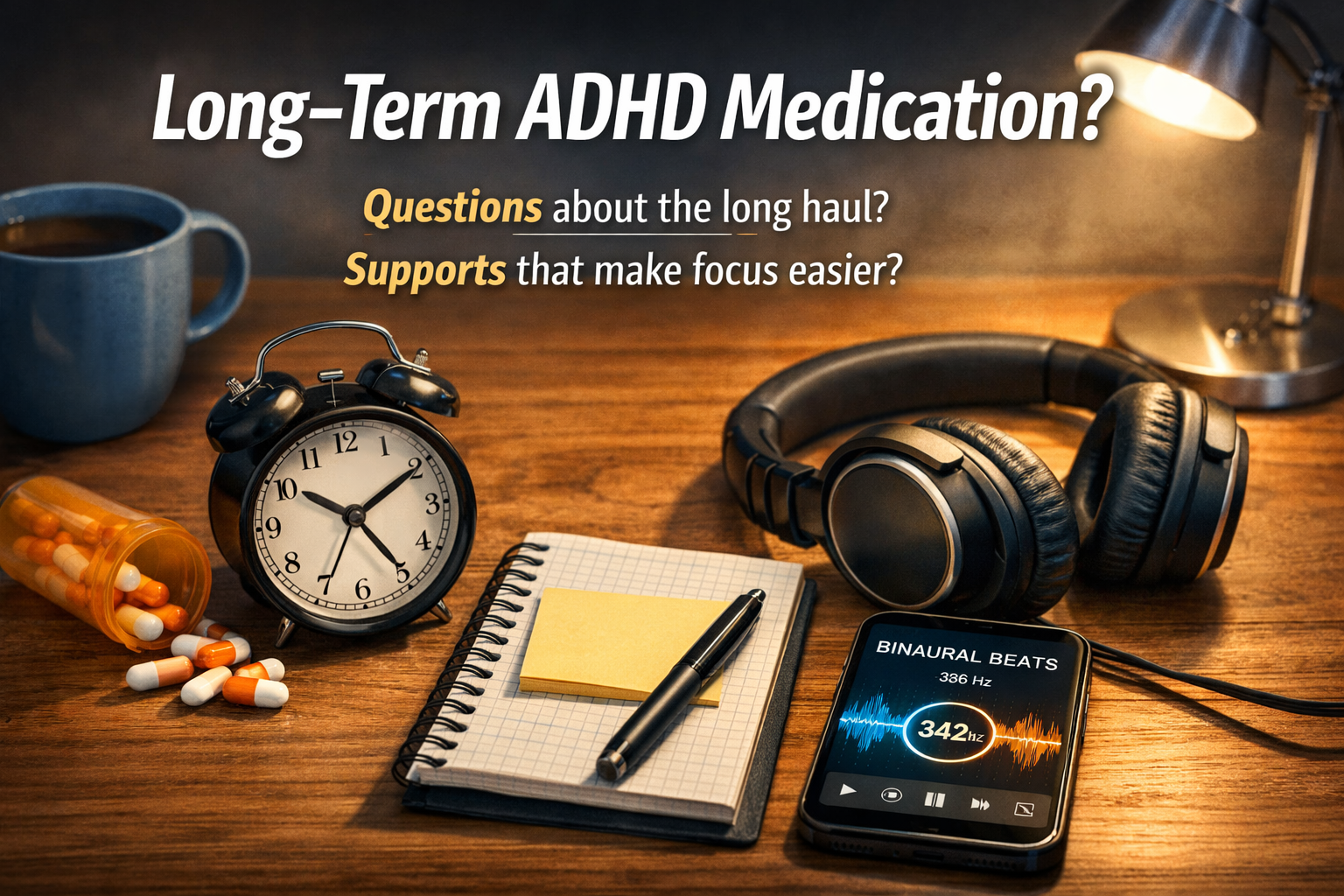
If you’ve been taking ADHD medication for a while—or you’re thinking about starting—it’s normal to wonder what long-term use really means.
This is not medical advice. It’s a practical guide to the questions people commonly ask, the tradeoffs they think about, and the non-invasive supports that can make focus more stable over time.
Why long-term use brings up real questions
Most people are not asking abstract questions. They’re asking practical ones:
-
Will I need medication indefinitely?
-
What if it affects my sleep or appetite?
-
Does it help me function, or does it make me feel unlike myself?
-
What happens if I want to stop?
Those are clinician-level decisions. They deserve a real conversation with someone who knows your history, your response, and your side effects. ADHD treatment often includes more than medication alone; psychotherapy, education, skills training, and other behavioral supports are commonly part of the picture.
The useful truth: medication can help, but it does not replace systems
Medication can reduce symptoms and improve functioning. It can also come with tradeoffs that need monitoring, including sleep disruption, appetite changes, weight changes, and small increases in heart rate or blood pressure for some medications. That is why ongoing review matters.
But even when medication works well, it does not build your workflow for you.
Attention still responds to structure:
-
routines
-
cues
-
friction reduction
-
environment design
-
repetition
That is good news. It means focus is not only something you “have” or “don’t have.” It is also something you can support.
Non-invasive supports that get stronger with repetition
The best tools are not the most dramatic. They are the ones you will still use on an ordinary Tuesday.
1) A repeatable start protocol
Make starting smaller and more automatic:
-
same place
-
same time window
-
same first task
-
same 10–25 minute block
Do not wait to feel ready. Reduce the number of decisions between “I should start” and “I started.”
2) A switching firewall
Attention breaks fast when context switching stays cheap.
Use simple barriers:
-
phone on Do Not Disturb
-
one-tab rule
-
one written parking lot for stray thoughts, urges, and ideas
The goal is not perfect discipline. The goal is making distraction slightly harder than staying with the task.
3) Sound as a focus cue
For some people, sound works less like entertainment and more like a container.
Used well, it can:
-
mask competing noise
-
create a steady sensory backdrop
-
reduce the urge to chase novelty
-
signal “work mode” to your brain through repetition
That last point matters. A cue becomes useful when it is consistent.
4) Sleep and recovery
A lot of “bad focus” is really exhausted focus.
Sleep debt can amplify inattention, irritability, and task-switching. If your sleep is off, your focus system usually gets noisier too. And because some ADHD medications can affect sleep or appetite, daily recovery habits matter more, not less.
Binaural beats: what they are, and what is fair to say about them
Binaural beats happen when two slightly different tones are played separately to each ear, creating the perception of a third rhythmic beat at the difference between those tones. Research has explored possible effects on relaxation, attention, and EEG activity, but findings are mixed and seem to depend heavily on the protocol. One 2024 PMC paper also suggests that some benefits may come from the spatial qualities of the sound, not the “beat” itself.
That is the honest version.
The practical appeal is simpler than the hype: some people find the structure of the sound calming, steadying, or easier to work with than silence.
Where High Frequency Headphones fit
This is the realistic case for tools like frequency headphones by High Frequency Highway:
not that they “treat ADHD,”
not that they “fix focus,”
not that one frequency changes your life.
The useful claim is smaller and stronger:
they can give you a repeatable sound cue for entering focus mode.
That matters because repeatable cues reduce friction. They travel with you. They are non-invasive. And they do not rely on you feeling motivated before you begin.
Used that way, the value is not magic. It is consistency.
Avoid miracle language
If someone says a sound frequency will cure ADHD, leave.
A more honest claim is this:
-
sound can reduce competing input
-
sound can create a stable cue
-
stable cues can make focus routines easier to repeat
That is enough. It is practical, believable, and much closer to how real progress usually works.
Bottom line: long-term ADHD medication is a conversation for you and your clinician. But whether you use medication or not, your best long-term advantage is still the same: build a focus system you can return to every day. Tools help when they are simple, repeatable, and easy to use under real-life conditions.
Share:
Why ADHD Gets Diagnosed — and Prescribed — So Fast
ADHD and the Attention Span Epidemic: Why Overstimulation Makes Focus Harder