
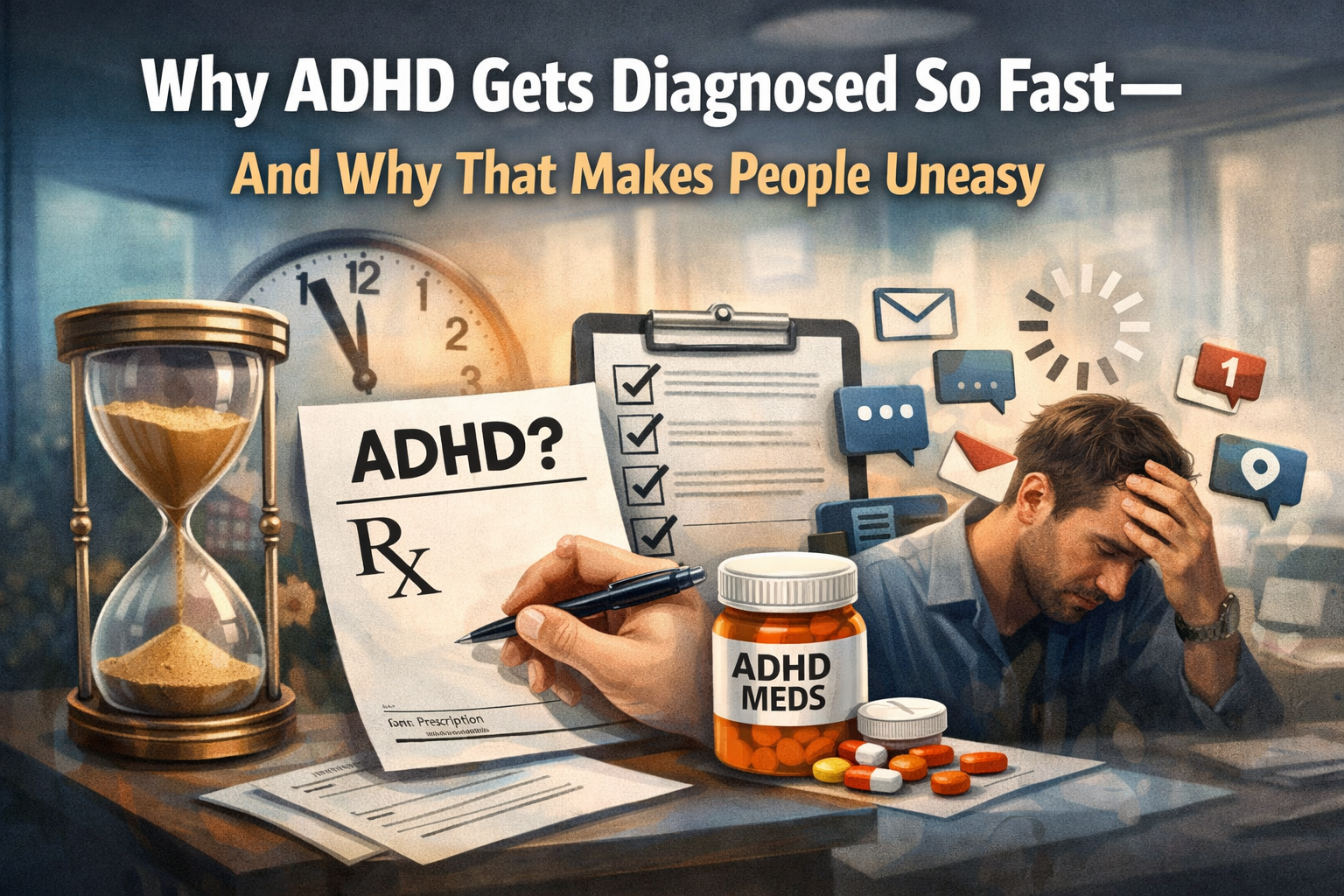
If you’ve ever thought, “They hand out ADHD meds way too fast,” you’re not imagining the feeling.
A lot of people walk away from the process unsettled. Not because ADHD is fake. Not because medication never helps. But because the path from “I’m struggling” to “here’s a prescription” can feel surprisingly short.
That tension is what people are reacting to.
ADHD is real. It can seriously disrupt work, school, relationships, and daily life. Medication helps many people. But it’s also true that some evaluations feel rushed, shallow, or too dependent on a checklist.
This is not medical advice. It’s a plain-English look at why the process can feel fast — and what to do if you want support that goes beyond medication.
Why the process can feel so quick
1) More people are asking for help
Attention problems are now impossible to ignore. People are overwhelmed, overstimulated, underslept, and stretched thin. More adults are also recognizing patterns they may have missed earlier in life.
That means more people are seeking answers at the same time.
2) Appointments are short
Many providers are trying to assess something complex inside a brief visit. When time is tight, nuance gets squeezed out.
You may get asked the right questions. You may still not get enough depth.
3) Screening tools are fast by design
Questionnaires and symptom checklists are useful. They help providers spot patterns quickly.
But a screening tool is not the same as a full evaluation. It can flag a possibility. It cannot capture the whole picture on its own.
4) People want relief now
When someone is falling behind, missing deadlines, losing focus, or feeling like their brain will not cooperate, there is pressure to offer something concrete.
Medication is concrete. It feels actionable. In a strained system, that often makes it the first move.
What a more thorough evaluation often includes
A stronger ADHD evaluation usually looks beyond a symptom list. It may include:
-
patterns across school, work, and home
-
how long the symptoms have been present
-
how much they actually impair daily life
-
sleep quality, stress load, anxiety, and depression
-
substance use, medical history, and other possible explanations
-
outside input from a partner, parent, or family member in some cases
Not every provider will do all of this. But if your evaluation felt thin, it is reasonable to ask for more depth or get a second opinion.
Why attention problems do not automatically mean ADHD
This is the part people often miss.
Modern life can produce attention problems in almost anyone. Constant notifications. Chronic stress. Sleep debt. Too many tabs open mentally and digitally. A nervous system that never fully settles.
Some people have ADHD. Some people are dealing with attention overload. Some have both.
The label matters. But the support matters too.
Because even if your focus issues are not fully explained by ADHD, you still need tools that make concentration easier and distraction less automatic.
Support beyond medication
Medication may help. It is not the only lever.
A lot of people benefit from simple, repeatable supports that reduce friction and make focus less dependent on willpower.
Reduce context switching
Every switch costs attention. Protect it.
Try:
-
single-task work blocks
-
one visible task at a time
-
a “later list” for random impulses, ideas, and tabs you want to open
Use a reliable start cue
Starting is often the hardest part.
Your brain responds well to patterns. The more consistent the cue, the less energy it takes to begin.
That cue might be:
-
the same workspace
-
the same timer
-
the same playlist or sound loop
-
the same first step every session
Control the sound environment
For many people, focus falls apart because the environment keeps interrupting it.
A steady sound anchor can help create a cleaner mental lane. Not magic. Just fewer competing inputs.
That is where tools like High Frequency Highway can fit. If you focus better with consistent audio and less ambient noise, using frequency headphones can help make your environment more predictable — which can make it easier to start, stay on task, and switch less.
That does not replace treatment. It supports attention in a practical way.
Aim lower — and get better results
Do not aim for perfect focus. That goal is fragile and usually unrealistic.
Aim for:
-
10 solid minutes without switching
-
faster starts
-
fewer unnecessary interruptions
-
a work setup you can repeat tomorrow
That is how focus improves in real life. Not through intensity. Through repeatability.
If the diagnosis process felt fast, your concern is not irrational. You are probably reacting to a system that often has to move faster than the problem deserves.
The answer is not cynicism. It is better support, better questions, and tools that actually help you stay with the work in front of you.
Try High Frequency Highway: High Frequency Highway
Share:
ADHD Medication Side Effects: Why Many People Build Non-Medication Support Too
Long-Term ADHD Medication: The Questions People Actually Ask—And the Non-Invasive Supports That Help