
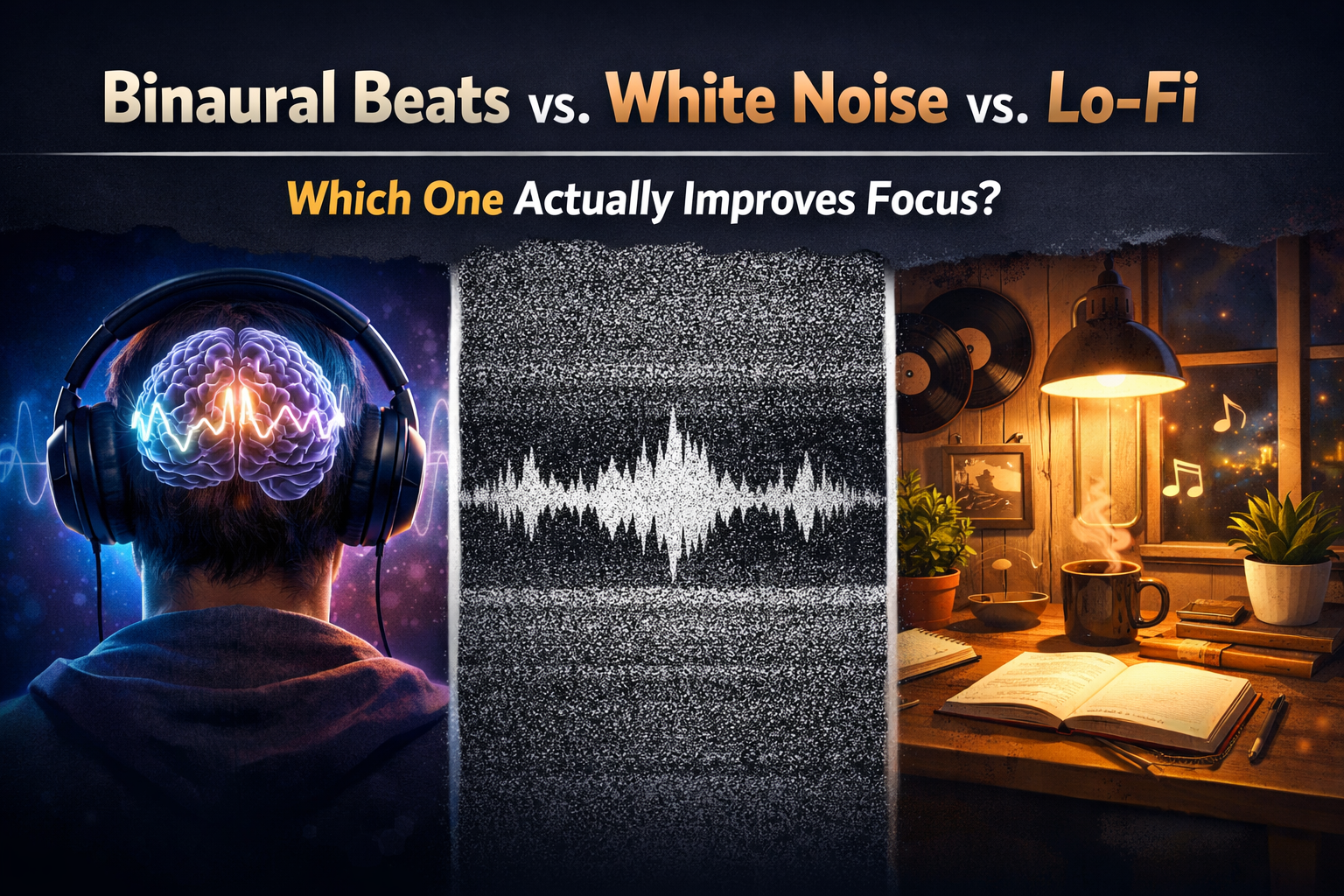
If you’ve ever wondered whether binaural beats, white noise, or lo-fi will help you focus, you’re asking the right question.
The answer is not “which one is best?”
It is: best for what?
The right audio depends on three things:
- the type of work you’re doing
- the environment you’re working in
- how easily your brain gets pulled away by sound
Some audio helps by masking distraction.
Some helps by adding structure.
Some just makes work feel better.
Here’s the practical breakdown.
Quick verdict
- White noise or pink noise is best for blocking distraction and creating a stable background.
- Lo-fi is best for routine work or creative sessions when you want a pleasant, low-pressure atmosphere.
- Binaural beats are best when you want a more structured focus cue and you’re using stereo headphones.
1) White noise and pink noise
What it is
Steady sound textures that reduce the impact of random background noise.
Think HVAC hum, rainfall, static, or broadband sound designed to smooth out your environment.
Best for
- noisy spaces like cafés, dorms, airports, or coworking rooms
- reading, studying, and deep work
- people who get distracted by lyrics, melody, or changing musical patterns
Why it works
Noise does one job extremely well: it makes your environment less unpredictable.
If your attention keeps getting hijacked by conversations, traffic, doors opening, or people moving around you, this is usually the best place to start.
Watch out
White noise can sound sharp or fatiguing for some people.
If it feels harsh after a few minutes, switch to pink noise. It is often softer, smoother, and easier to stay with for longer sessions.
2) Lo-fi
What it is
Chill instrumental music built around soft rhythm, minimal harmony, and a relaxed mood. Often layered with vinyl crackle, mellow drums, and ambient texture.
Best for
- routine admin work
- creative drafting
- low-friction work sessions
- people who focus better when the room feels less sterile
Why it works
Lo-fi can make starting easier.
That matters. A lot of people do not need perfect silence. They need enough emotional lift to get into motion. Lo-fi can lower resistance, make work feel lighter, and help sustain momentum on tasks that are repetitive or mentally flat.
Watch out
Lo-fi can quietly become entertainment.
If you start following the beat, waiting for the drop, or mentally drifting with the music, it is doing too much. For demanding work, “pleasant” can turn into “too engaging” fast.
3) Binaural beats
What it is
Two slightly different tones played separately into each ear, creating the perception of a third rhythmic pulse.
Example:
- 200 Hz in the left ear
- 210 Hz in the right ear
- your brain perceives a 10 Hz beat
Best for
- people who like a subtle sense of structure under their audio
- work that benefits from a steady mental groove
- users already listening with stereo headphones
Why it works
Binaural beats are less about blocking the outside world and more about shaping the feel of the session.
For some people, that subtle internal rhythm makes it easier to settle in, stay consistent, and reduce mental drift, especially when layered under a soundscape.
Watch out
They require stereo headphones and clear left/right separation.
Without that, the effect does not work the way it is intended to.
They are also not magic. If your real problem is a loud environment, masking noise will usually help more than a structured tone.
The real question: do you need masking, structure, or stimulation?
Most people choose focus audio by genre.
That is the wrong filter.
Choose it by problem.
- If your issue is external noise, start with white noise or pink noise
- If your issue is internal wandering, try binaural beats
- If your issue is boredom or friction, try lo-fi
That framing gets you closer to the right tool much faster.
A simple 2-minute decision test
Do not overthink it. Test it.
Pick one task.
Try each audio type for five minutes.
Keep everything else the same.
Track three things:
- Did I start faster?
- Did I switch tasks less?
- Did I feel more calm or more irritated?
The winner is not the one that sounds coolest.
It is the one that reduces switching and makes focused work easier to sustain.
Where High Frequency Highway High Frequency Headphones fit
No audio method works well if your listening setup is inconsistent.
That is where High Frequency Headphones matter.
They are designed to create a stable, immersive listening environment so whatever focus audio you choose can work as a repeatable cue, especially in noisy or unpredictable settings.
If you are trying to build a focus ritual that holds up in the real world, consistency matters more than novelty.
Share:
Best Focus Tools for Remote Teams in 2026 (A Practical Buyer’s Guide)
How to Build a Deep Work Culture in a Distracted World