
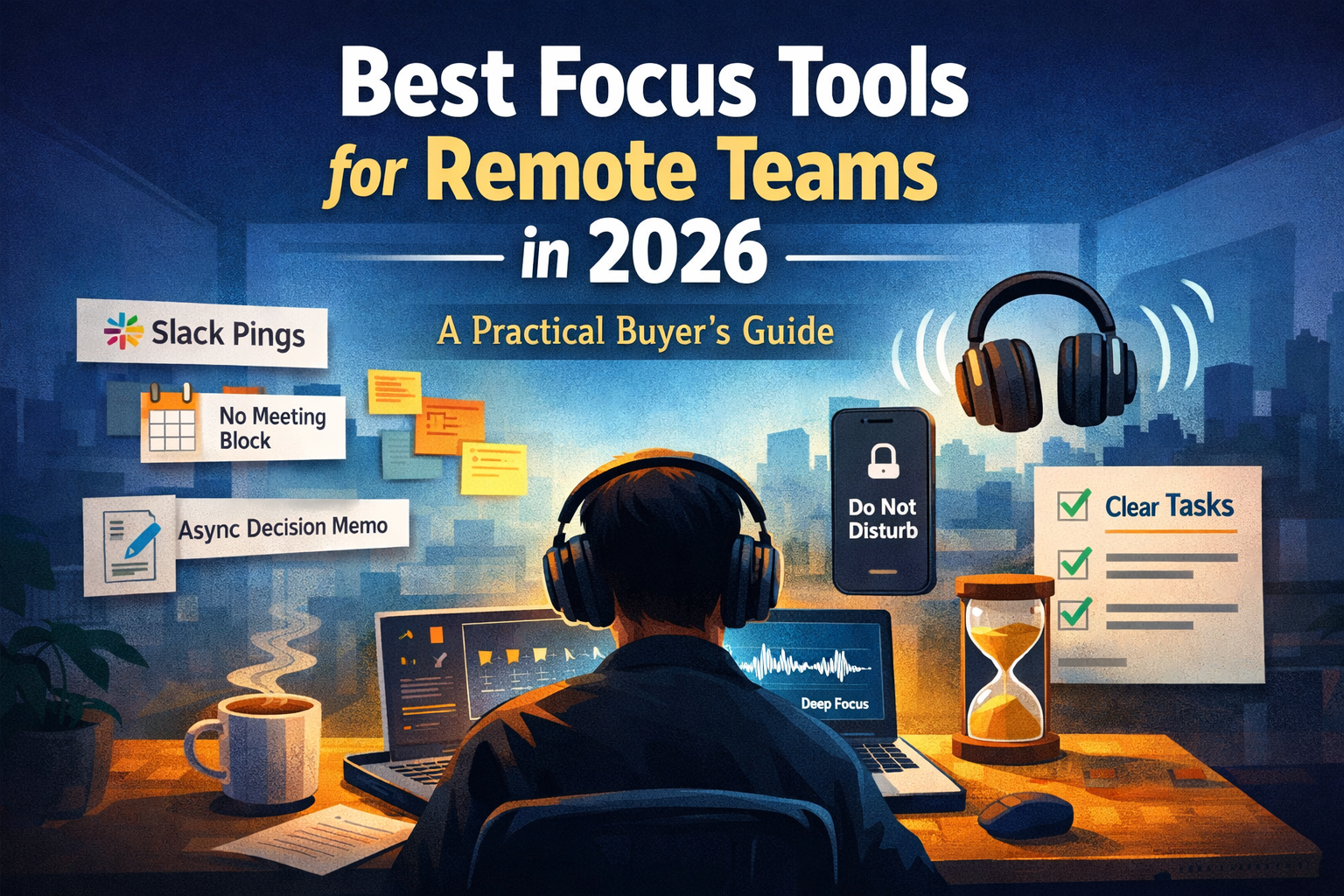
Remote teams did not lose productivity because people got lazy.
They lost it because work got fragmented.
Slack pings. Back-to-back meetings. Constant context switching. The unspoken pressure to always be available.
So when someone searches “best focus tools for remote teams,” the real question is not, What app should we buy? It is, What system will help our team protect attention and make deep work repeatable?
That is the lens for this guide.
This is a practical buyer’s guide for operators, HR leaders, and team managers who want fewer interruptions, better execution, and a team that can actually finish meaningful work.
What to implement first: the 80/20
If you do nothing else, start here:
- Protect deep work on the calendar
- Move more decisions to async workflows
- Create a repeatable focus cue with sound and headphones
Those three changes solve most of the real problem: too much switching, not enough uninterrupted time.
1) Async decision systems
What problem it solves: meetings that exist only because no one wrote the decision clearly.
A surprising amount of meeting volume comes from weak decision hygiene. People meet because the proposal is vague, the tradeoffs are unclear, or ownership is fuzzy.
Fix that first.
What to implement
- One-page decision memos
- A simple thread structure: proposal → objections → decision
- A default 24-hour async review window before live discussion
Best tools
- Notion or Google Docs for written proposals
- Loom for short context videos when nuance matters
Why it works
Async decisions reduce unnecessary meetings and force clearer thinking. They also create a written record, which matters even more in distributed teams.
If the decision can be read, challenged, and finalized without a meeting, that meeting should not exist.
2) Calendar protection and deep work blocks
What problem it solves: no contiguous time to do serious work.
Most teams do not have a motivation problem. They have a scheduling problem.
When the day is broken into 30-minute fragments, even strong people underperform. Focus needs time density.
What to implement
- Company-wide no-meeting mornings two to three times per week
- 50-minute meetings as the default, not 60
- Required agendas before a meeting can stay on the calendar
Best tools
- Google Calendar or Outlook
- Calendly scheduling rules to block protected time
Why it works
Deep work rarely happens by accident. It happens when the calendar makes room for it.
A protected block does more than save time. It signals that focused work is part of the operating model, not something employees have to fight for individually.
3) Noise control and a sound-based focus cue
What problem it solves: remote work is noisy, unpredictable, and hard to enter cleanly.
This is where most teams underestimate the opportunity.
You cannot control every employee’s environment. You cannot eliminate every distraction. But you can give people a reliable cue that tells the brain, it is time to focus now.
That matters because the hardest part of deep work is often not staying in it. It is starting.
Best practice
- Choose one dedicated deep work soundscape
- Use the same one consistently
- Start every focus block with that exact cue
- Pair it with the same headphones whenever possible
Why it works
Consistency creates conditioning.
Over time, the cue reduces start friction. People stop negotiating with themselves and start working faster. For teams, that creates something even more valuable than individual preference: a shared ritual.
Why this matters for remote teams
You cannot standardize every home office.
You can standardize the trigger.
That is a much more realistic way to build a focus culture across a distributed team.
4) Switching firewalls
What problem it solves: constant interruptions that reset attention all day long.
Most teams say they value focus, then leave every interruption channel wide open.
That contradiction is expensive.
What to implement
- Scheduled focus time in Slack
- Notifications off by default
- A clear rule that “urgent” means phone call, not message
- Team norms around response windows, not instant replies
Best tools
- Slack status and snooze settings
- Focus modes on iOS and macOS
Why it works
Every interruption carries a recovery cost.
The goal is not to remove communication. The goal is to separate what is truly urgent from what only feels urgent.
5) Task clarity tools
What problem it solves: vague work creates procrastination, drift, and avoidable follow-up.
People do not stall only because they are distracted. They stall because the next step is unclear.
Clarity is a focus tool.
What to implement
- One owner per task
- A visible next action
- A clear definition of done
Best tools
- Linear
- Jira
- Asana
Why it works
Ambiguity creates drag. Clear ownership and clear completion criteria reduce mental overhead and keep work moving.
A team cannot stay focused on work that has not been defined properly.
6) Documentation-first onboarding
What problem it solves: knowledge trapped in DMs, meetings, and tribal memory.
When onboarding depends on who happens to be online, remote teams lose time fast.
What to implement
- A principle of “if it is not written down, it does not exist”
- Clear onboarding checklists
- Centralized process documentation
Best tools
- Notion
- Confluence
Why it works
Documentation reduces repeated questions, speeds up onboarding, and lowers dependency on individual team members.
It also protects focus for senior operators who would otherwise become the default answer engine.
7) Focus-friendly hardware: High Frequency Headphones
What problem it solves: inconsistent focus state and noisy work environments.
Software matters, but hardware shapes the experience.
High Frequency Highway’s High Frequency Headphones are built to support repeatable focus by creating a more stable auditory environment. Used with soundscapes or structured audio, including binaural-style layers, they help keep attention on one rail for longer.
For teams, the advantage is not novelty. It is consistency.
- Same cue
- Same loop
- Same start ritual
That is how focus stops being random and starts becoming cultural.
If your team already believes in deep work but struggles to enter it quickly and consistently, the right audio setup can become a simple, high-leverage layer in the system.
Try High Frequency Highway: https://highfrequency.onelink.me/lwuw/mkogg00s
Quick buyer checklist
If you are evaluating focus tools for a remote team, ask three questions:
- Does this reduce context switching?
- Does this protect uninterrupted work time?
- Does this create a repeatable focus ritual?
If the answer is yes, it is probably worth implementing.
Because the best focus tools do not just help people concentrate harder.
They make focused work easier to begin, easier to maintain, and easier to scale across a team.
Share:
The Science Behind Flow State: How to Get There in Under 10 Minutes
Binaural Beats vs. White Noise vs. Lo-Fi: What Actually Helps You Focus?