
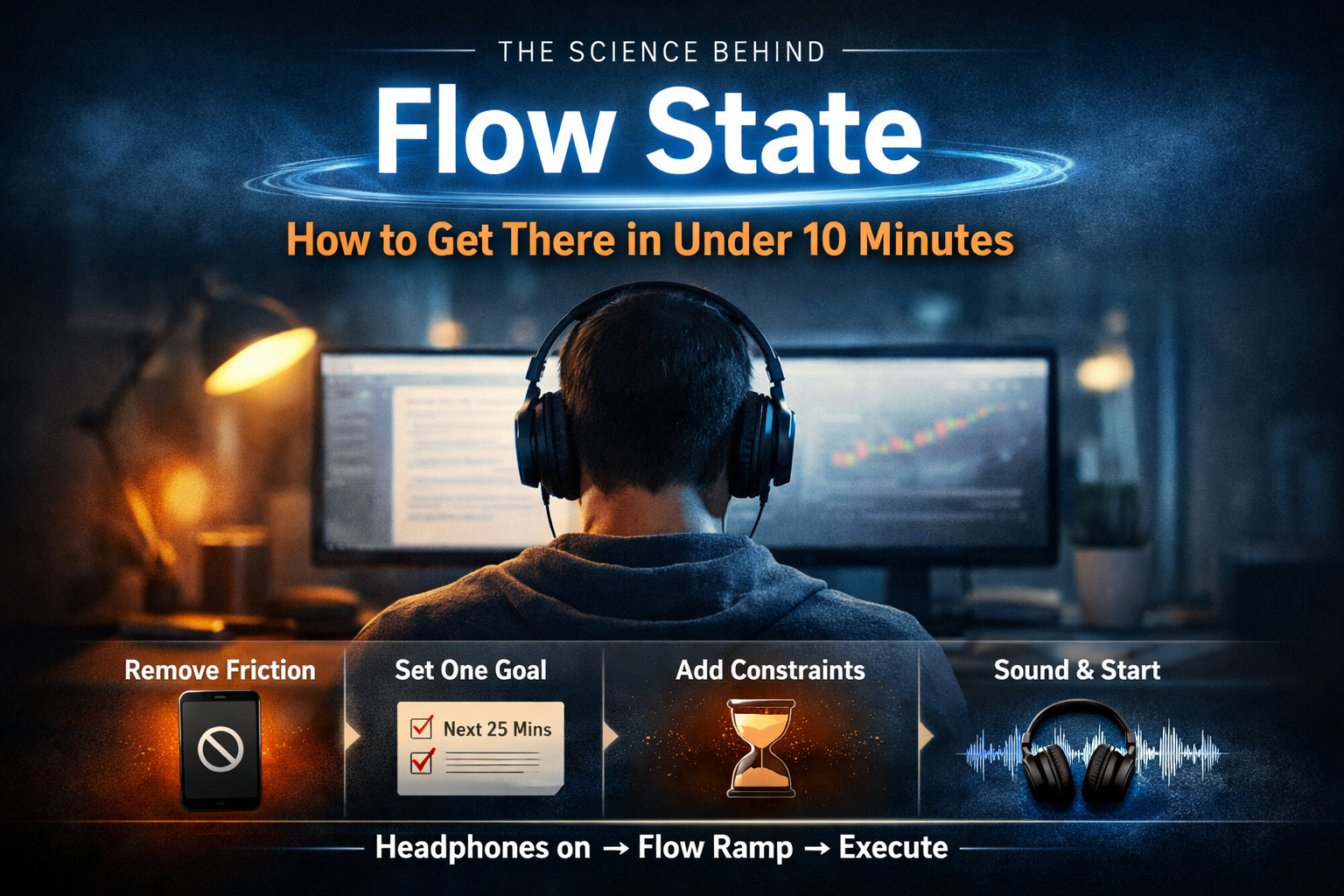
Flow state gets talked about like it is some rare, magical condition.
It is not.
The feeling is real: time bends, focus locks in, and work moves with less internal drag. But most advice on flow is useless because it treats flow like something you wait for.
You do not wait for flow. You create the conditions for it.
This article gives you a simple 10-minute flow ramp you can use before deep work, creative work, or any moment that requires clean attention. No hype. No medical claims. Just a repeatable protocol that helps you get moving fast.
What flow actually is
At a practical level, flow is a state where:
- your attention is fully engaged
- distractions lose some of their pull
- the task starts carrying its own momentum
Flow tends to show up when four things are true:
- The goal is clear
- Feedback is immediate
- The challenge matches your skill
- Switching is minimized
That is why flow often feels effortless. Not because the task is easy, but because the brain is no longer burning energy on constant re-entry.
The biggest myth about flow
The biggest myth is that flow is a feeling.
It is not.
Flow is usually the result of structure.
Most people do not struggle because they lack motivation. They struggle because they are trying to focus in an environment built for interruption. Too many tabs. Too many decisions. Too many open loops. Too much switching.
Flow is what happens when friction drops and constraints rise.
The 10-minute Flow Ramp
Use this before a work sprint, writing session, study block, or high-stakes meeting.
Minute 0–2: Remove friction
Before you ask your brain to focus, make focus easier.
- Put your phone on Do Not Disturb
- Close email, Slack, and extra tabs
- Leave one window open for the task that matters
Then write down any open loops bouncing around in your head. Keep it simple:
- reply to Sam
- send invoice
- review slide deck
The goal is not to solve them. The goal is to stop mentally carrying them.
Minute 2–4: Define one win
Write one sentence:
In the next 25 minutes, I will ______.
Make it specific and measurable.
Weak: “work on presentation”
Strong: “finish the opening slide and write 5 supporting bullets”
A clear target gives the brain something to lock onto.
Minute 4–6: Create one constraint
Constraints sharpen attention.
Pick one rule for the next block:
- no switching until the timer ends
- drafting only, no editing
- one tool only
- no research, just execution
People think freedom helps focus. Usually the opposite is true. The fewer choices available, the easier it is to stay in motion.
Minute 6–8: Use sound and breathing to shift state
This is where state change becomes physical, not just mental.
- Put on headphones
- Start a steady soundscape like rain, ambient sound, or pink noise
- Optionally layer in subtle binaural structure if that works for you
- Do 3 breath cycles: inhale for 4, exhale for 6
Why this works: sound reduces environmental randomness, and slower exhales help downshift tension. Your physiology settles first. Your attention usually follows.
Minute 8–10: Start the first micro-action
Do not wait for readiness. Start something small and concrete.
- write the first sentence
- rename the file
- build the outline
- draft the first three bullets
Flow rarely starts before motion. It usually starts because of motion.
Why sound belongs in a flow protocol
Sound matters because it changes the environment faster than willpower can.
The value is not in “magic frequencies.” It is in consistency.
The right sound cue can:
- reduce background unpredictability
- signal to your brain that it is time to lock in
- make distraction feel less rewarding
- become a repeatable ritual tied to deep work
Over time, the cue itself starts doing part of the work.
The real reason most people miss flow
They start too big.
They think they need an hour, perfect energy, a clean calendar, and the right mood. So they stall.
Flow does not usually begin with a breakthrough. It begins with a setup.
Remove friction. Pick one target. Add one constraint. Control the sound. Start small.
That is enough to change the texture of a work session in under 10 minutes.
Team version: how to build flow into culture
If you lead a team, flow should not depend on individual discipline alone. It should be supported by operating rules.
A few that work:
- two hours a day reserved for no-meeting deep work
- async by default
- protected no-switching blocks
- shared cues for focus time across the team
Teams lose enormous energy to context switching. A better system does more than a motivational speech ever will.
Where High Frequency Headphones fit
High Frequency Highway’s High Frequency Headphones fit into this process as a practical flow trigger.
They help create a cleaner, more stable sound environment you can use the same way every day. That matters because repeatable cues beat unreliable motivation.
A simple protocol looks like this:
Headphones on → flow ramp → execute
That is the point. Not hype. Not ritual for ritual’s sake. Just a cleaner way to enter focused work on command.
Share:
What Are Binaural Beats—and Do They Actually Help You Focus?
Best Focus Tools for Remote Teams in 2026 (A Practical Buyer’s Guide)