
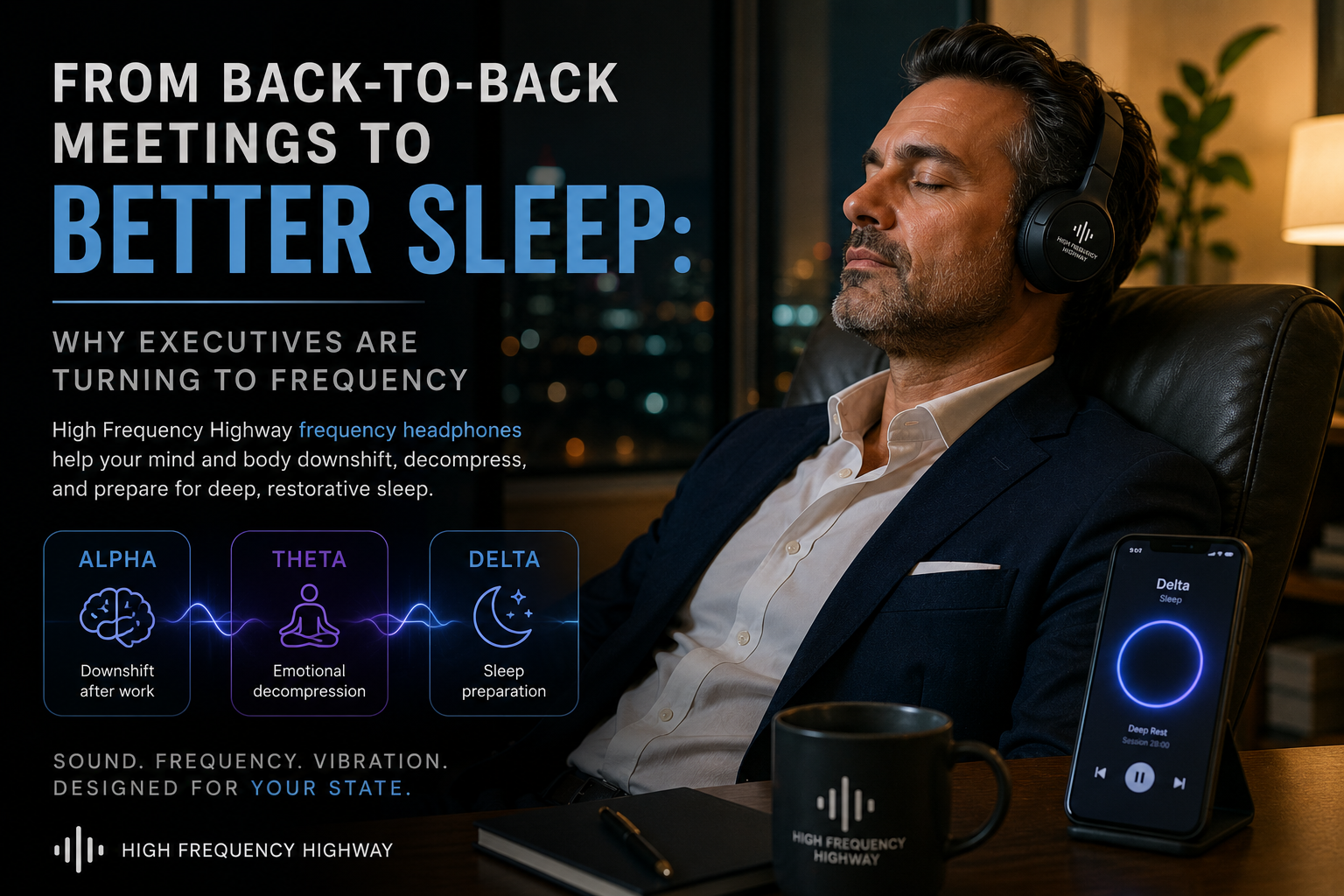
An executive can make decisions all day and still lose the night to the decisions they already made.
That is the part most productivity advice ignores.
The calendar ends. The laptop closes. The final meeting is over. But the mind keeps running.
A conversation replays. A decision gets questioned. A client issue comes back up. A team conflict follows you into dinner. A financial risk starts whispering the second the room goes quiet.
This is not laziness. It is not weakness. It is not a lack of discipline.
It is the residue of responsibility.
High-responsibility professionals spend the day accelerating. They lead calls, solve problems, manage people, protect revenue, make tradeoffs, absorb tension, and stay composed while the room looks to them for certainty.
Then they are expected to fall asleep on command.
That is where the system breaks.
Executives are often trained to perform, but not to recover. They know how to enter pressure. They do not always know how to exit it.
This is why more founders, managers, consultants, and high-output professionals are becoming interested in frequency headphones for sleep, calm, and end-of-day recovery.
Not because they need another gadget.
Because they need an off switch that actually fits the way they live.
High Frequency Highway sits inside that exact need. Its frequency headphones combine sound, vibration, bone-conduction technology, and app-based sessions designed to help users move from high-output mode into a more settled state.
For executives, that matters.
Because clear decisions require a recovered brain.
The Leadership Nervous System Does Not Clock Out at 5 PM
Most people think leadership stress comes from workload.
That is only partly true.
The heavier part is responsibility.
An executive is not just completing tasks. They are carrying consequences. Every decision affects people, money, timing, trust, strategy, or reputation. Even small choices can feel loaded because they sit inside a larger web of obligation.
That is why back-to-back meetings are so draining.
It is not only the talking.
It is the switching.
One meeting requires empathy. The next requires financial judgment. The next requires conflict management. The next requires vision. The next requires speed. The next requires restraint.
By the end of the day, the mind is not simply tired. It is still scanning.
That scanning can follow a leader into the night.
You lie down, but your system stays alert.
You want sleep, but your brain wants one more review.
You know the day is over, but your body has not received that message yet.
This is the missing transition most executives never build into their routine.
They move directly from pressure into home life, then from home life into bed, then wonder why sleep does not arrive cleanly.
The issue is not always sleep itself.
Often, the issue is the lack of a downshift.
The Missing Off Switch
High performers are usually good at activation.
They can push through fatigue. They can handle the call. They can show up prepared. They can hold tension without showing it. They can make the decision before everyone else feels ready.
But activation has a cost.
If the body spends the entire day in output mode, it needs a clear signal that the day has changed.
Without that signal, many executives reach for whatever is easiest.
A glass of wine.
Late-night scrolling.
Another email check.
A sleep supplement.
A show they barely watch.
A meditation app they open inconsistently.
None of these are automatically wrong. The problem is that many of them do not solve the transition problem.
Scrolling keeps the brain stimulated.
Email reopens loops that were supposed to close.
Passive entertainment can distract the mind without settling the body.
Supplements may help some people, but they do not teach the nervous system how to shift out of work mode.
Meditation can be powerful, but many executives struggle to go from twelve hours of decision-making into silent stillness without support.
That gap is where frequency-based sound becomes practical.
It gives the mind something to follow.
It gives the body a sensory cue.
It turns the transition into a repeatable routine instead of a nightly negotiation.
Why Frequency Belongs in the Executive Recovery Conversation
Sound already changes state.
A certain song can sharpen focus. A quiet room can make tension louder. White noise can soften distraction. A steady rhythm can make breathing feel easier. A harsh sound can spike irritation in seconds.
The body is already responding to sound all day.
High Frequency Highway makes that relationship more intentional.
Instead of asking, “What do I want to listen to?”
The better question becomes:
“What state do I need to enter next?”
That is the executive use case.
After meetings, the desired state is not more stimulation. It is not more input. It is not more analysis.
It is decompression.
A controlled descent.
A way to move from command mode into recovery mode.
High Frequency Highway frequency headphones are designed for that transition. The headphones use bone conduction, frequency-based sound, and vibration to create a more physical listening experience. The app acts as the control center, allowing users to choose sessions based on the state they want to support.
For sleep, the goal is not to force the body into rest.
The goal is to stop sending it work signals.
That distinction matters.
A strong end-of-day routine does not begin when your head hits the pillow. It begins when you start teaching your system that the day is complete.
Alpha, Theta, and Delta: Three Stages of the Downshift
For executives, the most useful way to think about frequency is not as a trend.
Think of it as sequencing.
Different parts of the evening require different kinds of support.
The first stage is the work exit.
The second stage is emotional decompression.
The third stage is sleep preparation.
High Frequency Highway sessions can be used around those stages through sound states commonly associated with alpha, theta, and delta.
Alpha: The First Downshift After Work
Alpha is the first step out of work intensity.
This is the post-meeting reset.
You are not asleep. You are not fully off. You are simply stepping out of the sharpest edge of the day.
For many executives, this is the most important transition because it prevents the workday from bleeding into everything else.
An alpha-focused session can become the bridge between the final meeting and the rest of the evening.
Use it after closing the laptop.
Use it before walking into the house.
Use it after a commute.
Use it before dinner.
The goal is not dramatic. It is simple:
Signal that the workday has ended.
Theta: Emotional Decompression
Theta is useful when the day carried emotional weight.
Not every stressful day is intellectually hard. Some days are emotionally noisy.
A tense conversation.
A difficult decision.
A disappointed client.
A team member who needs more than you have to give.
A meeting where you stayed calm while absorbing everyone else’s urgency.
This kind of residue does not disappear just because the calendar is clear.
Theta can support the deeper decompression phase, where the goal is to stop replaying the emotional charge of the day.
This is where executives need more than distraction.
They need a state shift.
A theta-focused session can create a softer landing after heavy interpersonal days. It gives the mind a place to go that is not another loop, another analysis, or another imaginary conversation.
Delta: Sleep Preparation
Delta is the final descent.
This is not for answering one more message. Not for planning tomorrow. Not for half-working from bed.
Delta belongs to the pre-sleep window.
The purpose is to help create a sleep-ready environment. Lower input. Fewer decisions. Less stimulation. A cleaner handoff from evening into rest.
For executives who struggle to fall asleep after high-pressure workdays, this stage matters because the brain often needs a stronger cue that it no longer has to perform.
A delta-focused session can become part of that cue.
Not a guarantee.
Not a medical treatment.
Not a replacement for healthy sleep habits.
A practical signal that supports the body’s shift toward rest.
A Realistic End-of-Day Routine for Executives
The best recovery routine is the one a busy person will actually use.
It cannot require perfect conditions. It cannot depend on a silent house, a long meditation block, or a full lifestyle redesign.
It needs to fit the real end of a demanding day.
Here is a practical sequence using High Frequency Highway frequency headphones.
Step 1: The Office Exit
Before moving into the next part of the evening, create a clean break.
Close the laptop.
Write down the three things that need attention tomorrow.
Do not solve them. Park them.
Then use a short alpha session.
This creates a boundary between work mode and personal mode. The goal is not to become sleepy. The goal is to stop carrying the meeting room into the rest of the night.
Step 2: The Home Transition
Once you are home, resist the urge to immediately replace work stimulation with digital stimulation.
No inbox check.
No fast scroll.
No “just one message.”
Use a theta session when the day had emotional charge. This is especially useful after conflict, negotiation, leadership pressure, or heavy people-management days.
Let the session become the decompression point.
You are not trying to erase the day.
You are giving your system a way to metabolize it.
Step 3: The Pre-Sleep Session
The final thirty to sixty minutes before sleep should not feel like another performance zone.
Lower the lights.
Put the phone away.
Avoid reopening work.
Use a delta session as part of the wind-down.
This is where frequency headphones for sleep become most practical. The headphones are not being used as entertainment. They are being used as a state cue.
The message is clear:
The day is complete.
The system can come down.
Frequency Headphones vs. Melatonin vs. Meditation Apps
Executives usually do not need more options. They need the right tool for the right problem.
Here is the practical comparison.
| Option | What It Helps With | Where It Can Fall Short | Best Use Case |
|---|---|---|---|
| Frequency headphones | Sensory downshift, calm, sleep preparation, state-based routines | Requires consistent use and a quiet transition window | Executives who need a repeatable end-of-day reset |
| Melatonin | May support sleep timing for some people | Does not address work stress, mental loops, or emotional residue | Occasional schedule disruption or sleep timing support |
| Meditation apps | Can support mindfulness and relaxation | Hard to use when the mind is overstimulated or resistant to stillness | People who already have a meditation habit or want guided practice |
| Passive scrolling | Feels easy and distracting | Often increases stimulation and delays sleep readiness | Not ideal as a recovery tool |
| Evening entertainment | Helps some people mentally detach | Can become another source of input and delay wind-down | Better earlier in the evening, not as the final sleep cue |
The point is not that one tool replaces every other tool.
The point is fit.
Melatonin may support timing.
Meditation may support awareness.
Frequency headphones may support the transition itself.
For high-responsibility professionals, that transition is often the missing piece.
The Kickstarter CEO Bedtime Use Case Matters
The most persuasive product stories are not abstract.
They show where the product enters real life.
That is why the bedtime use case connected to the Kickstarter CEO matters for High Frequency Highway.
It places frequency headphones inside a familiar executive problem: the day is over, but the body has not caught up.
This is the kind of use case that makes the product easier to understand.
Not “here is a futuristic audio device.”
Not “here is another wellness trend.”
A sharper frame:
Here is a tool for the executive who needs to come down after a demanding day.
That is practical.
That is specific.
That is why the story works.
High Frequency Highway is not only speaking to people who want better sleep. It is speaking to people whose sleep is affected by responsibility, pressure, decisions, meetings, and mental load.
That audience does not need a vague promise.
They need a routine that respects the reality of their day.
Recovery Is a Leadership Discipline
Executives often treat recovery as a reward.
Finish the work, then rest.
Hit the goal, then recover.
Survive the week, then reset.
That model is broken.
Recovery is not what leaders earn after performance. It is what makes sustained performance possible.
A tired brain makes narrower decisions.
A tense nervous system reacts faster than it reflects.
A poorly recovered leader brings yesterday’s residue into today’s room.
That is why sleep support is not a soft topic for executives.
It is operational.
Better rest affects judgment, patience, creativity, emotional control, and the ability to lead without dragging hidden fatigue into every decision.
This is where frequency technology becomes interesting. Not as a shortcut. Not as a cure. Not as a replacement for discipline.
As a tool that helps make recovery easier to repeat.
High Frequency Highway frequency headphones give executives a practical way to build an end-of-day reset around sound, vibration, and intentional state selection.
That is the value.
A clearer transition.
A calmer evening.
A more sleep-ready system.
A better chance at waking up with the brain you actually need.
Final Takeaway
The modern executive does not have a productivity problem only.
They have a transition problem.
They know how to accelerate. They know how to perform. They know how to carry pressure. But many have never built a reliable way to come down.
High Frequency Highway frequency headphones offer a practical end-of-day tool for that missing downshift.
Alpha can support the first exit from work mode.
Theta can support emotional decompression.
Delta can support sleep preparation.
Together, they create a simple evening sequence for leaders who need to move from pressure into recovery without relying on scrolling, overworking, or waiting for exhaustion to do the job.
Clear decisions need a recovered brain.
Try High Frequency Highway frequency headphones as your end-of-day reset after high-pressure work.
Share:
The Kickstarter CEO Tried HFH Headphones. Here’s Why That Moment Matters
From Prototype to Global Launch: How High Frequency Highway Took Frequency Headphones to the World