
In wellness tech, attention is easy to claim.
Proof is harder.
Anyone can build a product page. Anyone can talk about innovation, frequency, nervous system support, meditation, recovery, or focus. The harder test is what happens when the product is placed in front of someone who sees new ideas every day and has spent years around founders, creators, early adopters, and products trying to break into the market.
That is why one HFH moment matters.
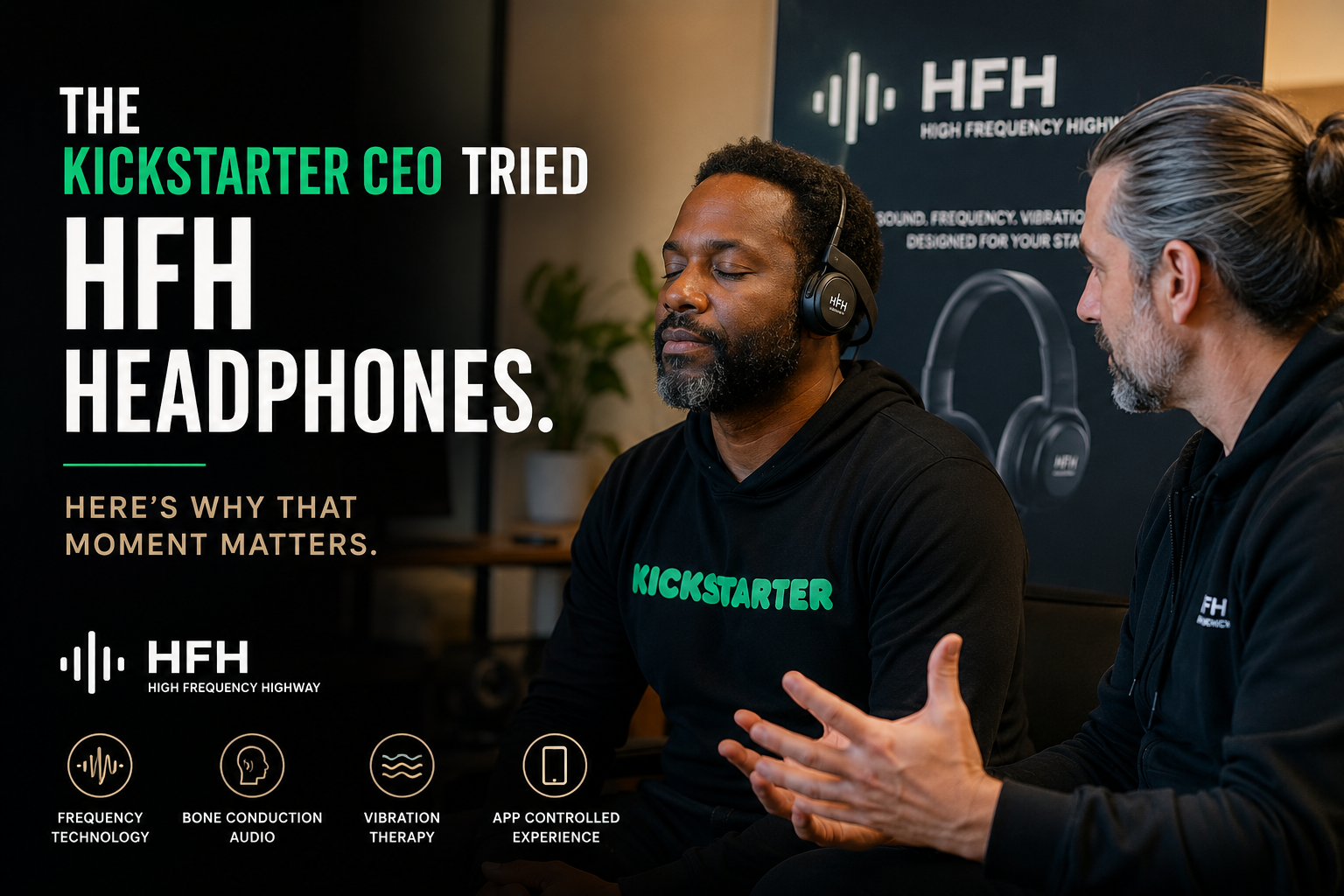
The CEO of Kickstarter, Everette Taylor, tried High Frequency Highway’s frequency headphones. Not in a polished commercial. Not through a scripted testimonial. Not as part of a mass-market campaign built after the fact.
He tried the technology.
He felt the experience.
And in that moment, HFH crossed one of the most important early thresholds for any wellness tech startup: the product became easier to understand through direct experience than through explanation.
That is the real story.
Not celebrity attention. Not borrowed credibility. Not hype.
A real person in a high-context product environment put the headphones on and had a reaction strong enough to become part of the brand’s proof story.
For a product like HFH, that matters.
Because frequency headphones are still new to most people. The category is not as familiar as standard audio headphones, sleep apps, meditation apps, or wearable trackers. HFH sits between several worlds at once: soundwear, wellness technology, frequency technology, meditation, performance, and state regulation.
That makes the product exciting.
It also makes buyers cautious.
When people hear about frequency headphones for the first time, they usually have three questions:
What are these?
Do they feel different from normal headphones?
Is this actually useful, or just another wellness gadget?
A strong demo answers those questions faster than a long explanation.
Why New Wellness Technology Needs Proof
Wellness shoppers have become more careful.
They have seen too many products promise transformation without giving them anything practical. They have bought apps they stopped using. They have tried devices that looked impressive but became another object in a drawer. They have heard exaggerated claims about biohacking, energy, meditation, sleep, focus, and recovery.
So when a product says it uses frequency, vibration, and bone conduction, skepticism is natural.
That skepticism is not a problem.
It is a filter.
Strong products should be able to survive it.
HFH’s challenge is simple: it is not selling ordinary headphones. It is selling a different relationship with sound.
Most headphones are built around listening. Better bass. Cleaner vocals. Noise cancellation. A more immersive music experience.
HFH is built around state.
That shift changes the product conversation.
The question is not only, “How does this sound?”
The better question is, “How does this make the body feel?”
That is where frequency headphones become interesting. HFH combines bone-conduction audio, frequency-based sessions, and gentle vibration to create a different kind of listening experience. The product is not positioned as background entertainment. It is built as a tool people can use when they want to move into focus, calm, meditation, sleep, recovery, or creative flow.
That is a more ambitious promise than standard audio.
It also requires more trust.
People need to experience the difference before they fully understand it.
This is why the Everette Taylor moment matters. It was not just a “nice person tried the product” moment. It was a validation moment inside the exact world where new products are judged quickly, directly, and often without patience for weak ideas.
Kickstarter is built around early belief.
Creators bring something new to the market before the market has fully accepted it. Backers evaluate the idea, the story, the usefulness, the credibility, and the feeling that this product deserves to exist.
That is why the setting matters.
HFH was not just trying to impress someone with a title.
It was placing a new product idea in front of someone who understands what it takes for a product to move from prototype to public demand.
The Moment Was Bigger Than a Demo
A good product demo does not feel like a pitch.
It feels like a shift.
Before the demo, the product is an idea. After the demo, the product has a physical memory attached to it.
That is especially true for frequency headphones.
You can describe bone conduction. You can explain that the headphones use vibration. You can talk about frequencies, sound sessions, nervous system support, and state-based audio. You can explain the app ecosystem and how users can choose sessions for focus, relaxation, sleep, meditation, or recovery.
All of that helps.
But the product becomes much clearer when someone puts it on.
The body understands before the buyer has finished analyzing.
That is the gap HFH is trying to close.
Most people do not need another playlist. They already have music. They already have podcasts. They already have meditation tracks. They already have noise-canceling headphones.
What they often do not have is a simple tool that helps them choose the state they want to enter.
That is HFH’s core difference.
The headphones are hardware. The app is the control center. The frequencies are the experience layer. Together, they create a system that is more specific than “listen to something relaxing.”
This is state-based soundwear.
Not sound as decoration.
Sound as direction.
That is why a live reaction matters more than a polished claim. A buyer can ignore marketing language. It is harder to ignore a visible shift when someone actually tries the product.
For HFH, the Kickstarter CEO moment worked because it compressed the story.
New product.
High-skepticism category.
Credible product discovery environment.
Immediate physical experience.
Real reaction.
That is the kind of sequence early-stage brands need.
Why Kickstarter Is the Right Context for HFH
Kickstarter has always attracted a specific kind of buyer.
Not passive consumers. Early believers.
People who support campaigns on Kickstarter are often willing to evaluate a product before it becomes obvious. They look for new categories, clever engineering, strong founder stories, and products that feel slightly ahead of mainstream retail.
HFH fits that environment.
Frequency headphones are not a commodity purchase. Nobody wakes up thinking, “I need a pair of frequency headphones” the same way they might think, “I need new earbuds.”
That means the product has to create its own category in the buyer’s mind.
This is where Kickstarter can be powerful.
It gives category-building products a stage before traditional retail has fully caught up. It allows a wellness tech startup to explain not only what the product is, but why the product needs to exist.
For HFH, the Kickstarter connection is not just about fundraising or pre-orders. It is about market education.
It gives the brand a place to say:
Here is what frequency headphones are.
Here is how bone conduction changes the experience.
Here is why vibration matters.
Here is how the app gives users control.
Here is why sound can be designed around state, not just entertainment.
That matters because the future of audio is not only about better sound quality. It is about better use cases.
People are beginning to think differently about what they listen to and why.
They want help focusing without overstimulation.
They want tools that support recovery without requiring a complicated routine.
They want meditation support that does not feel abstract.
They want sleep support that fits into real life.
They want technology that feels less like another screen and more like an actual sensory experience.
HFH sits directly inside that shift.
The product is not asking people to abandon music, meditation, or wellness routines. It is giving them a more intentional way to use sound as a state tool.
That is why the phrase “frequency headphones” matters for search, but the product experience matters even more for conversion.
Search brings people to the idea.
The demo makes the idea believable.
The Real Product Difference: Frequency, Vibration, and Bone Conduction
HFH is not trying to win by being another premium headphone brand.
That lane is already crowded.
The real difference is how the product delivers the experience.
Bone conduction technology sends sound through gentle vibration rather than relying only on traditional air-conducted audio through the ear canal. That creates a different physical relationship with sound. Instead of sound feeling purely external, it can feel more embodied.
For HFH, that matters because the brand is not only focused on what users hear. It is focused on how users feel while listening.
The frequency layer adds another dimension.
HFH’s app gives users access to sound sessions designed around different states and intentions. That could mean focus, calm, meditation, rest, or recovery. The app becomes the control center, while the headphones become the physical delivery system.
This is the difference between a gadget and an ecosystem.
A gadget does one thing.
An ecosystem gives users a repeatable way to return to the experience.
That matters for customers because wellness products only work in real life when they are easy to use repeatedly. People do not need another complicated ritual. They need a clear path:
Choose the state.
Put on the headphones.
Start the session.
Feel the shift.
That is the practical promise of HFH.
Not magic.
Not medical certainty.
Not a cure-all.
A sensory tool designed to help people use sound more intentionally.
The strongest product claims here should stay rooted in experience. Users may report feeling calmer, more focused, more grounded, or more ready to rest. Those reactions matter because they are the language of lived experience, not overpromised science.
For skeptical buyers, that distinction is important.
HFH does not need to pretend frequency headphones are a replacement for medical care, therapy, sleep hygiene, training, or disciplined recovery. The stronger position is simpler:
HFH gives people another way to work with their state.
That is enough.
And for many buyers, it is exactly what they are looking for.
What the Everette Taylor Moment Signals to Buyers
A single demo does not prove everything.
It does not replace customer reviews. It does not replace product testing. It does not replace long-term use. It does not mean every person will have the same reaction.
But it does signal something important.
HFH had enough product clarity to create a reaction in the room.
That is a meaningful threshold.
Many early-stage products fail because they need too much explanation. The founder understands the product, but the buyer does not. The pitch sounds interesting, but the experience is flat. The product looks innovative, but the use case is weak.
HFH’s advantage is that the product can be felt.
That changes the buyer journey.
For someone discovering HFH online, the Everette Taylor moment becomes a credibility bridge. It tells the buyer that this is not only an abstract wellness concept. It is a physical product that created attention when placed in front of someone who understands early-stage innovation and product discovery.
That matters for founders.
It matters for tech skeptics.
It matters for crowdfunding audiences.
It matters for wellness shoppers who want something practical, not performative.
And it matters for anyone trying to decide whether frequency headphones are worth paying attention to.
The point is not, “A CEO tried it, so you should buy it.”
The point is sharper than that:
HFH created enough of a real-world reaction to move from concept to campaign.
That is the proof story.
The product earned attention before the mainstream category fully formed.
Why This Matters for the Future of Frequency Wellness
The wellness market is moving through a correction.
People still want to feel better, sleep better, focus better, and recover better. But they are becoming less patient with vague promises. They want tools that are specific. They want technology that fits their day. They want products that help without demanding an entirely new lifestyle.
That is where frequency wellness has an opportunity.
Sound is already part of people’s lives.
They use music to focus. They use podcasts to walk. They use sleep sounds to rest. They use meditation audio to calm down. They use playlists to change their mood.
HFH takes that existing behavior and makes it more intentional.
Instead of asking, “What do I want to listen to?”
The product invites a better question:
“What state do I want to enter?”
That is the category shift.
If HFH can help people make that shift, then the headphones are not just another piece of hardware. They become part of a daily state-design routine.
Morning focus.
Midday reset.
Pre-sleep downshift.
Post-work decompression.
Meditation support.
Creative flow.
Those use cases are simple enough to understand and practical enough to repeat.
That is what gives the product commercial potential.
Not because frequency technology is trendy.
Because the problem is real.
People are overstimulated. Their attention is fragmented. Their nervous systems are carrying the cost of constant input. Most people do not need more content. They need better signals.
HFH’s bet is that sound can become one of those signals.
The Everette Taylor moment matters because it showed that the idea could travel beyond theory. In a room where product ideas are judged quickly, the experience created attention.
That is what early proof looks like.
Not perfection.
Traction.
Final Takeaway
The Kickstarter CEO trying HFH headphones matters because it gave the product a credibility moment that could not be manufactured by copywriting alone.
HFH did not have to over-explain the category.
The demo did the work.
That is the strongest kind of product validation for a new wellness tech startup: when the experience makes the idea easier to believe.
HFH is building more than a pair of headphones. It is building a frequency hardware and app ecosystem around state-based sound. The headphones deliver the physical experience. The app gives users control. The sessions help turn sound into a more intentional tool for focus, calm, sleep, meditation, and recovery.
For buyers, that is the reason to pay attention.
Not because frequency headphones are everywhere yet.
Because they are early.
And the products that define new categories usually create belief before the mainstream catches up.
Explore High Frequency Highway frequency headphones and see why the product created attention before the category became obvious.
FAQ
Were HFH headphones on Kickstarter?
Yes. High Frequency Highway brought its High Frequency Headphones to Kickstarter as part of its move from concept and product story into a public campaign environment. That matters because Kickstarter is where early adopters often evaluate products before they become mainstream retail categories.
What are frequency headphones?
Frequency headphones are headphones designed around more than standard audio playback. Instead of only delivering music, podcasts, or entertainment, they use frequency-based sound experiences to support a chosen state, such as focus, calm, meditation, rest, or recovery.
How do HFH headphones work?
HFH combines bone-conduction headphone technology with frequency-based audio and gentle vibration. The headphones deliver the physical listening experience, while the High Frequency Highway app acts as the control center for choosing sessions based on the state the user wants to enter.
Are HFH headphones the same as normal headphones?
No. Normal headphones are usually built around sound quality, entertainment, and convenience. HFH headphones are designed as soundwear for state-based experiences. The goal is not just to hear something. The goal is to use sound, frequency, and vibration more intentionally.
Who are HFH frequency headphones for?
HFH is built for people who want a more intentional relationship with sound. That includes founders, athletes, creators, wellness shoppers, meditation users, focus-driven professionals, and anyone looking for a practical tool to support calm, clarity, recovery, or rest.
Do HFH headphones make medical claims?
No. The product should be understood as a wellness and sound experience tool, not a medical device or treatment. The strongest claims are experience-based: users may report feeling more focused, calmer, more grounded, or better supported in their routines.
Share:
Why Your Health Quotient May Matter More Than Your Productivity Score
From Back-to-Back Meetings to Better Sleep: Why Executives Are Turning to Frequency