
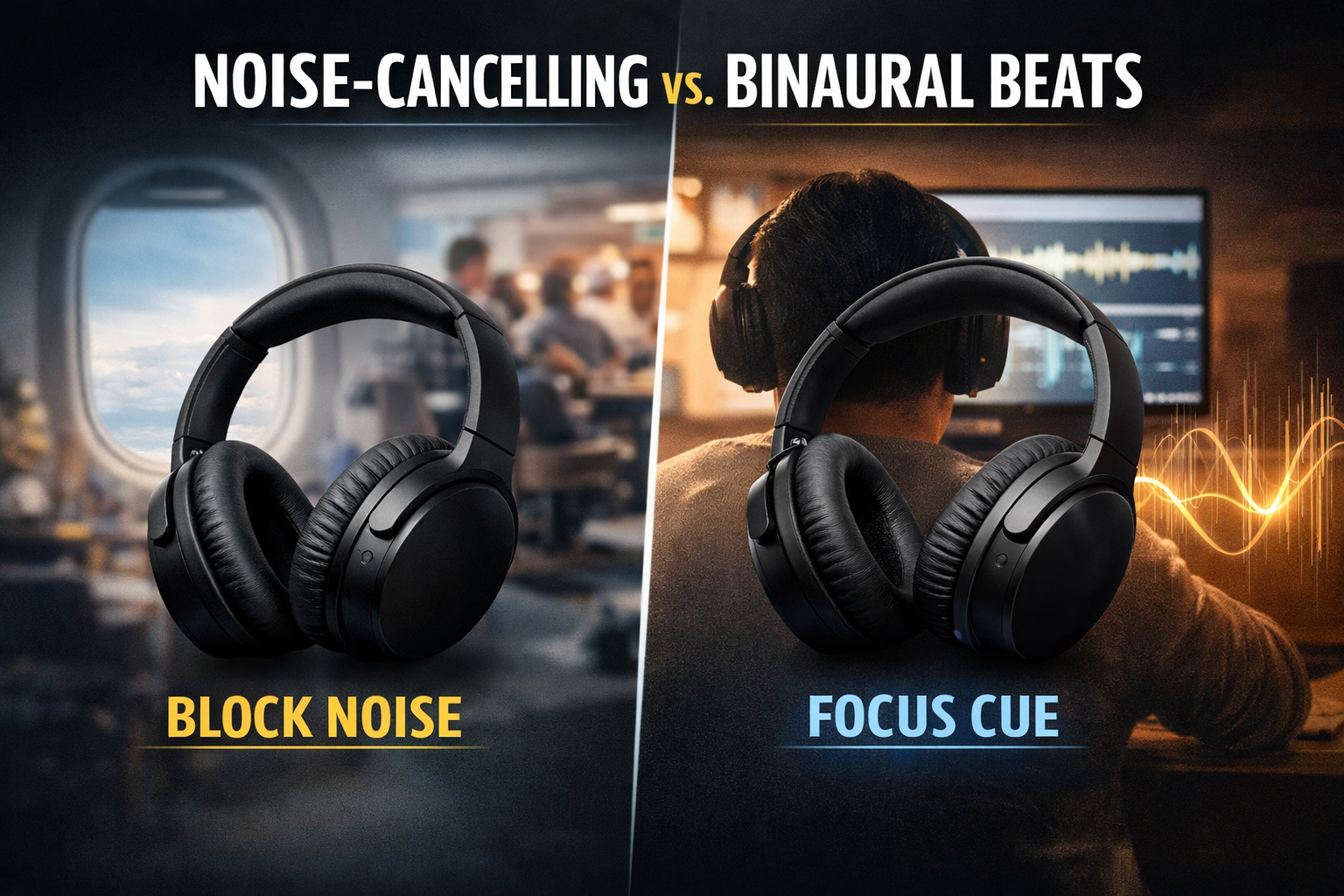
If you’re shopping for focus headphones, you’ll usually run into two categories:
Noise-cancelling headphones.
Binaural beats or frequency headphones.
They may look similar on the surface, but they solve different problems.
The simplest way to think about it is this:
Noise-cancelling headphones are built to remove distraction.
Binaural-style headphones are built to support a focus state.
That distinction matters, because “better focus” can mean two very different things. Sometimes your problem is the world around you. Sometimes it’s the noise inside your own mind.
Noise-cancelling headphones reduce what’s around you
Noise-cancelling headphones are designed to lower external sound. They work best when your environment is the problem.
They’re especially useful for:
- flights
- cafés
- open offices
- shared spaces
- any place with unpredictable background noise
Their job is subtraction.
They take the edge off the outside world so your brain has fewer interruptions to process. That can make it easier to stay steady, especially when noise keeps breaking your concentration.
If your attention gets pulled every time someone talks nearby, a chair scrapes, or a machine hums, noise cancellation solves a real problem.
Binaural beats headphones add a structured audio cue
Binaural beats work differently.
Instead of only reducing sound, they rely on stereo playback to deliver a subtle audio structure. The goal is not to “block everything out.” The goal is to give your mind something stable to lock onto.
That matters for people whose biggest challenge is not external chaos, but internal drift.
You sit down to work. The room is quiet enough. But your attention still scatters. You check another tab. You reread the same sentence. You feel busy, not focused.
This is where structured audio can help.
Used properly, binaural-style listening can provide:
- a consistent cue
- a repeatable work environment
- a stable attention rail
- a more intentional transition into focus
That’s why many people use binaural layers underneath ambient sound, music, or a soundscape. The benefit is not “magic.” It’s structure.
The real question is not which one is better
The real question is: what is disrupting your focus?
If your biggest issue is loud, inconsistent surroundings, you need stronger noise reduction.
If your biggest issue is mental wandering, you need a stronger internal cue.
For a lot of people, the answer is both.
They want less interference from the outside and more consistency on the inside.
That is where standard noise-cancelling headphones and frequency-oriented headphones start to separate.
What to look for in focus headphones
If you want headphones that actually support deep work, don’t just look at marketing claims. Look at the listening experience over time.
The details that matter most are:
- comfort during long sessions
- clear stereo separation
- stable, consistent sound
- low listening fatigue
- immersive enough audio to support routine use
- easy pairing with loops, soundscapes, or structured focus tracks
The best focus headphones are not just impressive for ten minutes. They stay wearable and effective over a full work block.
Why High Frequency Headphones are different
High Frequency Highway’s High Frequency Headphones are not just built to mute the world. They’re built to support a repeatable focus protocol.
That means they are designed to help you:
- block competing noise
- stay inside an immersive sound environment
- use structured audio routines, including binaural-style layers
- create a more deliberate entry into focused work
In practice, that makes them different from standard noise-cancelling headphones.
The point is not just cancelling sound.
The point is creating conditions that help you concentrate on demand.
If regular noise-cancelling headphones help you escape distraction, High Frequency Headphones are designed to help you build a state.
Share:
The ROI of Focus: What Distraction Actually Costs Your Business
Flow State at Work: What Neuroscience Says About Peak Performance