
You’ve seen it:
A player is automatic in practice… then goes stiff when the game tightens.
It looks “mental.” Most of the time it’s mechanical—just upstream.
It’s a nervous system state problem.
When arousal spikes, predictable stuff happens:
-
Vision narrows (you miss options you usually see)
-
Breathing gets shallow (tension climbs)
-
Fine motor control degrades (touch goes first)
-
Decision-making gets loud (rushing, forcing, second-guessing)
So if you want consistency under pressure, don’t only train the skill.
Train the state the skill needs.
The “free throw problem” is everywhere
Swap “free throw” for:
-
penalty kick
-
third-down read
-
serve
-
putt
-
late-game inbound
-
last-shot footwork
Same pattern every time:
Pressure raises arousal.
Too much arousal = sloppy execution.
The goal isn’t to feel nothing.
The goal is to build a reliable return-to-steady.
Calm is trainable (like conditioning)
Most athletes practice in one state: neutral.
Then the game demands a different state: amped + precise.
If you never practice the transition, you don’t own it.
So you train it in small reps—fast, repeatable, measurable.
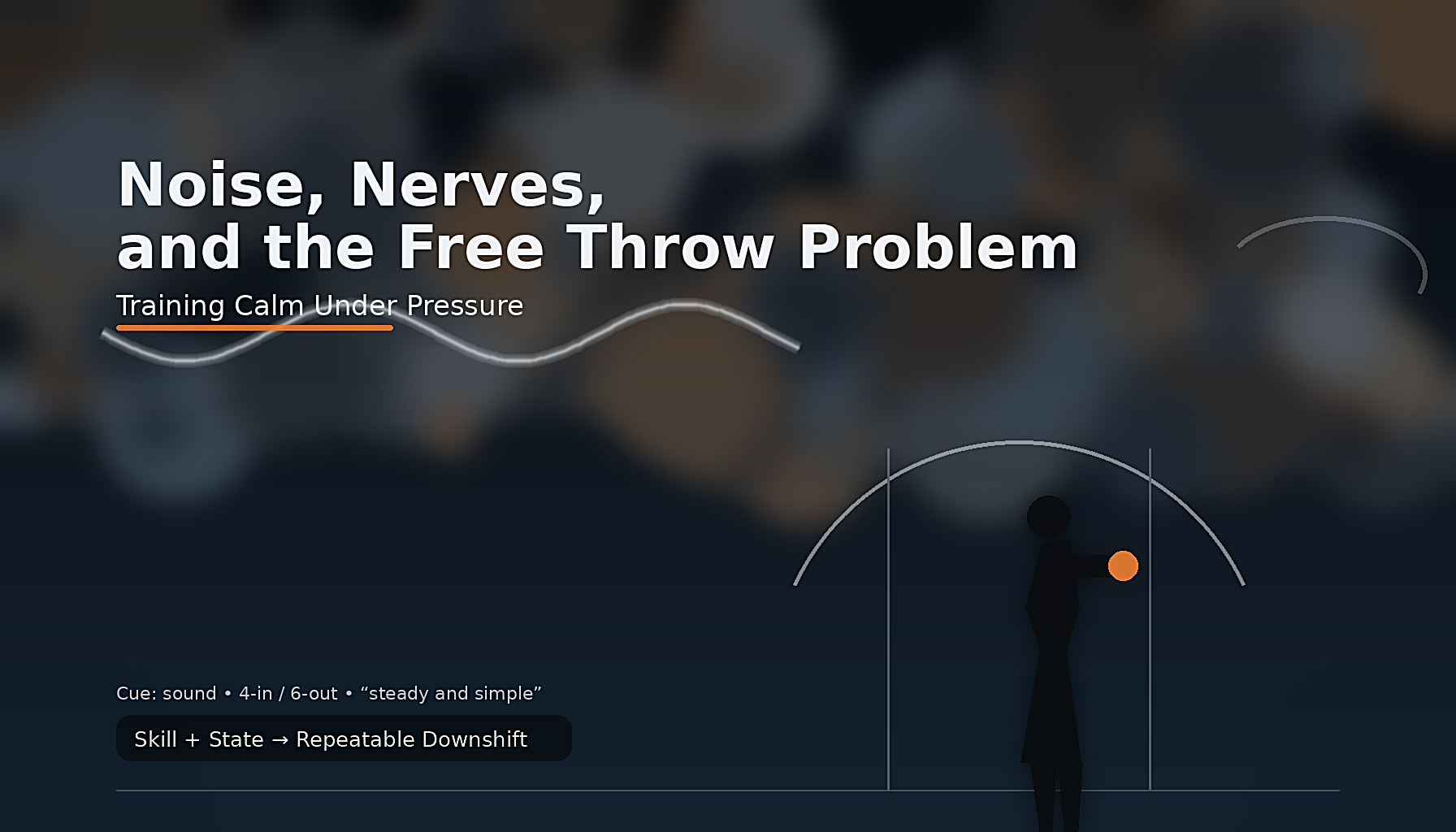
The Calm Cue Protocol (3 minutes)
This is not a “separate mental session.”
It’s a switch you run before real reps.
Protocol:
-
Headphones on
-
60–90 seconds of a steady sound loop (same track every time)
-
3 breath cycles: inhale 4, exhale 6
-
One short phrase: “steady and simple.”
Then you immediately practice the skill.
Why it works: the brain learns sequence → state → action.
Not “talk about calm,” but do calm, then shoot.
A drill coaches actually keep: Pressure Reps
Take a normal drill and add just enough stress to change the body.
Examples:
-
One-and-one free throws (miss = consequence)
-
Last-minute set (clock + score + one possession)
-
Serve targets (points + leaderboard)
-
Putts (must-make streaks)
Before each rep, run the short version:
20-second reset:
-
Headphones on
-
One exhale you can feel
-
Phrase: “steady and simple.”
-
Go.
You’re not trying to “calm down forever.”
You’re teaching the athlete to return—on demand, mid-chaos.
Why headphones beat speeches
People try to cue calm with words from the sideline. It’s inconsistent:
-
different tone every time
-
public pressure attached to it
-
the athlete has to interpret it
Headphones + a consistent sound are cleaner:
-
private cue (no performance theater)
-
blocks the environment
-
the brain learns it fast because it’s the same input every rep
That’s the point of High Frequency Headphones: the cue feels like gear—reliable when the gym isn’t.
What to say to skeptical athletes
Keep it blunt:
“This isn’t spiritual. It’s a routine. We’re practicing the skill of returning.”
If they ask “why,” give one line:
“Your hands work better when your system isn’t redlining.”
Then run the reps. Let the results do the convincing.
Bottom line
Clutch isn’t just skill.
It’s skill + state.
Train the downshift like footwork: small reps, repeated, under pressure.
Never forget this: Try High Frequency Highway.
Share:
Travel Days Quietly Tax Performance: The Recovery Stack Most Teams Skip
Why “Hype” Isn’t Focus: The Readiness Spectrum Every Program Should Track