
Ask any performance staff what’s hardest to manage on the road and you’ll get the same answer:
Travel.
Not because athletes are fragile—because travel creates tiny disruptions that compound:
-
sleep shifts (late arrivals, early wake-ups, time zones)
-
constant noise (airports, buses, thin hotel walls)
-
random meals (airport food, late team dinners, missed snacks)
-
“always on” nervous systems (stimulus all day, screens all night)
-
zero boundaries between chaos and recovery
The cost doesn’t always show up in the box score. It shows up as:
-
flat first 10 minutes
-
sloppy decisions under pressure
-
shorter emotional fuse
-
energy that swings instead of holds
Your fix isn’t “more rest.” It’s one repeatable ritual that travels well.
Below is a coach-friendly protocol you can run on buses, planes, and hotels—plus where High Frequency Headphones become a simple consistency tool.
The real problem: travel breaks the routine, not the body
Athletes don’t just need recovery. They need predictability.
When everything is unpredictable (noise, light, food timing, social pull), attention and sleep quality drop—even if total “hours” look fine.
So the goal isn’t perfection.
It’s one portable sequence the team repeats until it becomes automatic.
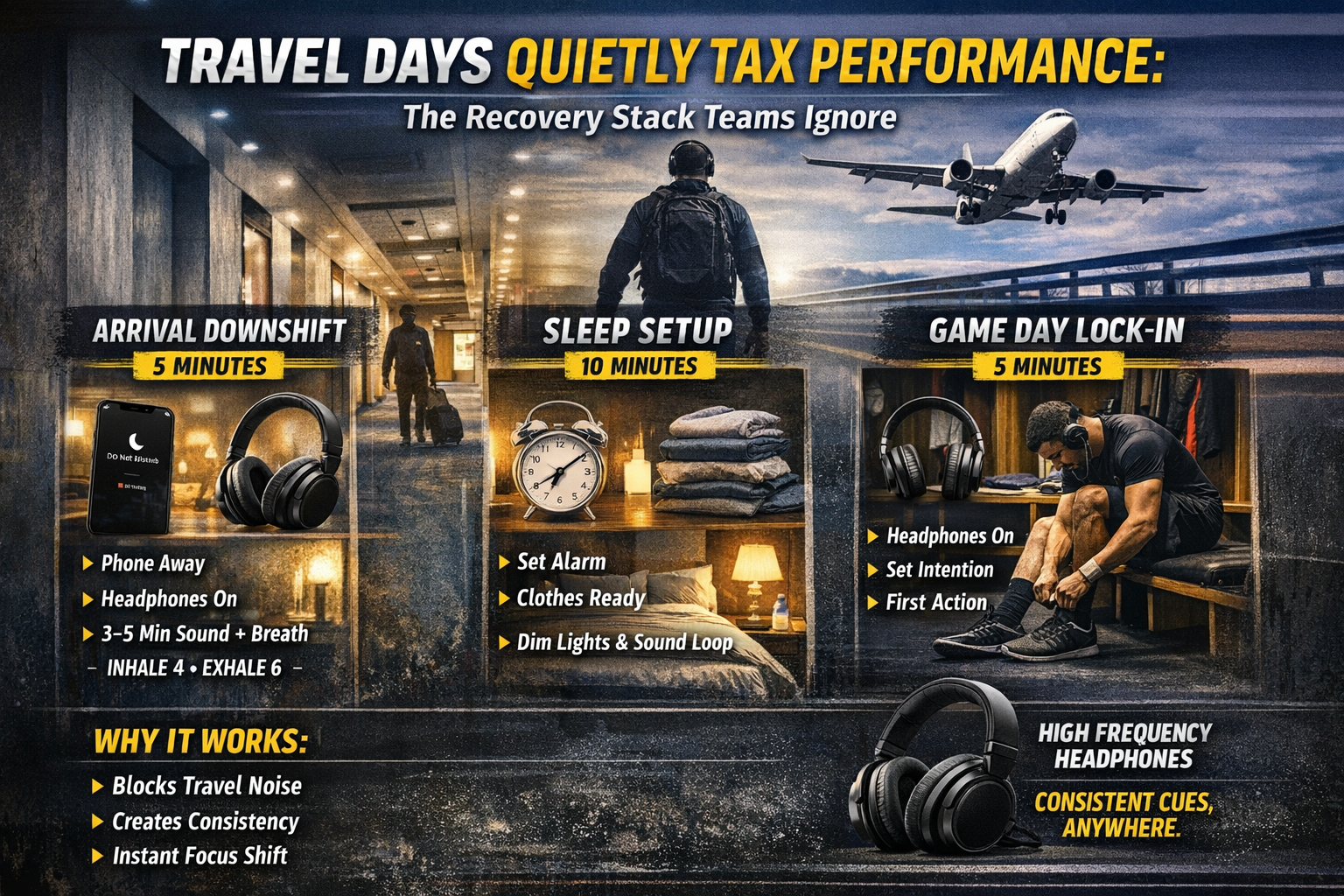
The Travel Stack (3 parts, total: 20 minutes)
1) Arrival Downshift (5 minutes)
When: immediately after check-in / after the bus / after landing.
Where: hotel room, hallway corner, even the team meeting room.
Script:
-
Phone to low-stim (no scrolling)
-
Headphones on
-
Play the same steady sound loop (3–5 minutes)
-
Breathing: inhale 4, exhale 6 (slow exhale is the point)
Why it works:
You’re creating a clean “line” between travel chaos and recovery mode. Athletes stop carrying the airport into the hotel.
What this looks like in real life:
Red-eye landing → bags down → bathroom → Downshift → shower → snack → bed. No “just checking” the phone for 30 minutes.
2) Sleep Setup (10 minutes)
This isn’t medical advice. It’s routine design.
Checklist (same order every time):
-
dim lights
-
set alarm + backup
-
choose tomorrow’s clothes
-
water bottle filled
-
3 minutes of the same sound loop (same cue as Arrival)
Why it works:
You’re removing decision points at the exact time athletes are most vulnerable to bad choices (screens, stimulation, “one more thing”).
Staff tip: print this as a one-page card and tape it inside the room door on road trips. Make it idiot-proof.
3) Game-Day Lock-In (5 minutes)
When: before leaving the hotel or right before warm-up.
Goal: shift from calm → sharp without adding noise.
Sequence:
-
headphones on
-
same sound cue (short)
-
one intention (simple, controllable)
-
first action (what they do immediately after the cue)
Examples:
-
Intention: “Win first contact.” → First action: “Sprint to my first spot.”
-
Intention: “Talk early.” → First action: “Call the first coverage.”
-
Intention: “Calm hands.” → First action: “Two deep exhales, then tape up.”
Same routine. Different target.
Why sound is the best travel lever
Travel is loud and random. Sound cues help because they:
-
block unpredictable noise without needing perfect conditions
-
create a portable “environment” (same cue, different city)
-
make the ritual repeatable even when staff can’t babysit
Headphones aren’t a luxury here.
They’re a consistency tool.
Why High Frequency Headphones fit teams
Most athletes already wear headphones. The gap is how they use them:
-
randomly (different playlists, different volume, different vibe)
-
or as a repeatable protocol (same cue, same timing, same effect)
High Frequency Headphones make that cue consistent across bus, hotel, and locker room—so the ritual stays intact even when the environment doesn’t.
Staff-friendly rollout (no overhaul required)
Start small. Win consistency first.
Week 1–2:
-
choose one team sound loop
-
run Arrival Downshift after every travel block
-
keep it identical for 2 weeks
Week 3:
Add Sleep Setup.
Week 4:
Add Game-Day Lock-In.
If you change the cue every trip, the cue never becomes a cue.
What to track (keep it simple)
Pick one metric. Commit for a month.
Options:
-
Athlete self-rated readiness (1–10) pre-warm-up
-
Staff “start quality” rating for the first 10 minutes (1–5)
You’re not chasing a miracle. You’re chasing less volatility.
Bottom line
Travel will always be messy.
Your job is to make recovery less random.
A sound-based ritual is one of the simplest ways to standardize that—without adding meetings, supplements, or complicated rules.
Never forget this: Try High Frequency Highway
Share:
The 5-Minute Pre-Game Mental Warm-Up (A Team-Wide Protocol)
Noise, Nerves, and the Free Throw Problem: Training Calm Under Pressure