
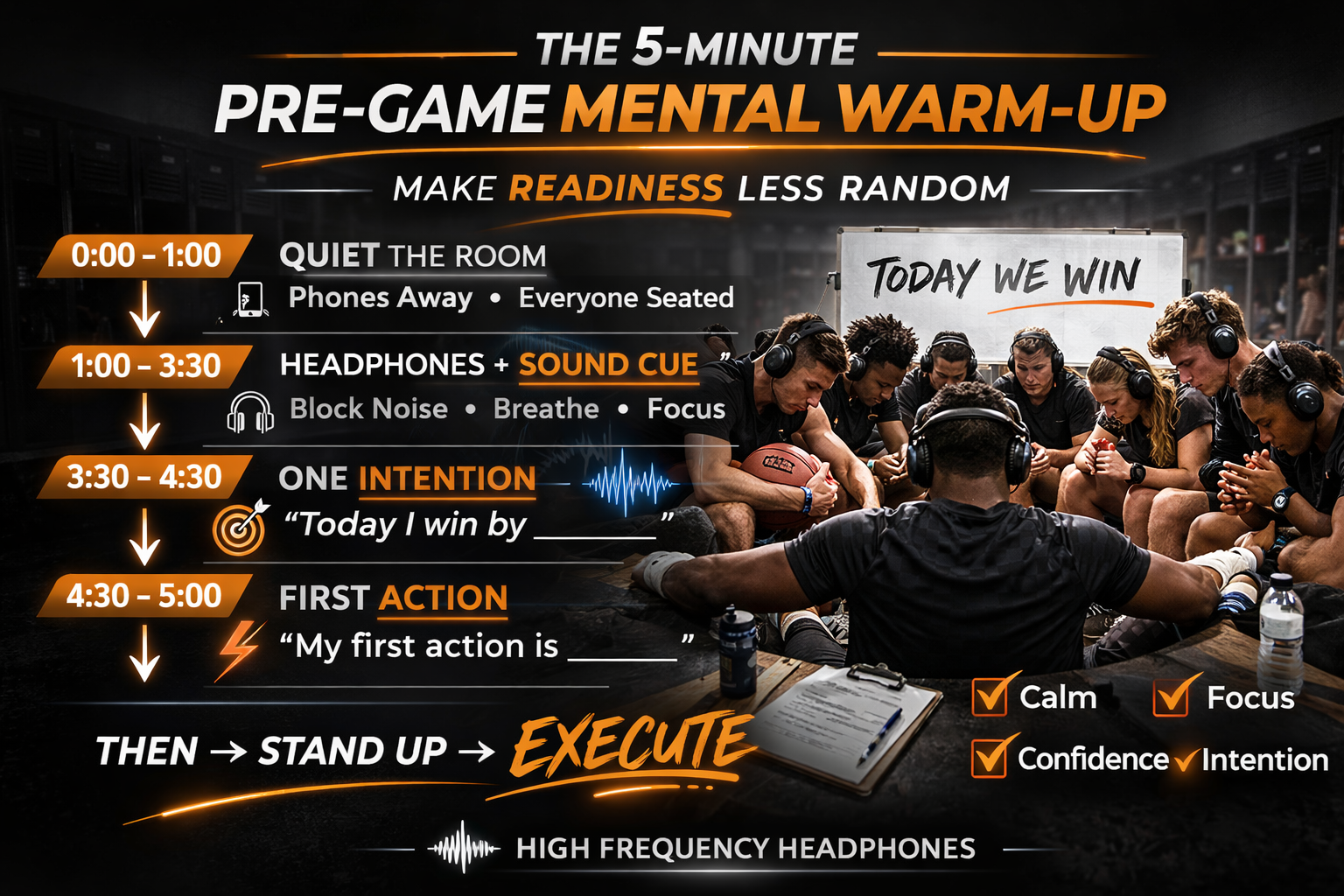
If you’ve coached long enough, you’ve seen it:
Two athletes with the same talent can show up in two completely different states.
One is calm and sharp.
The other is over-hyped, anxious, distracted, or flat.
And you can’t “locker-room speech” your way out of that.
What you can do is treat mental readiness like physical readiness: build a standard warm-up you run every game.
Same steps. Same timing. Same cue. Less randomness.
This is a five-minute protocol you can read out loud to the entire team—any sport, any level.
The principle: readiness isn’t “energy”
Teams confuse “high energy” with “game-ready.”
Readiness is a blend of:
-
calm (not rattled)
-
focus (locked on the next job)
-
confidence (no second-guessing)
-
intention (one clear way to win today)
Some athletes need to come up.
Some need to come down.
A good routine doesn’t hype everyone—it stabilizes everyone.
The 5-minute protocol
0:00–1:00 — Quiet the room
-
phones away
-
no side conversations
-
everyone seated
Coach sets the frame (short, non-negotiable):
“This is part of our warm-up. We do it every game.”
That line matters. It’s not “motivation.” It’s a standard.
1:00–3:30 — Headphones + one consistent sound cue
This is the anchor.
You want a repeatable cue that tells the brain: we’re in game mode now.
Headphones work best because they:
-
block the locker-room chaos
-
create a clean boundary (same input every time)
-
let each athlete regulate privately (no performance, no talking)
What to play
-
steady ambient sound (rain, brown noise, simple soundscape)
-
optional: a subtle structured layer (if your team likes it)
Volume rule
Loud enough to erase chatter. Quiet enough to keep the body calm.
No chasing the “perfect track.” Consistency beats creativity.
3:30–4:30 — One-sentence intention
In their head, every athlete answers:
“Today I win by ______.”
Give examples so it stays concrete:
-
“Today I win by controlling my breathing after mistakes.”
-
“Today I win by sprinting through the first cut.”
-
“Today I win by finishing contact on every rebound.”
-
“Today I win by talking early on defense.”
One sentence. No essays. No goals that need a scoreboard.
4:30–5:00 — First action (the opener)
In their head, every athlete answers:
“My first action is ______.”
Examples:
-
“Pressure the first pass.”
-
“Attack the first rebound.”
-
“Win the first sprint.”
-
“Be patient on the first drive.”
This matters because nerves live in the future.
First action pulls them into the next 10 seconds.
Then: headphones off → stand up → physical warm-up begins.
The coach script (read it word-for-word)
“We don’t control the noise out there. We control our state in here.
Headphones on. Breathe slow. Let the sound steady you.
Pick one intention. Pick your first action.
Then we go execute.”
Deliver it calm. Not dramatic. You’re not trying to fire them up— you’re trying to settle them into precision.
Why this works (without pretending sound is magic)
This isn’t claiming music fixes performance.
It’s using sound as a repeatable cue—the same way a whistle, a routine, or a ritual tells the nervous system “this matters.”
Athletes don’t need another lecture.
They need a simple tool that makes the right state easier to access—on demand.
The win is the repetition:
same steps → same state → fewer outliers.
Where High Frequency Headphones fit
If you’re serious about standardizing game-day readiness, you need gear athletes actually use.
High Frequency Headphones are built to make sound-based state control feel like performance equipment—something you bring to games, travel with, and run as part of your routine.
(Translation: fewer tangled cords, fewer “my earbuds died,” less friction, more consistency.)
Implementation (keep it tight)
-
Start with captains (or your most consistent 5) for 1 week
-
Roll it to the full roster
-
Don’t “optimize” for 10 games—run the same protocol so it becomes automatic
If you change it every week, it never becomes a cue. It becomes a novelty.
Bottom line
If physical warm-up is non-negotiable, mental warm-up should be too.
Run it. Repeat it.
Make readiness less random.
Share:
The Attention Crisis in Athletes: Why Focus Is the New Conditioning
Travel Days Quietly Tax Performance: The Recovery Stack Most Teams Skip