
If you run a program, you’ve probably seen it:
Your athletes aren’t soft. They aren’t lazy. In many cases, they’re working harder than ever.
But they’re showing up fragmented.
Shorter attention spans. More mental noise. More day-to-day inconsistency.
That’s the real issue.
Call it the attention crisis.
Strength and conditioning built modern bodies.
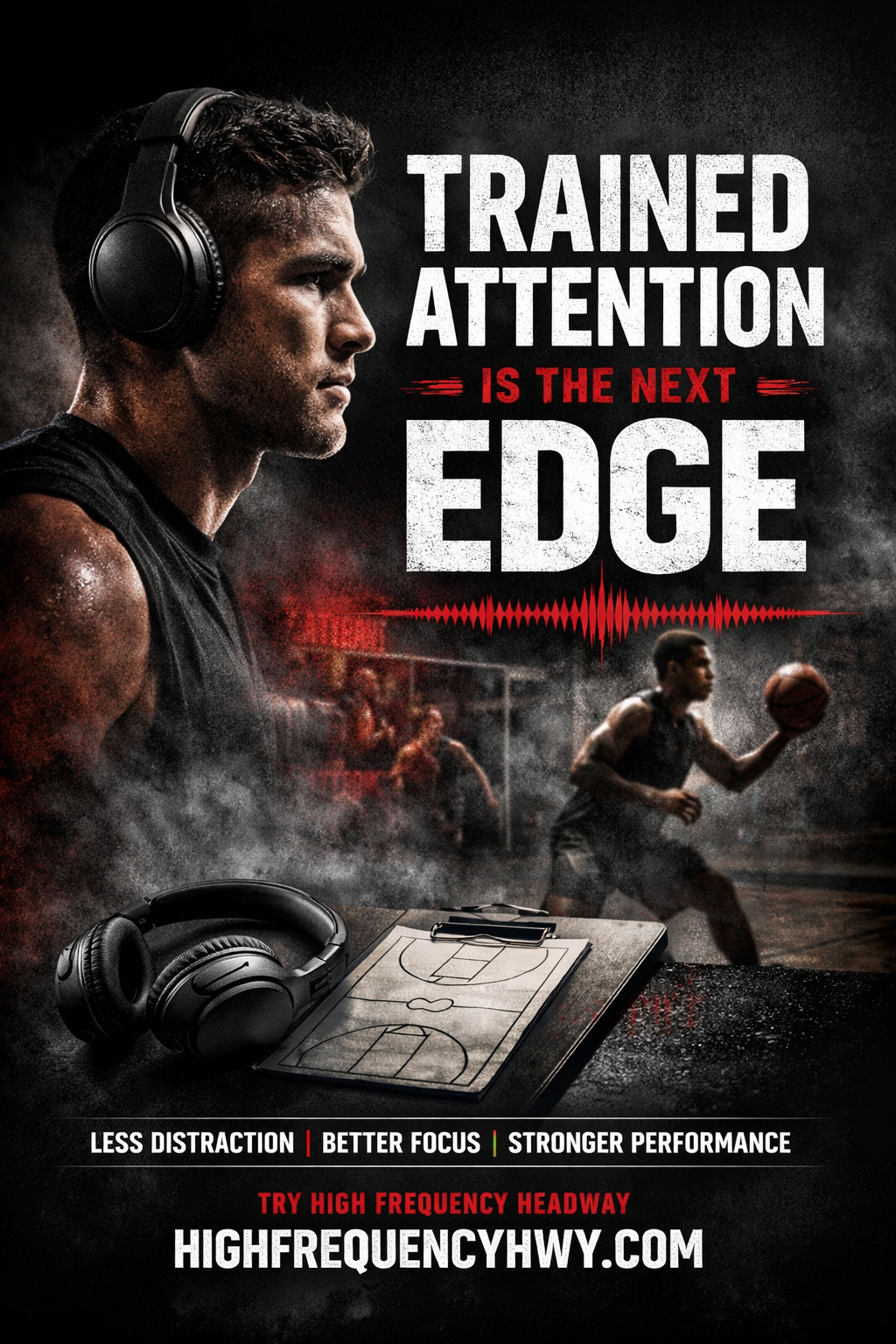
The next edge is going to come from attention conditioning—the ability to enter the right state, on cue, repeatedly.
This breakdown covers what’s happening, what to do about it, and why consistent sound cues (via headphones) may be one of the simplest advantages a team can standardize.
The real enemy is context switching
Most performance drop-offs are not effort problems. They’re switching problems:
-
switching tasks
-
switching emotional states
-
switching between “locked in” and “scattered”
And modern life trains switching all day.
When an athlete spends hours bouncing between class, texts, social feeds, and notifications, don’t be surprised when:
-
practice starts sloppy
-
film sessions drift
-
focus comes and goes
-
clutch execution becomes inconsistent
That’s not a character flaw.
It’s training—just not the kind you want.
Focus is not a personality trait. It’s a state.
Here’s the frame that works inside programs:
Focus is a state you can cue.
You already cue warm-up, lift tempo, and competition mode.
Focus works the same way.
Telling athletes to “lock in” is not a system.
Building an environment that makes focus easier than distraction—that’s a system.
Three problems teams are dealing with right now (and what to do)
1) Practice starts in ten different states
Some athletes arrive amped. Some are flat. Some are anxious. Some are mentally elsewhere.
Fix: standardize a short pre-practice state shift that everyone runs.
Not a speech. Not a vibe. A repeatable routine.
2) Mental recovery is undertrained
Programs train output. Few train the ability to downshift after adrenaline.
Result: athletes stay “on” too long, sleep worse, recover worse, and come back mentally noisy.
Fix: add a 2–5 minute post-practice decompression block.
3) There’s no shared focus cue
Most teams have a shared warm-up. Very few have a shared focus trigger.
Fix: choose one consistent sensory cue and run it daily.
Sound is one of the easiest to standardize.
A simple team-wide attention protocol (6–8 minutes)
This is not complicated. That’s the point.
Phase A — 90 seconds: remove friction
-
phones away
-
one instruction: “Practice starts now.”
-
coaches hold extra talking until after the cue
This creates a clean transition instead of a messy ramp.
Phase B — 3 minutes: sound cue (headphones)
This is where good headphones matter.
Not because of “magic frequencies.”
Because headphones create:
-
a predictable auditory environment
-
a boundary between chaos and task
-
a repeatable cue the brain learns quickly
Teams can use:
-
a steady soundscape (rain, ambient, low-distraction audio)
-
optionally, a structured audio track athletes associate with focus
The win is not the content alone.
The win is consistency.
Phase C — 2 minutes: one intention + one action
Each athlete answers two prompts:
-
What do I do well today? (one sentence)
-
What is my first action? (one sentence)
Then move directly into warm-up.
This prevents the most common failure mode: a good reset with no behavioral target.
Why headphones are the cleanest practical solution
Programs often rely on speeches, hype videos, or “mental toughness” language.
Those tools can help—but they’re inconsistent and mood-dependent.
Headphones are different:
-
portable (bus, hotel, locker room)
-
repeatable (same cue, same sequence)
-
private (athletes can self-regulate without performative behavior)
-
fast (minutes, not extra meetings)
If you want consistency under pressure, you need something athletes will actually use when nobody is watching.
That’s where High Frequency Headphones fit.
They make sound-based state control feel like a performance tool—not a “wellness” add-on.
What to measure (so this doesn’t become vibes)
Pick one metric and run it for 7 days before you judge anything:
-
practice start quality (coach-rated 1–5)
-
early-practice mental errors (turnovers, missed assignments, blown cues)
-
time-to-lock-in (athlete self-rating)
No complex dashboard needed.
Just enough data to see whether the routine improves consistency.
Bottom line
The next performance edge is not just stronger bodies.
It’s trained attention.
Build a repeatable cue. Run it daily. Measure what changes.
That’s how focus stops being a motivational speech and becomes part of your program.
Share:
The Mantra Loop Method
The 5-Minute Pre-Game Mental Warm-Up (A Team-Wide Protocol)