
It is 3:30 PM.
You have already sat through work meetings, answered texts you did not have the energy for, forgotten at least one thing you meant to do, and tried to hold your whole life together with caffeine and momentum. Then school pickup hits. Someone is hungry. Someone is crying. Someone is already fighting over screen time before you have even made it home.
And suddenly, you are yelling in a tone you hate.
Again.
This is the part many parents carry in silence. The guilt. The shame. The quiet fear that maybe you are not handling motherhood or fatherhood as well as everyone else seems to be.
But here is the truth.
This is not a character flaw. It is not proof that you are failing. It is what parental burnout looks like when a nervous system has been running too hot for too long.
Modern parenting asks people to absorb an impossible amount of pressure. You are expected to be emotionally available, financially responsible, professionally competent, physically present, mentally organized, and endlessly patient, often all in the same hour. Most parents are not falling apart because they are weak. They are overwhelmed because they have been carrying too much, for too long, with too little recovery.
That is why parenting anxiety relief has to go deeper than surface-level self-care.
You do not just need better coping tips. You need nervous system regulation that works in real life.
For many overwhelmed parents, that is exactly why frequency therapy is starting to matter.
The real reason parenting feels so overwhelming
When you are responsible for children, your body rarely gets the message that it is safe to fully relax.
Even when things look calm from the outside, your brain is still scanning. Is everyone okay? Did I forget something? Is my child struggling? Am I behind at work? Are we eating well? Why am I so irritated? Why can’t I reset?
That constant mental load is exhausting on its own. Add sleep disruption, financial stress, household logistics, behavior challenges, and the pressure to “be present,” and many parents end up functioning in a near-constant state of activation.
That matters because the nervous system does not care whether the stress comes from a true emergency or from ten small demands stacked on top of each other. It still responds.
Your shoulders stay tight. Your thoughts speed up. Your patience gets shorter. Your body feels wired, even when you are tired. Then the smallest thing, spilled milk, sibling conflict, one more request, feels far bigger than it should.
This is one of the clearest signs of parental stress overload. It is also why so many moms searching for natural anxiety relief feel confused. They know they love their kids. They know they are trying. But their body is acting like it never gets off duty.
Because often, it does not.
Why “take care of yourself” is not enough
Most parenting advice sounds good in theory and useless in practice.
Take more time for yourself.
Go for a walk.
Meditate.
Journal.
Rest when the baby rests.
Parents hear this and almost laugh.
Not because the advice is wrong. Because it often ignores reality.
Real parents do not always have an uninterrupted hour. Some do not have fifteen quiet minutes without someone needing a snack, a ride, a form signed, a bedtime routine, or emotional support. Even the idea of “self-care” can start to feel like one more thing to fail at.
That is why stress relief for parents has to be practical.
It has to work in small windows.
It has to fit inside real schedules.
It has to help fast enough that parents will actually use it.
This is where sound-based nervous system support becomes more interesting than another guilt-inducing wellness routine.
What if calming down did not require you to leave the house, find childcare, book a class, or become a different kind of person?
What if it could happen in fifteen minutes, on your couch, in your car, during nap time, or before bed?
What frequency therapy is, in plain English
Frequency therapy uses sound patterns designed to support different mental and emotional states.
You are not “trying harder” to relax. You are giving your brain and body a different input.
That matters, especially for parents whose minds do not respond well to force.
If you have ever tried to calm yourself down by thinking calm thoughts while your body still felt tense, overstimulated, or on edge, you already understand the problem. Cognitive strategies help, but they do not always reach the body fast enough.
Sound can.
When frequency-based audio is paired with high-quality headphones, especially formats like binaural beats layered with calming soundscapes, many parents find it easier to shift out of mental overdrive and into a state that feels more grounded, spacious, and manageable.
Not because life suddenly becomes easy.
Because their system gets a chance to downshift.
And for a parent carrying too much, that shift can change the tone of an entire evening.
The frequencies that may matter most for overwhelmed parents
Not every parent needs the same thing.
Some are anxious and overstimulated.
Some are emotionally drained.
Some are exhausted but cannot sleep deeply.
Some are carrying guilt, grief, resentment, or the quiet ache of trying to do too much without enough support.
That is why different frequencies can serve different moments.
10 Hz Alpha for fast stress relief
Alpha frequencies are often associated with calm focus.
For parents, this can be especially useful during transition moments, when the nervous system is revving up and you need to reset before the next demand hits.
Think:
- after school drop-off
- before leaving work to re-enter family mode
- during nap time
- on a lunch break
- after a hard morning that already went sideways
A short Alpha session can feel like taking your foot off the internal gas pedal. Not numb. Not checked out. Just less flooded.
For parents dealing with constant irritability, shallow breathing, racing thoughts, or that “I’m one more inconvenience away from losing it” feeling, Alpha can be a realistic place to start.
6 to 7 Hz Theta for emotional release
Some parenting stress is not just stress.
It is sadness.
It is guilt.
It is the feeling that you are never doing enough.
It is grief for the version of yourself that used to have more space.
It is carrying the emotional weight of your child’s struggles while pretending you are fine.
Theta frequencies are often used when the goal is deeper emotional processing and release.
This may be especially supportive for moms experiencing burnout symptoms that feel emotional as much as physical. Crying more easily. Feeling numb. Feeling touched out. Feeling like even small moments hit too hard.
Theta is not about productivity. It is about softening what has been clenched for too long.
Binaural beats plus nature sounds for a full-body exhale
Some parents do not want a clinical experience. They want relief that feels gentle.
That is where binaural beats paired with nature sounds can be powerful. The soundscape helps the body feel safe enough to settle. The frequency layer helps guide the brain toward a calmer state.
The result can feel like a mini retreat, without needing an actual retreat.
For the parent who cannot disappear for a weekend, that matters.
You do not need perfect silence, a mountain cabin, or a completely empty calendar. You need a repeatable way to come back to yourself before your nervous system burns through the last of its patience.
Delta support for parents who are running on broken sleep
Sleep deprivation changes everything.
It shortens patience.
It increases reactivity.
It makes small parenting problems feel huge.
It drains your capacity to regulate the next day.
And for many parents, especially those with young children or interrupted nights, sleep is not just a wellness goal. It is mental health maintenance.
Delta-oriented sessions are often used to support rest and deeper downshifting before sleep.
For parents who end the day completely exhausted but still cannot settle, this can become a meaningful part of a nighttime reset routine.
A calmer night does not fix every parenting challenge. But better sleep often makes tomorrow more survivable.
Why High Frequency Highway fits real life
The reason many wellness tools fail parents is simple. They require a version of life most parents do not have.
High Frequency Highway is more realistic.
It does not ask for an hour.
It does not ask for perfect conditions.
It does not require you to leave your house, rearrange your schedule, or perform calmness.
It gives you a practical way to regulate in the life you already have.
That may look like:
- fifteen minutes after drop-off, before diving into work
- ten minutes in the car before walking back into the house
- a short session during naptime instead of doom-scrolling
- a pre-sleep reset when your body is tired but your mind will not stop
- a bath-time ritual with Alpha frequencies when you need to feel like a human again
This is what makes it compelling for stressed parents.
It is not fantasy self-care.
It is usable self-care.
And that difference matters.
When you are calmer, the whole house feels it
Parents often hesitate to invest in themselves because it feels selfish.
But nervous system regulation is not selfish. It is one of the most generous things you can do for your family.
Children are constantly reading the emotional environment around them. They notice your tone, your pace, your face, your tension, your threshold. They may not understand what is happening in your nervous system, but they absolutely feel it.
When you are chronically overloaded, family life gets more reactive.
You snap faster.
You recover slower.
You feel guilty more often.
You are physically present but mentally gone.
But when your body has more capacity, something shifts.
You pause before reacting.
You speak more softly.
You tolerate small frustrations better.
You enjoy your child more.
You feel more available for connection instead of just management.
This is what calmer parenting actually looks like.
Not perfection.
Not endless patience.
Not becoming some impossibly serene version of yourself.
Just more space between stimulus and reaction.
More repair.
More steadiness.
More moments where home feels safe instead of tense.
That is the kind of change families feel.
Frequently Asked Questions About Frequency Therapy for Parents
Can frequency therapy really help with parenting anxiety relief?
It can be a useful support tool for parents who feel overstimulated, emotionally drained, or stuck in constant stress mode. It is not a magic fix for every cause of anxiety, but many parents use it as a practical way to calm their nervous system and create more emotional space in the day.
How long do I need to use it for?
Many parents start with short sessions, often around 10 to 15 minutes. The key is not making it complicated. The best routine is the one you will actually use consistently.
Can I use frequency headphones while my baby naps?
In most homes, yes, because the headphones are for your private listening session while your baby sleeps nearby. The bigger question is whether you can stay relaxed enough to use the time for yourself instead of filling it with chores. Start there.
Is this a replacement for therapy or medical care?
No. If your anxiety feels severe, persistent, or disruptive to daily life, professional support matters. Frequency-based tools can be a helpful layer of support, but they are not a substitute for medical or mental health care.
Is sound therapy safe while pregnant?
Pregnancy is a good time to be more cautious with any wellness tool. If you are pregnant, check with your clinician before starting something new, especially if you have migraines, sensory sensitivity, or any neurological concerns.
What frequency should I start with as a parent?
If you feel tense, reactive, and mentally overloaded, start with Alpha. If you feel emotionally heavy and need a deeper exhale, Theta may be a better fit. If sleep is your biggest struggle, a Delta session before bed may be the most supportive place to begin.
You do not need a week off to start feeling better
Most overwhelmed parents are not asking for luxury.
They are asking for a little more patience.
A little more sleep.
A little less snapping.
A little less guilt.
A little more capacity to be with the people they love without feeling constantly on edge.
That is what makes this kind of support worth paying attention to.
You do not need to escape your life.
You need tools that help you regulate inside it.
High Frequency Highway gives parents a simple, realistic way to reset their nervous system in the middle of modern family life, not someday, now.
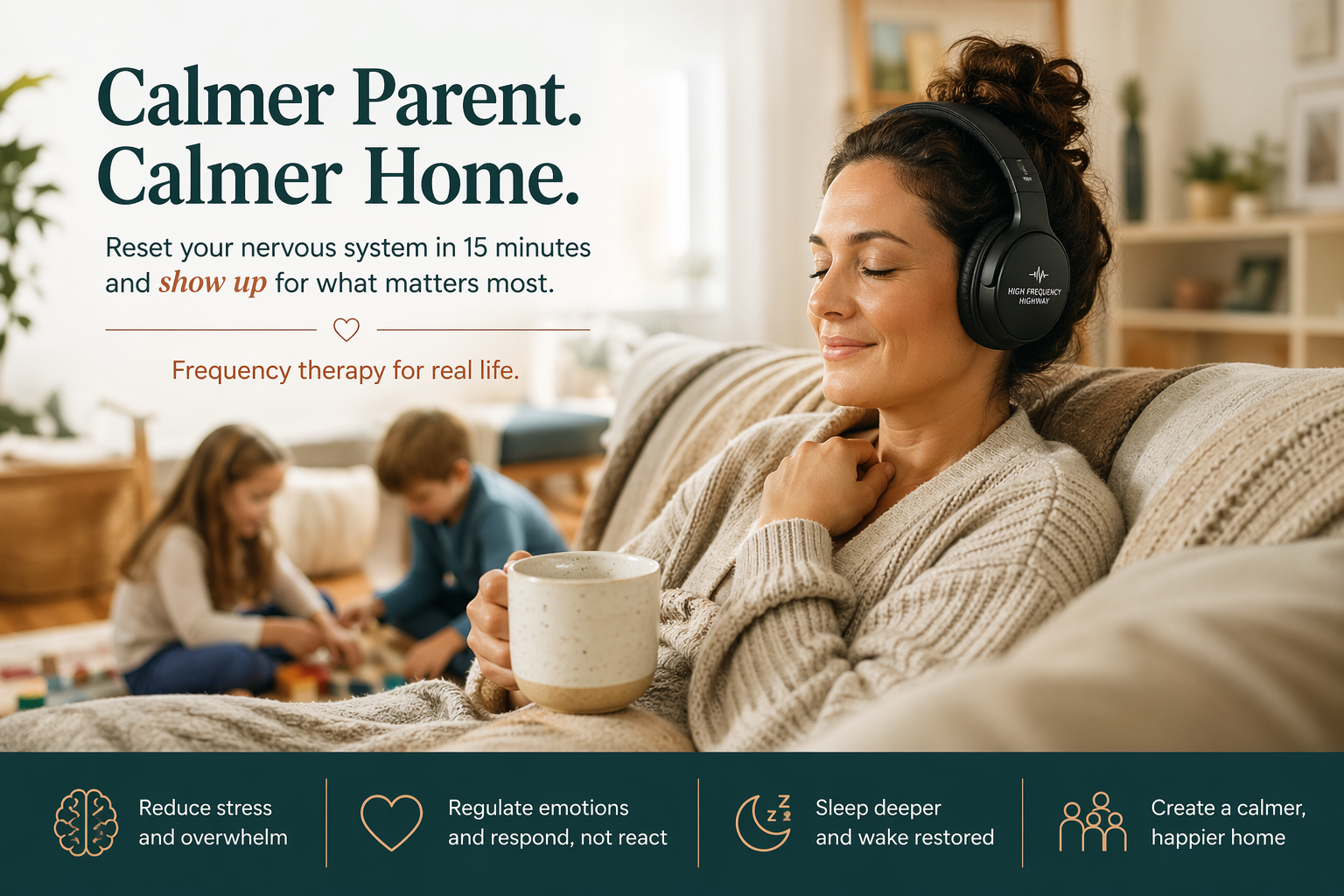
Give yourself 15 minutes with High Frequency Highway Frequency Headphones.
You will feel the difference.
And chances are, your family will too.
Explore High Frequency Highway Frequency Headphones and build a calmer reset ritual that actually fits your life.
Share:
Your Brain on Deadlines: Why Work Anxiety Is Getting Worse and the Sound-Based Reset Professionals Are Using
Why First Responders Can’t Sleep After the Shift, And What Helps the Nervous System Reset