
You’ve heard both:
-
“Work in silence.”
-
“Use sound to focus.”
Both can work.
The better question is: Which one lowers friction for your brain?
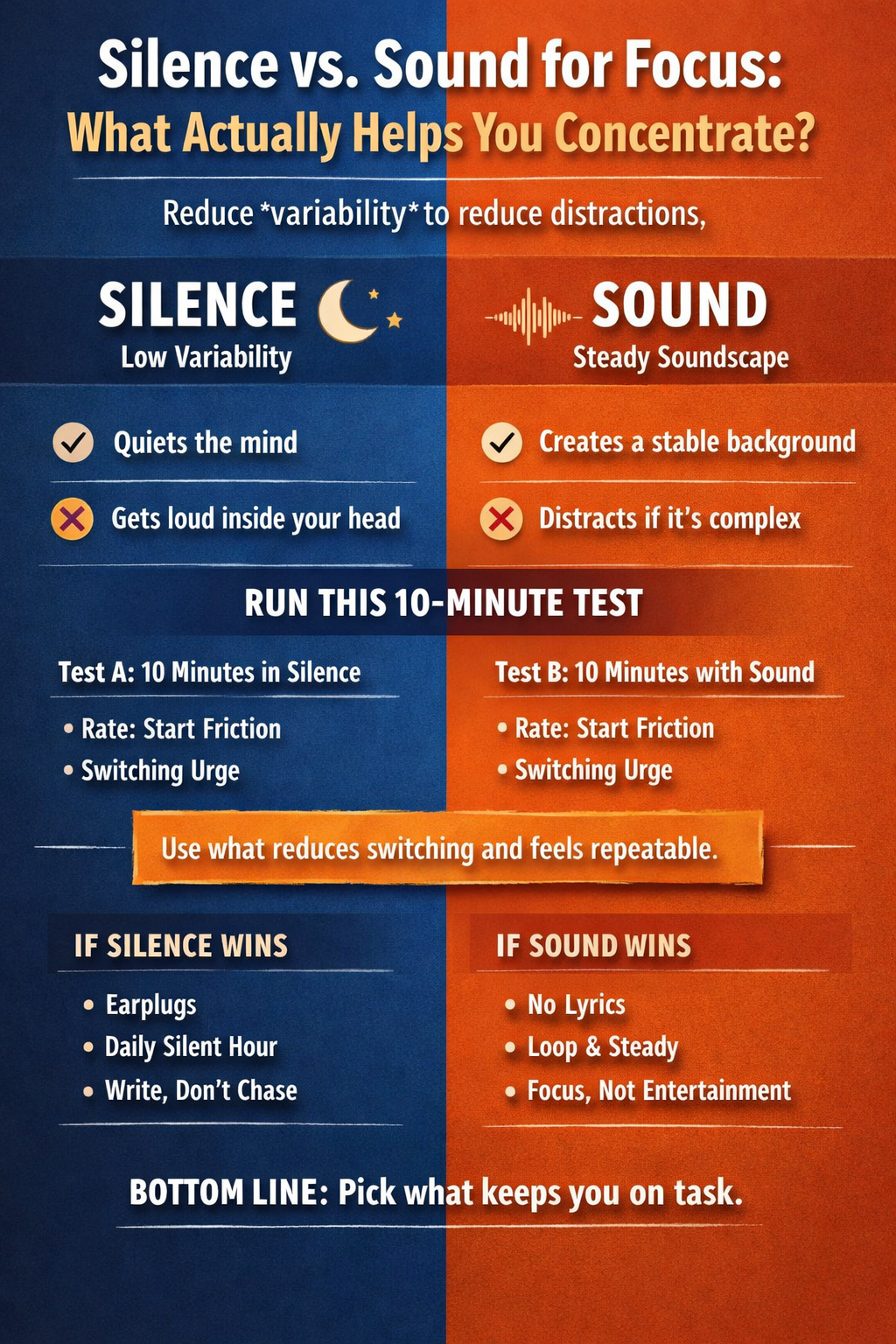
The real issue isn’t silence or sound. It’s variability.
Your brain is constantly predicting what happens next.
When the environment is unpredictable, attention gets taxed.
That’s why:
-
Silence can help (low sensory variability)
-
Silence can also backfire (your internal chatter gets louder)
And:
-
Sound can help (it masks randomness and creates a stable backdrop)
-
Sound can hurt (if it’s complex, lyrical, or constantly changing)
So the goal is simple: reduce switching.
Stop guessing: run this 10-minute self-test
Do this once and you’ll know what works better for you.
Test A — 10 minutes in silence
-
Pick one task
-
Set one timer (10 minutes)
-
No background audio
Rate each from 1–10:
-
Start friction: How hard was it to begin?
-
Switching urge: How often did you want to check something else?
Test B — 10 minutes with a steady soundscape
Use something non-lyrical and consistent:
-
rain
-
ocean
-
pink noise
-
soft ambient
Rate the same two metrics:
-
Start friction
-
Switching urge
The winner
Use the setup that:
-
makes starting easier
-
reduces the urge to switch
-
feels easy to repeat tomorrow
That’s your focus environment.
If silence works for you, make it stronger
Silence helps most when you protect it.
-
Use earplugs in noisy environments
-
Block one “silent hour” each day (same time if possible)
-
Externalize intrusive thoughts: write them down instead of following them
Small rule, big payoff:
Capture the thought. Don’t chase it.
If sound works for you, use it like a tool (not entertainment)
Rule 1: No lyrics
Lyrics compete with language-heavy work (writing, reading, studying).
Rule 2: Choose steady textures
Soundscapes and noise textures are easier to ignore than songs with changing melodies.
Rule 3: Loop it
Looping works better than variety.
Variety grabs attention. Repetition becomes a cue.
Optional: add a subtle structure layer
If you like binaural beats, keep them quiet under a soundscape.
If you don’t notice a benefit, skip them.
No need to force a “hack” that doesn’t help.
Use sound as a boundary, not a reward
Think of your focus audio like a work uniform.
You’re not pressing play to be entertained.
You’re pressing play to signal:
-
distraction mode → off
-
focus mode → on
That mindset shift matters more than the exact track.
Bottom line
Silence is not morally superior.
Sound is not magic.
Use the setup that:
-
reduces switching
-
lowers start friction
-
stays repeatable
That’s the one that will actually improve your concentration.
Never forget this: Try High Frequency Highway
Share:
The Two-Minute Drill for Focus
The Mantra Loop Method