
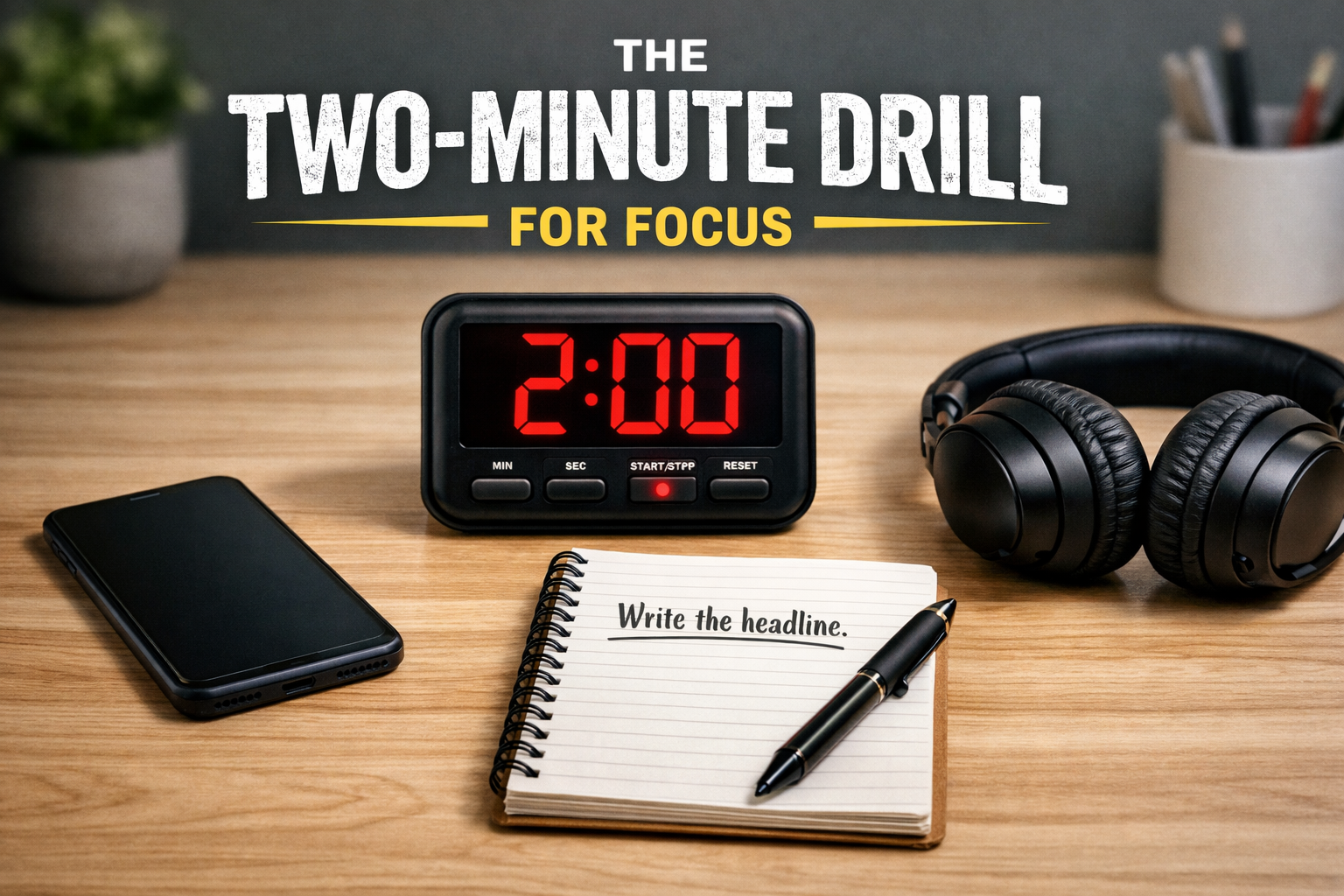
A fast reset for the exact moment your attention breaks
When your attention breaks, most people do one of two things:
-
Push harder → friction, irritation, zero progress
-
Switch tasks → “quick check” becomes a 40-minute detour
There’s a better third move: reset.
Short. Repeatable. Low effort. So you actually do it.
This is a two-minute drill you can run anytime—mid-email, mid-edit, mid-meeting prep—when you feel the drift start.
Why short resets work
You’re not trying to “fix your attention.” You’re trying to re-enter the task.
A tiny reset does three jobs fast:
-
Interrupts the distraction loop (you break the pattern, not “fight it”)
-
Re-anchors your body (posture + breath changes state faster than motivation)
-
Creates a single next action (your brain stops negotiating)
The Two-Minute Drill (set a timer)
0:00–0:20 — Clear the lane
Make the task easier to start by removing friction.
-
Put your phone face down (or out of reach)
-
Close one unnecessary tab/app (not ten—just one)
-
Sit up. Shoulders back. Feet planted. Give your brain “work posture.”
0:20–1:10 — Breath + cue (same cue every time)
Start one consistent audio cue you always use (same track, same soundscape, same tone—no browsing).
Then do 3 smooth cycles:
-
Inhale 4 seconds
-
Exhale 6 seconds
No forcing. You’re signaling “downshift,” not trying to win a breathing contest.
1:10–2:00 — Pick one next action (under 60 seconds)
Write ONE next action you can complete in under a minute:
-
“Write the headline.”
-
“Open the doc and rename it.”
-
“Draft the first two sentences.”
-
“Outline 3 bullets.”
-
“Reply with a one-line yes/no + next step.”
Then do it immediately.
The drill isn’t complete until you move.
Make it stick: one cue, one rule
The magic isn’t the numbers. It’s consistency.
Pick one cue you use every time:
-
the same timer length
-
the same starting posture
-
the same audio track
You’re building a reflex: drift → drill → next action.
Outside-the-box: a “reset playlist” that’s one track
Most playlists create a new problem: choice.
Make it one track. Loop it.
You remove the decision point—and decision points are where focus leaks.
Binaural beats (practical use, not hype)
If you like them, use them as a thin structure layer under your base soundscape—especially for work blocks.
If you don’t, skip them. The drill still works.
Never forget this
If you want a ready-made cue you can loop for resets and work blocks: Try High Frequency Highway:
Share:
The Attention Friction Audit: Find the 5 Leaks Stealing Your Focus (and Fix Them)
Silence vs. Sound for Focus: What Actually Helps You Concentrate?