
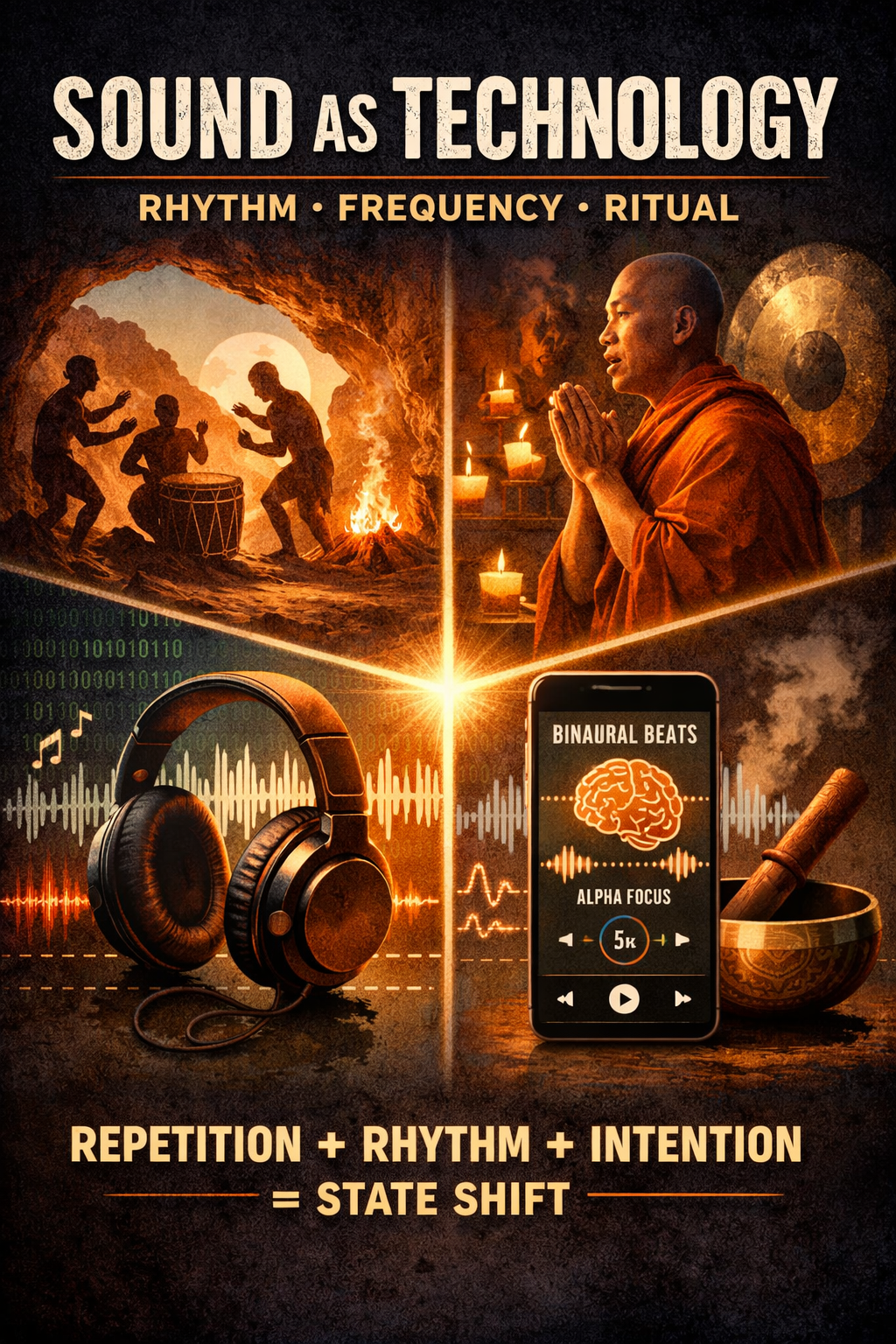
Before apps, before algorithms, before “optimization,” humans used sound to do one thing well: direct attention.
No mysticism required. Just a durable pattern:
Rhythm + repetition + intention changes subjective state.
Different cultures found this through practice, not theory.
1) Rhythm was the first human interface
Drums, claps, footsteps, breath cadence—rhythm is ancient and universal.
Why rhythm works:
-
It gives the mind a predictable frame.
-
Predictability lowers cognitive scatter.
-
Repetition reduces decision load.
In modern terms, rhythm is a constraint.
Constraint cuts noise.
Noise drops, focus rises.
2) Chanting was loop listening before playlists
Monasteries, temples, ceremonies, work songs, marches—repeated vocal patterns are everywhere in human history.
What chanting does in plain language:
-
One phrase replaces many thoughts.
-
The voice becomes a built-in anchor.
-
Shared tempo aligns group attention.
You don’t need belief to observe the effect.
Repeat a phrase for three minutes and your internal chatter usually thins out.
3) Long tones changed the environment, not just the beat
Singing bowls, gongs, drones, horns: many traditions used sustained tones instead of pulses.
Rhythm organizes in time.
Sustained tones organize in space.
Modern takeaway:
-
A continuous tone can function like an auditory room.
-
That room makes it easier to stay with one experience.
-
It helps when attention keeps jumping tabs internally.
If rhythm is a metronome, sustained tone is weather.
4) Recording made ritual portable
Once audio became portable—tapes, CDs, MP3s, streaming—sound moved from communal ceremony to personal protocol.
People started using audio as behavioral scaffolding:
-
Morning priming before deep work
-
Transition tracks between meetings
-
Commute decompression
-
Night wind-down before sleep
This was the real shift: ritual on demand.
5) Binaural beats signaled the design era
Binaural beats (two nearby frequencies, one in each ear) create a perceived internal beat. Some people feel a clear effect; others don’t.
Either way, the cultural move matters:
We’re no longer just choosing songs.
We’re trying to engineer states.
That marks a broader trend: audio is being used less as background and more as a deliberate cognitive tool.
6) A grounded spiritual frame (without the cringe)
If you want a frame that is practical and honest:
-
Attention is finite.
-
Sound can guide attention.
-
Guided attention shapes experience.
That’s enough to justify practice.
5-minute daily protocol (modern + timeless)
Pick one target state: calm, focus, or clarity.
-
Set one intention in a sentence: “For 5 minutes, I train calm.”
-
Choose one track and commit to it.
-
Use headphones if possible.
-
No skipping, no switching, no multitasking.
-
When attention drifts, return to the sound.
Do this daily.
The power is not novelty. The power is repetition.
Bottom line
Humans have always used sound to shape inner experience.
The tools changed; the mechanism didn’t:
repetition + rhythm + intention → state shift
If you want to test it instead of debating it, start with five minutes today.
Try High Frequency Highway
Share:
Build a Sound Stack for Focus (You’ll Actually Use)
The Attention Span Epidemic: A Focus Protocol You Can Run Today