DJs and producers do not just play music.
They move nervous systems.
A great set does not work because the songs are technically correct. It works because the room changes. The bass hits and people stop thinking. The tempo rises and the crowd lifts. A drop lands and strangers move like one body. A sudden silence creates tension before the next wave of sound releases it.
That is frequency in action.
Long before most people had words like brainwaves, nervous system regulation, or audio wellness, music creators were already working with state change. They understood that sound can sharpen attention, loosen emotion, build anticipation, calm a room, or push people into motion.
They may not always describe it clinically.
But they feel it instantly.
That is why DJs, producers, musicians, audio engineers, and serious music fans are often ahead of everyone else when it comes to sound frequency music. They already know the core truth: sound is not decoration. Sound changes the body.
High Frequency Highway takes that same principle and brings it closer to the individual.
Not the crowd.
Not the festival.
Not the studio monitors.
You.
Your focus. Your recovery. Your sleep. Your creative flow. Your reset after too much noise, travel, pressure, or screen time.
This is where frequency technology for creators starts to make sense.
Because creators already understand the power of sound. High Frequency Highway simply makes that power more intentional.
Music Creators Build Emotional Architecture
Every DJ knows the room has a pulse.
Every producer knows a track can feel wrong even when the mix is technically clean.
Every engineer knows a small frequency shift can change the entire emotional texture of a song.
That is not abstract. That is the work.
A kick drum creates weight. A sub-bass line creates pressure. A hi-hat pattern creates urgency. Reverb creates space. Silence creates suspense. Tempo changes the body before the mind catches up.
Music is emotional architecture.
Creators build with rhythm, tone, texture, bass, contrast, and release. They understand that a song is not just something people hear. It is something people enter.
That is why a DJ can move a room without saying a word.
They are reading energy in real time.
When the crowd is scattered, they tighten the rhythm.
When the room is too tense, they open the space.
When attention drops, they rebuild momentum.
When the night peaks, they do not just make it louder. They make it land.
This is the difference between playing songs and shaping states.
The best music creators are not only selecting sound. They are directing attention.
That is also why creators are usually quick to understand frequency wellness. They already know sound has consequences. They have watched people change in front of a speaker system. They have watched a melody bring memory back. They have watched a beat pull someone out of their head and into their body.
Frequency is not a theory to them.
It is Tuesday night in the studio.
It is 2:00 a.m. before a deadline.
It is the crowd before the first drop.
It is the moment a loop finally unlocks the next idea.
From Crowd State to Individual State
For years, frequency has mostly been discussed through music, performance, and entertainment.
But the same principle applies at the personal level.
If sound can shift the energy of a room, it can also shape the energy of a person.
That does not mean every sound creates the same result. A driving club track, a slow ambient pad, a theta meditation, and a deep sleep frequency are not interchangeable. They carry different instructions for the nervous system.
This is the part most people miss.
They talk about music as mood.
Creators understand it as mechanism.
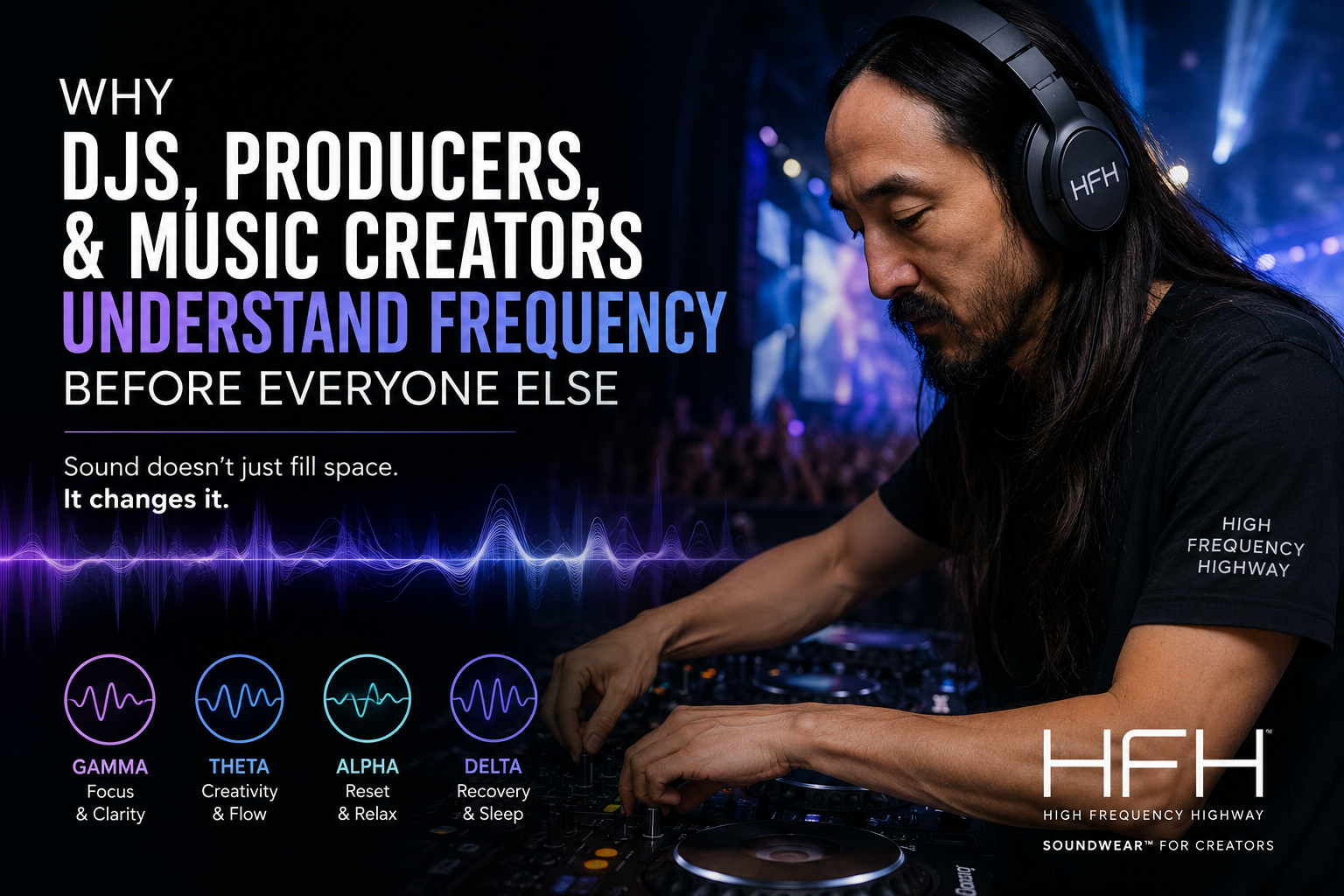
A faster tempo can create activation. A slower rhythm can invite downshifting. A dense mix can stimulate. A minimal soundscape can create space. Certain brainwave-associated frequencies are often used to support different internal states: gamma for focused processing, theta for looseness and idea flow, alpha for reset, delta for deeper recovery.
High Frequency Highway lives in that space.
It is not trying to replace music. It is not trying to turn creativity into a formula. It is taking the creator’s natural understanding of sound and giving it a more personal use case.
Instead of asking, “What should the room feel?”
The question becomes:
“What state do I need to enter right now?”
For creators, that question matters.
Because creative work is not one state. It is several.
Writing requires one kind of focus.
Producing requires another.
Editing requires detail and patience.
Performing requires activation.
Recovery requires release.
Travel requires regulation.
Sleep requires surrender.
One playlist cannot do all of that well.
That is why frequency for creators is not just a wellness trend. It is a workflow tool.
Why Creators Need State Control More Than Most People
Creative work looks flexible from the outside.
From the inside, it is demanding.
A producer may spend hours chasing one sound nobody else will notice consciously, but everyone will feel. A DJ may land in a new city with little sleep and still need to perform at full energy. A musician may move from emotional openness to technical precision within the same session. A content creator may need to write, record, edit, publish, respond, and repeat before the nervous system has had time to reset.
The creator economy rewards output.
But the body still has limits.
This is where soundwear and audio wellness become more than aesthetic categories. They become practical tools for managing attention, energy, and recovery.
For creators, the problem is rarely a lack of ideas.
It is state friction.
You sit down to create, but your mind is still carrying the last meeting.
You open the session, but the idea will not land.
You finish a performance, but your body is still wired.
You travel across time zones, but your nervous system has not arrived.
You try to sleep, but your brain is still mixing, editing, planning, replaying.
Sound can become a bridge between the state you are in and the state your work requires.
That is the real promise of frequency technology for musicians and creators.
Not magic.
Not hype.
A cleaner transition.
A way to use sound intentionally before, during, and after creative work.
How Creators Can Use Frequency Before, During, and After Work
The easiest way to understand frequency is not through theory.
It is through timing.
Different creative moments require different states.
Before deep work: gamma-style focus
Before writing, editing, producing, mixing, designing, or planning, creators need clean attention.
This is where gamma-focused sessions can be useful. Gamma is often associated with high-level processing, concentration, and cognitive integration. For a creator, the goal is simple: reduce mental noise and enter the work faster.
Use it before opening the DAW.
Use it before scripting.
Use it before editing a podcast.
Use it before a focused 60-minute creative sprint.
The point is not to force creativity.
The point is to create a cleaner entry point.
During idea generation: theta-style looseness
Not every creative block needs more pressure.
Sometimes the mind is too tight.
Theta is often connected with meditation, imagery, and relaxed internal attention. For creators, that can be valuable when the work needs openness instead of control.
Use it when brainstorming hooks.
Use it when exploring melodies.
Use it when writing first drafts.
Use it when the idea feels close but not yet reachable.
This is not the “finish the task” state.
This is the “let something emerge” state.
After long sessions: alpha-style reset
Long creative sessions create residue.
Even when the work goes well, the system can stay activated. You close the laptop, but the mind keeps looping. You finish the mix, but the body still feels plugged into the session.
Alpha is commonly associated with relaxed alertness. It can be used as a reset between states.
After editing.
After client calls.
After a live stream.
After hours of headphones, screens, and decisions.
Alpha is useful because creators do not always need to collapse into sleep. Sometimes they just need to come back to baseline.
After performance or travel: delta-style recovery
Performance is expensive.
So is travel.
A DJ set, a live show, a long studio night, or a multi-city creator schedule can leave the body overstimulated long after the work is done. Delta is associated with deep sleep and restoration, which makes it a natural fit for post-event recovery routines.
Use it after late nights.
Use it after flights.
Use it after high-output days.
Use it when the body is tired but the brain is still awake.
For creators, recovery is not separate from the work.
It protects the next session.
Why Steve Aoki-Style Creator Validation Matters
When someone like Steve Aoki connects with a frequency brand, it matters culturally because he represents the exact world where sound, performance, energy, and human state collide.
But the bigger story is not one person.
The bigger story is pattern recognition.
Music creators are usually early to this category because they already live inside frequency. They know sound can move people. They know energy is not imaginary. They know a room can shift in seconds when the right sonic decision lands.
So when creators notice frequency technology, it is not random.
It is alignment.
They are seeing a familiar principle applied in a new way.
High Frequency Highway is not asking creators to believe in sound. Creators already do. The product simply gives them a more direct way to use it for their own state.
That is what makes this moment important.
Frequency wellness is moving out of the abstract and into daily use.
Not as background music.
As intentional sound.
As soundwear.
As a tool for focus, recovery, meditation, sleep, and creative flow.
The Future of Sound Is Personal
The next evolution of music and audio will not only be about better speakers, cleaner headphones, or higher-quality files.
It will be about state.
What do you want sound to help you do?
Focus before a session.
Reset after a deadline.
Open your mind before writing.
Recover after performing.
Sleep after overstimulation.
Regulate your body when the world gets too loud.
That is the shift.
Sound is no longer only something we consume.
It is something we can use.
DJs and producers understood this before everyone else because their work depends on it. They know sound can turn strangers into a crowd, tension into release, silence into anticipation, and rhythm into movement.
Now that same intelligence is moving from the stage to the individual.
From the room to the body.
From entertainment to intentional practice.
Creators have always known the truth:
Sound does not just fill space.
It changes it.
High Frequency Highway exists for the people ready to use that truth with purpose.
Explore High Frequency Highway frequency headphones and start using sound intentionally before, during, and after your creative work.
FAQ
What frequency helps creativity?
Different frequencies are often used for different creative states. Gamma-style frequencies are commonly associated with focus and cognitive processing, while theta-style frequencies are often used for looser, more meditative idea flow. The best choice depends on whether you need precision, openness, reset, or recovery.
Can sound help focus?
Sound can help create a focused environment by reducing distraction, shaping attention, and giving the brain a consistent auditory anchor. Many creators use specific soundscapes, binaural beats, or frequency-based audio before deep work to enter a more intentional state.
What is soundwear for creators?
Soundwear for creators refers to audio tools designed to support focus, recovery, meditation, sleep, and creative flow. Instead of using headphones only for listening to music, creators can use soundwear as part of their workflow to shift states before, during, and after creative work.
Share:
From Sound Bowls to Soundwear: Why Music Culture Is Moving Toward Frequency
Why Fighters and High-Adrenaline Performers Need Better State Control