
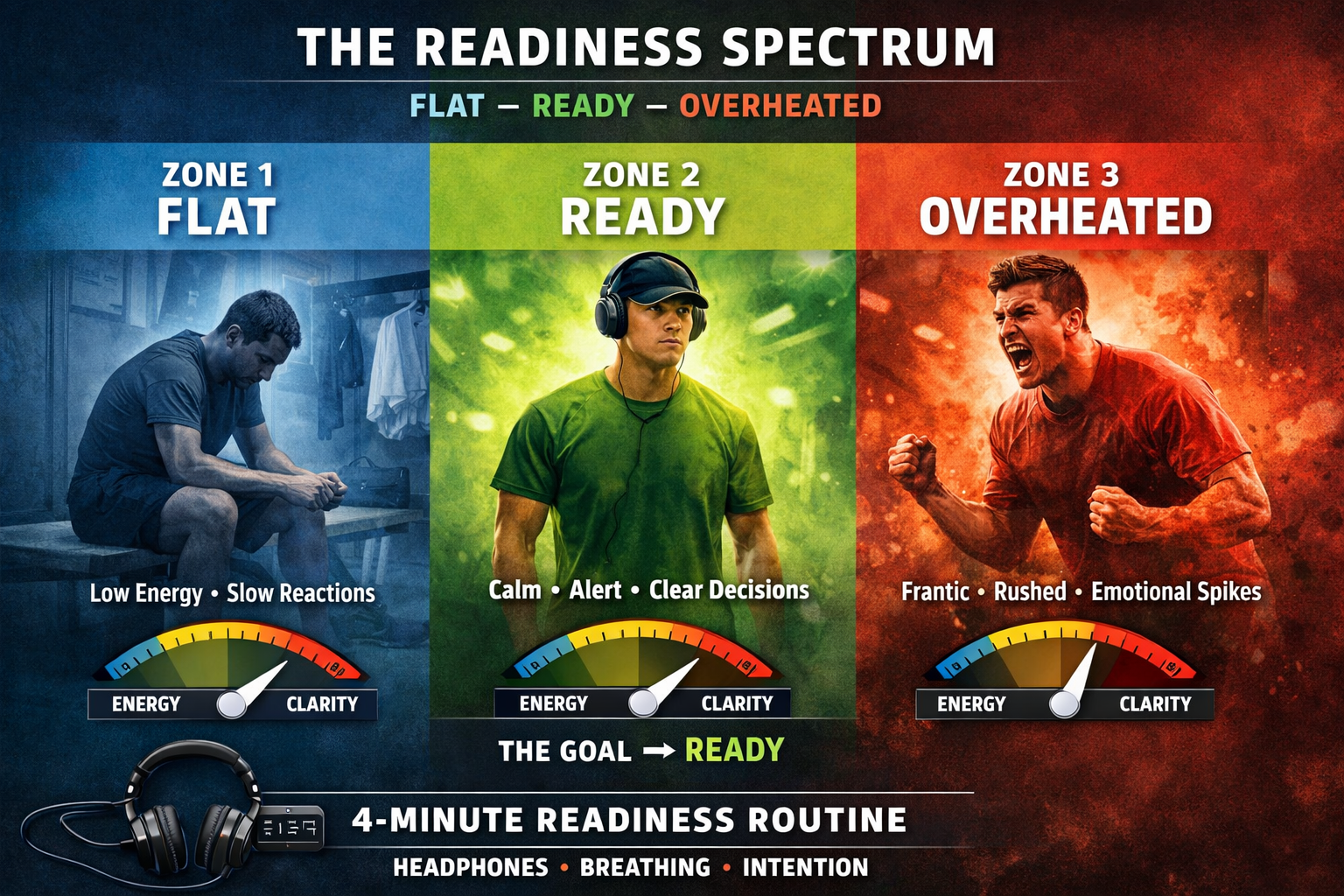
A lot of teams carry a quiet assumption: if we crank the energy, performance rises.
Sometimes it does.
And sometimes it produces the ugliest version of your team: rushed decisions, forced plays, emotional spikes, dumb penalties.
Because hype isn’t focus.
It’s just energy without steering.
The best programs treat readiness like a state—and they train state control like any other skill: measure it, name it, shift it.
The readiness spectrum (coach-friendly, no jargon)
Think in three zones:
Zone 1 — Flat
-
low energy
-
slow reactions
-
casual body language
-
“I’m here, but I’m not in it.”
Zone 2 — Ready
-
calm, alert
-
quick reads
-
clean communication
-
“I can see it and execute it.”
Zone 3 — Overheated
-
frantic tempo
-
rushed choices
-
emotional volatility
-
“I’m trying too hard… and I’m leaking points.”
The goal isn’t “high.” The goal is “ready.”
High energy is only useful when it stays attached to clarity.
The 10-second check-in that changes a program
Before practice or a game, ask every athlete for two numbers:
-
Energy (1–10)
-
Clarity (1–10)
That’s it. No speeches. No therapy circle.
You’re not hunting perfect honesty. You’re collecting trend data:
-
Who runs hot every day (high energy, low clarity)?
-
Who lives flat (low energy, low urgency)?
-
Who swings wildly based on pressure, opponents, or mistakes?
Actionable read:
-
Overheated profile: Energy 8–10 / Clarity 3–6 → prone to forcing, arguing calls, rushing reps.
-
Flat profile: Energy 2–5 / Clarity 4–7 → late reactions, low physical intent, quiet leadership.
When you see the pattern, you stop guessing. You start coaching state.
The missing piece: a standard way to move zones
Most teams are great at telling athletes what they should be.
Very few give them a reliable way to get there.
That’s why routines work. Not because they’re cute. Because they’re repeatable under stress.
And one of the cleanest triggers for a routine is sound—not as a magic trick, but as a consistent start signal.
Why sound works (the real reasons)
Sound helps because it creates:
-
predictability (same cue = same shift)
-
a boundary from chaos (locker room noise stops owning your nervous system)
-
a consistent “start” (no waiting for motivation)
If your athletes already use headphones, you’re not adding a new habit—you’re aiming an existing one.
How to use sound to stabilize readiness (one tool, two dials)
This is simple: same tool, different setting.
If an athlete is overheated (Zone 3):
-
steady loop / calming track
-
slow exhale breathing (longer out-breath tells the body “we’re safe”)
-
posture: shoulders down, jaw loose
-
intent: “I play simple. I see first.”
If an athlete is flat (Zone 1):
-
slightly more energizing soundscape
-
posture: tall spine, eyes up
-
intent: “First three minutes: win space / win contact / win the next decision.”
The point is not the playlist. The point is the protocol.
A program-wide routine (4 minutes, plug-and-play)
Run this before warm-ups. Every day. Same order.
-
Headphones on
-
2 minutes sound loop (chosen for the zone you’re shifting from)
-
1 minute breathing: inhale 4, exhale 6
-
1 minute intention: “I win by ___.” (one concrete behavior)
Examples of “I win by ___” that actually work:
-
“First step on defense.”
-
“Talk early.”
-
“Rebound and outlet.”
-
“Next play face.”
-
“Hands high, feet calm.”
Then warm-up. No extra talk needed.
What this looks like on a real team
-
The kid who starts every game with two rushed turnovers? You’ll usually see Energy 9 / Clarity 4. Treat it like a skill gap, not a personality flaw.
-
The athlete who’s “fine in practice” but disappears in competition? You’ll often see Energy 4 / Clarity 6—flat, not ready. Give them a warm-up that raises intent, not just heart rate.
-
The team that plays its best after a timeout? That’s a state reset. You’re just systematizing it before the damage.
Why Athletic Directors should care
Inconsistency is expensive. It costs:
-
wins
-
athlete confidence
-
coach trust
-
program reputation
Standardizing readiness is a high-leverage upgrade because it scales:
-
across teams
-
across coaching styles
-
across pressure environments
-
without adding practice time
You’re building a program that can self-regulate. That’s culture you can measure.
Bottom line
Don’t chase hype.
Track readiness. Train the shift.
The best teams don’t “hope to feel right.” They run a system that gets them there.
Never forget this: Try High Frequency Highway:
Share:
Noise, Nerves, and the Free Throw Problem: Training Calm Under Pressure
Binaural Beats for Sports Performance? A No-Hype Guide for Coaches