
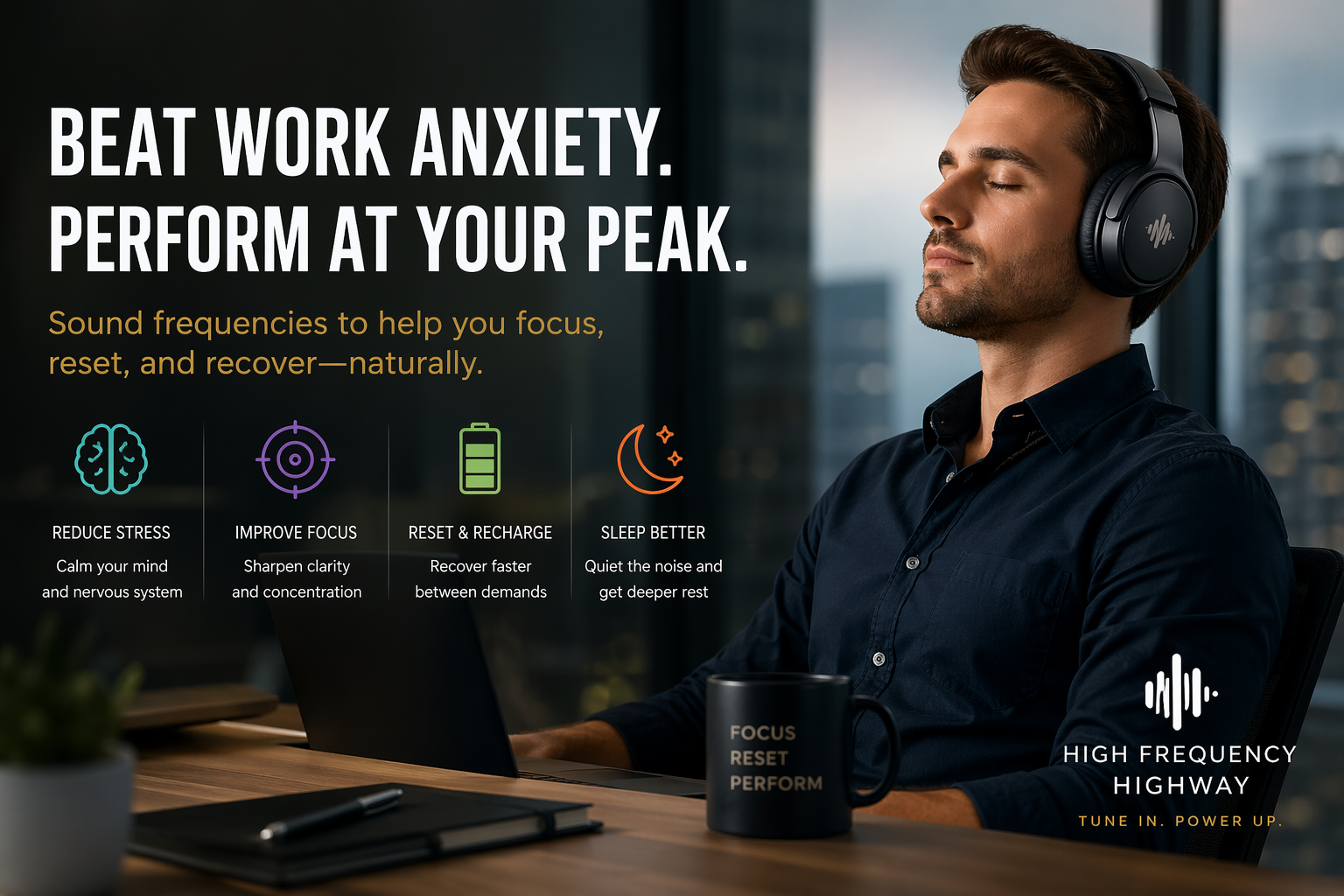
Work anxiety is rising fast, especially for professionals carrying constant deadlines, decision fatigue, and AI-era uncertainty. Here is a grounded look at how sound-based frequency sessions can support focus, recovery, and a healthier workday rhythm.
Sunday night.
9:07 PM.
Your laptop is closed, but your mind is still open in twelve tabs.
You are replaying tomorrow’s presentation. Rewriting a Slack message you already sent. Thinking about the email you forgot to answer. Wondering whether your role will still look the same in a year now that AI is changing how work gets done.
You are tired, but not off.
You are home, but not recovered.
That is what work anxiety looks like for a lot of high-performing professionals now. Not a dramatic breakdown. Not an obvious crash. Just a constant, low-grade hum of pressure that follows you from your desk to dinner to bed.
And it is more common than most people admit. SHRM found that 31% of U.S. workers say they feel stressed because of their job often or always. APA’s Work in America research found that 57% of workers reported negative effects tied to work-related stress, and APA’s 2025 survey also found that job insecurity is a significant stressor for 54% of workers. On top of that, Pew reported that 52% of workers are worried about the future impact of AI in the workplace.
So when people ask, “How do I stop feeling anxious about work?” the real answer is not “just manage your time better.”
Because the problem is not only your calendar.
It is your state.
The anxious professional brain is not broken. It is overloaded.
Most ambitious professionals do not struggle because they are weak. They struggle because their brain never gets a clean handoff between performance mode and recovery mode.
Think about the average workday:
You wake up and check email before your feet hit the floor.
You jump between meetings, chats, decisions, and micro-crises.
You context-switch all day.
You stay mentally “on” long after your output quality starts dropping.
That creates a familiar pattern:
You feel wired, but unfocused.
You feel tired, but you cannot slow down.
You procrastinate, not because you are lazy, but because your system is overloaded.
You sit down to rest, but your mind keeps rehearsing, scanning, and bracing.
This is why so many smart professionals keep asking, “Why am I always stressed about work?” or dealing with what feels like decision fatigue anxiety.
At a certain point, it is not about motivation. It is about cognitive load.
SHRM’s 2025 workplace mental health data points to workload, pay pressure, and poor leadership or management among the leading contributors to workplace stress. That matters because it confirms what many professionals already feel: the issue is not imaginary, and it is not purely personal. The structure of modern work is stressful by design.
The problem is that your body does not care whether the threat is a tiger or a calendar. If your system reads constant demand, constant uncertainty, and constant performance pressure, it stays activated.
That activation leaks into everything:
Poor sleep
Shorter patience
More irritability
Lower creativity
Slower recovery
Harder transitions
More mental noise during moments that should feel calm
This is where a lot of workplace stress advice falls flat. It tells people to meditate more, breathe more, journal more, or “create boundaries,” which sounds nice until you are staring at a full inbox five minutes before a leadership call.
Professionals do not just need more advice.
They need tools that help them change state faster.
Workplace stress in 2026 is fueled by uncertainty as much as effort
A lot of professionals can handle hard work. What drains them is hard work plus ambiguity.
Am I doing enough?
Am I falling behind?
Will my role change?
Will AI replace part of what makes me valuable?
Am I actually resting, or just pausing before the next demand?
That uncertainty is not theoretical anymore. APA reported that job insecurity is a significant stressor for a majority of workers, and among workers ages 26 to 43, that number is even higher. Pew’s data on AI in the workplace shows that workers are more worried than hopeful overall about AI’s future effect on work.
This is why workplace stress relief needs a more practical frame.
Not “How do I become a calmer person forever?”
More like: “How do I regulate my system well enough to think clearly under pressure, recover between demands, and stop bringing work brain into every part of my life?”
That is a better question.
And it is exactly where sound-based tools have become interesting.
What frequency headphones are really doing for professionals
Let’s strip away the fluff.
Frequency headphones are not magic.
They are not a cure for burnout.
They are not a replacement for therapy, sleep, better management, or a healthier workload.
What they can be is a fast, repeatable way to support state shifts.
That matters because most professionals are not failing at performance. They are failing at transitions.
They do not know how to move cleanly from:
sleep to focus
meeting to reset
work mode to home mode
mental tension to actual rest
This is where rhythmic audio, binaural beats, and brainwave-oriented listening protocols enter the picture.
The research is promising, but it should be described honestly. Reviews suggest binaural beat stimulation may help with anxiety and some aspects of cognition in certain settings, and newer studies have reported improvements in working memory under some alpha- and gamma-related protocols. At the same time, the evidence base is still mixed, methods vary widely, and exact frequency-specific claims should not be overstated. In other words: useful support tool, not miracle intervention.
That honest framing is exactly why frequency headphones can work for this audience.
Because the best professionals are not looking for hype.
They are looking for leverage.
They want something they can use:
before deep work
between calls
after high-pressure meetings
at the end of the day
before sleep
They want something that does not ask for a 45-minute ritual.
They want something they can actually repeat.
That is the practical value of a tool like High Frequency Highway.
Not that it turns you into a different person.
That it helps you stop staying in the same state all day.
A better way to think about frequency sessions: state switching
The cleanest way to position this is not “one magical frequency fixes everything.”
It is this:
Different audio sessions can support different mental modes.
You can use a more alert, steady track when you need to lock in.
You can use a softer, slower session when you need to come down from cognitive overdrive.
You can use an evening session when your brain will not stop replaying the day.
That is how professionals should think about frequency headphones: less like entertainment, more like a mental warm-up and cool-down system.
Athletes do not train hard and then just hope their body recovers.
They follow protocols.
Knowledge workers need the same mindset.
Because if your job requires focus, presence, emotional control, judgment, communication, and creative problem-solving, then your mental state is not a side issue.
It is infrastructure.
Why High Frequency Highway fits the professional use case
Most wellness tools fail at work because they create friction.
They ask too much time.
They feel too abstract.
They rely too heavily on motivation.
They are hard to use consistently inside a real schedule.
High Frequency Highway works better as a professional tool when it is framed around efficiency.
Use it at your desk during a focused work block.
Use it between meetings when your mind feels scattered.
Use it after work when your body is home but your brain is still in the office.
Use it before bed when your thoughts keep reloading tomorrow before today is even done.
That is where the value shows up.
Not in theory.
In transitions.
A strong product in this category is not selling “peace.”
It is selling faster recovery, cleaner focus, and less drag between one part of the day and the next.
That is a much smarter promise.
The anxious professional’s daily frequency protocol
Here is a practical way to use frequency headphones without turning your workday into a wellness project.
7:30 AM — 10 minutes before opening email
Start with a session built for calm alertness. The goal is not to hype yourself up. It is to begin the day steady instead of reactive.
10:30 AM — deep work block
Use a more focus-oriented track when you need concentration, writing, analysis, strategy, or presentation prep. This works best when paired with one task, one window, one objective.
12:30 PM — reset between work halves
Instead of scrolling during lunch, use a short reset session. This can help create an actual break in the nervous system instead of a fake break where your eyes leave the screen but your mind stays activated.
3:30 PM — post-meeting recovery
If you have been in back-to-back calls, this is where many professionals quietly crash. A short session here can help reduce mental residue so you do not carry one meeting into the next five decisions.
5:30 PM — transition out of work brain
This is one of the most overlooked moments in the day. Most people do not end work. They just stop typing. Use a decompression session to create a real handoff into evening mode.
9:30 PM — before sleep
If your brain tends to replay emails at 2 AM, make this part of the routine. The goal is not sedation. It is reducing cognitive momentum before bed.
The key is consistency, not intensity.
You do not need to listen for hours.
You need repeatable signals that teach your brain and body when to focus, when to downshift, and when to let go.
Frequency headphones vs meditation apps vs sleep supplements
If someone is looking for the best tool for work stress relief in 2026, the better question is not “Which is best overall?” It is “Which works best for the moment I am actually in?”
Frequency headphones
Best for: fast state shifts during a real workday
Strength: low effort, easy to repeat, useful for focus and decompression
Tradeoff: works best as a support tool, not a standalone solution
Meditation apps
Best for: building long-term awareness and emotional regulation
Strength: strong habit-builder over time
Tradeoff: harder to use when you are already overloaded and impatient
Sleep supplements
Best for: occasional support at night
Strength: can help with short-term sleep issues
Tradeoff: does little for daytime focus, work anxiety, or the transition out of performance mode
That is why many professionals end up using multiple tools.
But frequency headphones occupy a useful lane because they are fast, portable, and easy to insert into real life.
For busy professionals, ease matters.
If a tool is hard to use on a Tuesday, it is not a real solution.
The real advantage is not working harder. It is recovering better.
Top performers do not stay sharp because they push endlessly.
They stay sharp because they know how to reset before stress becomes identity.
They know the difference between being committed and being constantly activated.
They know that focus is not just effort. It is regulation.
They know that if they never leave work mode, the quality of their work eventually drops anyway.
That is the hidden cost of anxiety at work.
It does not just make you feel worse.
It makes you think worse.
So if you want to reduce work anxiety naturally, start there.
Not with guilt.
Not with another productivity hack.
Not with the fantasy that one perfect morning routine will fix a broken rhythm.
Start with state.
If your brain is asked to perform at a high level every day, then it needs better transitions, better recovery, and better tools.
That is where High Frequency Highway can earn its place.
Not as a trend.
As a repeatable system for helping ambitious people focus better under pressure, reset faster, and stop taking work brain everywhere they go.
Try High Frequency Highway frequency headphones and feel what a targeted sound session can do for your focus, recovery, and end-of-day reset.
Share:
Why Nurses Can’t Turn Off Their Brains After Work, and the Frequency-Based Solution That Actually Helps
Your Brain on Deadlines: Why Work Anxiety Is Getting Worse and the Sound-Based Reset Professionals Are Using