
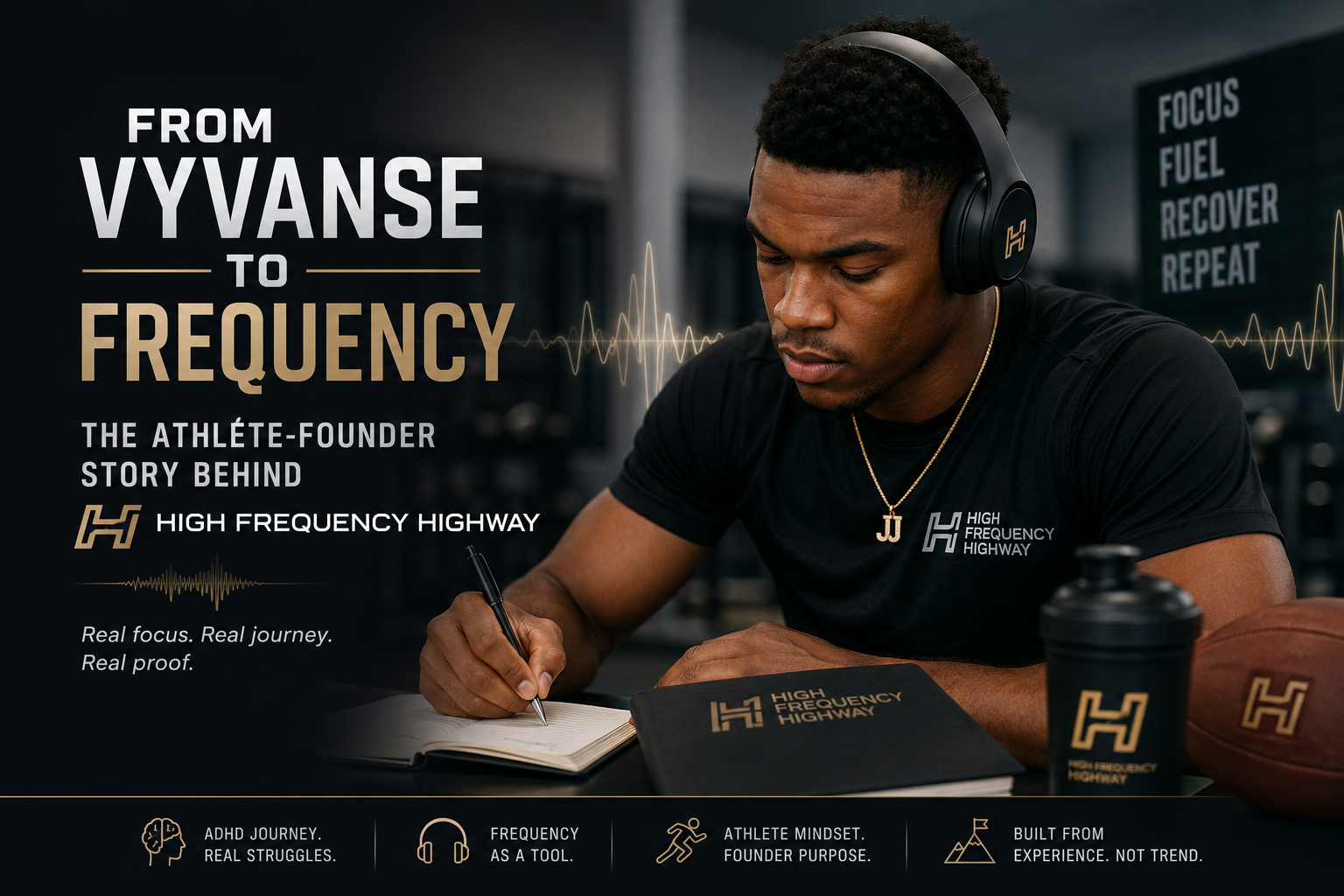
Focus was helping J Johnson Jr move forward.
But it was also creating a new problem.
After being diagnosed with ADHD, J was prescribed Vyvanse. In his experience, the medication helped him concentrate, stay on task, and manage the mental friction that had made focus difficult.
The tradeoff showed up somewhere he could not ignore: his appetite.
For many people, eating less might sound manageable. For an elite athlete, it can affect everything. Training quality. Energy. Recovery. Strength. The ability to perform when the body is under pressure.
J was trying to build a future that demanded both mental focus and physical readiness. He did not want to choose between the two.
That tension became the starting point for High Frequency Highway.
Not a wellness trend. Not a branding exercise. Not a product category invented in a conference room.
A lived problem.
J began looking for natural focus support that could help him shift his mental state without asking his body to absorb another cost. That search eventually led him to frequency technology and, later, to the company he would build around it.
High Frequency Highway exists because its founder needed the product before he ever thought about selling it.
When Focus Has a Personal Cost
ADHD is commonly described through symptoms: difficulty concentrating, impulsivity, restlessness, disorganization, or trouble completing tasks.
Those descriptions are accurate, but they do not always capture the lived experience.
For J, the challenge was not a lack of ambition or effort. He knew what he wanted to do. The difficulty was getting his mind to stay connected to the task long enough to execute.
That gap can be exhausting.
You can care deeply about an assignment, workout, business idea, or responsibility and still struggle to begin. You can understand exactly what needs to happen and still feel unable to organize your attention around it. You can spend hours trying to force focus, then blame yourself when pressure fails to produce it.
Medication became one tool for closing that gap.
J’s experience with Vyvanse was not simply negative. It helped him focus. That matters.
But the appetite changes created a conflict with the demands of athletic performance. His body needed consistent fuel. Training required energy. Recovery required nutrition. Progress required repetition.
The very tool supporting one part of his performance appeared to be complicating another.
This article is not an argument against prescribed medication. ADHD treatment is personal, and medication can be valuable for many people. Decisions about starting, stopping, or changing medication should be made with a qualified medical professional.
J’s story is narrower and more personal.
He needed to explore whether another form of support could fit alongside the demands of the life he was building.
The Athlete’s Dilemma
Elite performance is not powered by motivation alone.
Athletes must manage multiple systems at once:
- Attention during practice
- Energy during competition
- Nutrition throughout the day
- Recovery between sessions
- Sleep at night
- Emotional control under pressure
A tool that improves one system but disrupts another can create a difficult decision.
J was not searching for an easier path. He was looking for a more sustainable one.
The goal was not to become permanently locked into a high-intensity state. That would be neither realistic nor useful. Athletes need activation before performance, composure during pressure, recovery after exertion, and sleep when the work is done.
The deeper need was state control.
Could he become more intentional about moving between focus, calm, recovery, and rest?
Could sound support those transitions?
Could he build a routine that helped him prepare his mind without pretending one tool could solve everything?
These questions moved J toward frequency technology.
Discovering Frequency as a State-Support Tool
Frequency technology offered J a different framework.
Instead of treating focus as a personality trait you either possess or lack, it encouraged him to think about focus as a state that can be supported.
That distinction shaped everything that followed.
High Frequency Highway uses audio experiences designed around different mental states and intentions. Rather than promising to treat ADHD, the technology is positioned as a tool that may support a person’s environment, routine, and ability to transition into the state a task requires.
Different frequency ranges are commonly associated with different use cases:
- Beta-oriented sessions are positioned for alertness, concentration, and task engagement.
- Gamma-oriented sessions are often used when someone wants an intense, mentally active focus experience.
- Alpha-oriented sessions are positioned for calm, reset, and relaxed attention.
- Delta-oriented sessions are designed around deep rest and sleep routines.
These are not medical treatments or guaranteed biological outcomes. The practical value is simpler: audio can become a repeatable cue.
Put on the headphones.
Choose the state you are trying to support.
Reduce competing input.
Begin the task.
Over time, the ritual itself can become useful. The sound signals that it is time to work, recover, settle, or sleep.
For J, frequency was not attractive because it promised a miracle. It was attractive because it gave him another way to work with his state intentionally.
From Personal Experiment to Founder Proof
Many wellness companies begin with a market opportunity.
High Frequency Highway began with founder-product fit.
J was the first person who needed the solution. He was also the first person responsible for testing whether it belonged in a demanding life.
That distinction matters.
A founder can study customer behavior from a distance. J lived inside the problem.
He understood what it felt like to need focus while protecting appetite. To pursue athletic performance while managing ADHD. To require energy during the day and recovery at night. To know the desired state without always being able to access it on command.
That lived experience shaped the product philosophy.
High Frequency Highway was not built to tell people that discipline does not matter. It was built around the understanding that discipline is easier to apply when your environment supports the state you need.
The company does not position frequency technology as a cure for ADHD.
It does not claim that headphones should replace medical care.
It does not suggest that a sound session can replace sleep, nutrition, training, planning, or professional support.
The product plays a narrower role: intentional state support.
That role may be especially relevant for people who are searching for non-stimulant focus tools they can incorporate into an existing routine.
What Natural Focus Support Actually Means
“Natural focus support” can easily become vague marketing language.
In practice, it should mean something concrete.
It might mean creating a stronger separation between distraction and deep work. It might mean using a consistent audio cue before studying. It might mean choosing a focus session instead of filling the background with unpredictable content. It might mean using a calming session when stress is interfering with concentration.
Natural does not mean medically superior.
It does not mean universally effective.
It does not mean risk-free or appropriate for every person.
It means the tool is non-pharmaceutical and can be used as part of a broader routine.
For someone with ADHD, that routine might also include medical care, prescribed medication, therapy, exercise, sleep support, structured planning, environmental changes, or accountability.
High Frequency Highway is designed to sit within that larger system, not replace it.
That is the responsible way to understand frequency for focus: not as a treatment, but as one possible layer of support.
Why the Founder Story Matters
Consumers are right to question wellness products.
The industry is crowded with dramatic promises, vague science, and solutions designed to sound more powerful than the evidence behind them.
A founder story does not prove that a product will work for everyone.
But it can reveal why the product exists, what problem shaped it, and how carefully its claims should be interpreted.
J did not approach frequency technology as an outsider searching for a profitable trend.
He approached it as an athlete with ADHD trying to solve a conflict in his own life.
He needed focus.
He needed to eat.
He needed to train.
He needed to recover.
He needed a way to support different states without pretending that human performance could be reduced to a single switch.
That became the foundation of High Frequency Highway.
The founder story and the product story are inseparable because the company was built from the exact tension the product is designed to support.
How to Use Frequency Headphones for Focus
Frequency headphones are most useful when they are connected to a specific intention.
A simple focus routine might look like this:
1. Define the task
Do not begin with “I need to be productive.”
Choose a clear target:
- Read ten pages
- Complete one workout block
- Write the introduction
- Review one chapter
- Finish one client deliverable
The brain works better with a defined finish line than with a vague demand.
2. Choose the state
Ask what the task requires.
Do you need alert concentration? A beta- or gamma-oriented session may fit.
Are you mentally overstimulated and unable to settle? An alpha-oriented reset may be more appropriate before attempting intense work.
Are you preparing for sleep and recovery? A delta-oriented session may fit that routine better than a focus track.
More stimulation is not always the answer. The useful state depends on the problem in front of you.
3. Reduce competing inputs
Put the phone away.
Close unnecessary tabs.
Remove visual clutter.
Frequency audio should support attention, not compete with five other sources of stimulation.
4. Use a defined work period
Start with a manageable block, such as 20 to 45 minutes.
The goal is not to prove that you can focus indefinitely. It is to create a repeatable entry point into focused work.
5. Track your response
Notice what changes.
Did you start faster?
Did you stay with the task longer?
Did you feel calmer, more alert, or more distracted?
Personal observation matters. A tool is only useful when it supports the person using it.
A Company Built Around Intentional State Control
High Frequency Highway grew from one founder’s need, but the underlying problem extends far beyond athletics.
Students need to move from distraction into study.
Founders need to move from noise into clear decision-making.
Parents need moments of reset inside demanding days.
Athletes need focus before competition and recovery afterward.
People with ADHD may need more support moving between intention and execution.
Different lives. Similar challenge.
Knowing the state you need is not the same as being able to access it.
High Frequency Highway was built to help make that transition more intentional.
The headphones do not perform the work for you. They do not replace the habits that sustain performance. They do not remove the need for medical care when medical care is appropriate.
They create a focused audio environment designed around what you are trying to do next.
That is the promise: not perfection, but support.
The Walking Proof Behind High Frequency Highway
J Johnson Jr remains central to the High Frequency Highway story because he represents the problem in full.
He is not only a founder who talks about focus.
He is someone who has lived with ADHD, used prescribed medication, experienced a personal tradeoff, competed as an elite athlete, searched for another form of support, and built a product around what he discovered.
That does not make him proof that frequency technology will affect every person in the same way.
It makes him proof that the company was built from genuine need.
High Frequency Highway did not begin with a claim that sound could solve everything.
It began with a more honest question:
Can we create tools that help people support the state they need without pretending one method fits every mind, body, or life?
For J, that question changed his direction.
For High Frequency Highway, it became the mission.
Explore High Frequency Highway frequency headphones for natural focus support and more intentional state control.
Frequently Asked Questions
Can frequency headphones treat ADHD?
No. High Frequency Highway frequency headphones are not intended to diagnose, treat, cure, or prevent ADHD or any other medical condition. They are designed as a non-pharmaceutical tool that may support focus routines, relaxation, recovery, and intentional state changes.
Should I stop taking ADHD medication before using frequency headphones?
No. Do not stop, reduce, or change prescribed medication without consulting the qualified medical professional responsible for your care. Frequency headphones should not be treated as a replacement for prescribed medication or professional support.
Can frequency headphones be used with ADHD medication?
Some people may choose to use sound-based focus tools as part of a broader routine that includes medication. Questions about your personal circumstances should be discussed with a qualified healthcare professional.
Which frequency is associated with focus?
Beta- and gamma-oriented audio experiences are commonly positioned around alertness, concentration, and mentally active work. Individual responses vary, and no frequency guarantees focus.
Which frequency should I use when I feel overstimulated?
An alpha-oriented session may be better suited to calm or relaxed attention. In some cases, reducing stimulation before beginning focused work may be more useful than immediately choosing a more activating session.
Can frequency headphones help with sleep?
Delta-oriented sessions are designed around deep rest and sleep routines. They should be used as part of healthy sleep habits rather than as a replacement for medical support when persistent sleep problems are present.
Are frequency headphones safe?
Use them at a comfortable volume and follow the product’s instructions. Do not use headphones when you need to remain fully aware of your surroundings, such as while driving, cycling in traffic, or operating machinery. People with medical concerns should consult an appropriate healthcare professional before use.
What does natural focus support mean?
Natural focus support refers to non-pharmaceutical tools or routines that may help create conditions for concentration. These can include structured work periods, exercise, sleep, environmental changes, audio cues, planning systems, and frequency-based sound experiences. “Natural” does not mean medically superior or guaranteed to work.
Share:
The Future of Meditation Is Personalized, Not Generic
How High Frequency Highway Reached 100M+ Organic Impressions With One Message: Change Your State