Generic meditation does not work for everyone. High Frequency Highway combines personalized meditation, AI, and frequency for a more adaptive state reset.
Most people do not quit meditation because they hate calm.
They quit because the experience never feels specific enough to their actual life.
They open an app after a stressful meeting, a bad night of sleep, an anxious morning, or a long day of mental noise. Then they get the same kind of session everyone else gets: a calm voice, a soft background track, and a general instruction to breathe.
That can help.
But it does not always meet the moment.
A stressed founder does not need the same meditation as someone winding down for sleep. A student trying to focus does not need the same session as someone trying to process emotion. A parent sitting in the car between responsibilities does not need a generic twenty-minute script that assumes they have a quiet room, a clear mind, and unlimited patience.
This is where the old meditation app model starts to break.
The future of meditation is not generic.
It is personalized.
The Problem With Generic Meditation Apps
Most meditation content is built around broad categories.
Stress. Sleep. Focus. Anxiety. Confidence. Relaxation.
Those categories are useful, but they are still blunt.
Two people can open the same “stress” meditation and need completely different support. One person may need to calm their nervous system after a difficult conversation. Another may need to stop spiraling before a work presentation. Another may be carrying fatigue, overstimulation, and emotional pressure at the same time.
Same category. Different state.
Generic meditation assumes the user can adapt to the content.
Personalized meditation flips that.
The content should adapt to the user.
That shift matters because meditation is not only about hearing the right words. It is about entering the right state.
A script can sound peaceful and still miss the body. A soundscape can be beautiful and still feel wrong for the moment. A session can be well-produced and still not work because it was designed for a broad audience, not a specific person in a specific state.
That is the gap personalized meditation is built to close.
What Personalization Changes
Personalized meditation starts with a better question.
Not “What category do you want?”
But “What state are you in, and what state do you need next?”
That is a much more useful frame.
A person may not need “meditation” in the abstract. They may need to shift from scattered to focused. From tense to grounded. From wired to rested. From emotionally heavy to clear. From overstimulated to present.
This is where an AI meditation app becomes more than another content library.
AI guided meditation can help shape the session around the user’s intention, current energy, and desired outcome. Instead of forcing someone into a prebuilt track, the experience can become more responsive.
The difference is simple:
Generic meditation says, “Here is a session. Try to fit into it.”
Personalized meditation says, “Here is what you need right now. Let’s build around that.”
That does not mean meditation needs to become complicated. In fact, the opposite is true. The best personalization should make the experience feel easier, not heavier.
A user should not need to scroll through hundreds of tracks, guess what might work, or abandon the app because nothing feels quite right.
They should be able to enter the app, identify the moment, and start a session that feels relevant.
That is the practical promise of personalized meditation.
Less searching. Less guessing. Less friction.
More fit.
Why Frequency Adds Another Layer
Spoken guidance is only one part of the meditation experience.
Sound matters too.
The tone, rhythm, texture, and frequency of a session can influence how the experience feels in the body. This is why frequency meditation creates a deeper layer than standard guided meditation alone.
Different states call for different sound environments.
Theta is often associated with meditative depth and inner stillness.
Alpha is useful for calm presence, light focus, and a more grounded mental state.
Delta supports sleep wind-down and deep rest.
Gamma can be used when the goal is pre-work clarity, alertness, and cognitive readiness.
This is not about treating sound like magic.
It is about recognizing that meditation is not only cognitive. It is sensory. The body responds to sound before the mind finishes analyzing it.
That is why frequency meditation is so important for the future of meditation apps.
A session should not only say the right thing.
It should sound like the state the user is trying to enter.
When personalized guidance meets intentional frequency, meditation becomes more state-aware. The experience is no longer just content. It becomes a reset environment.
Where High Frequency Highway Fits
High Frequency Highway is built around this exact shift.
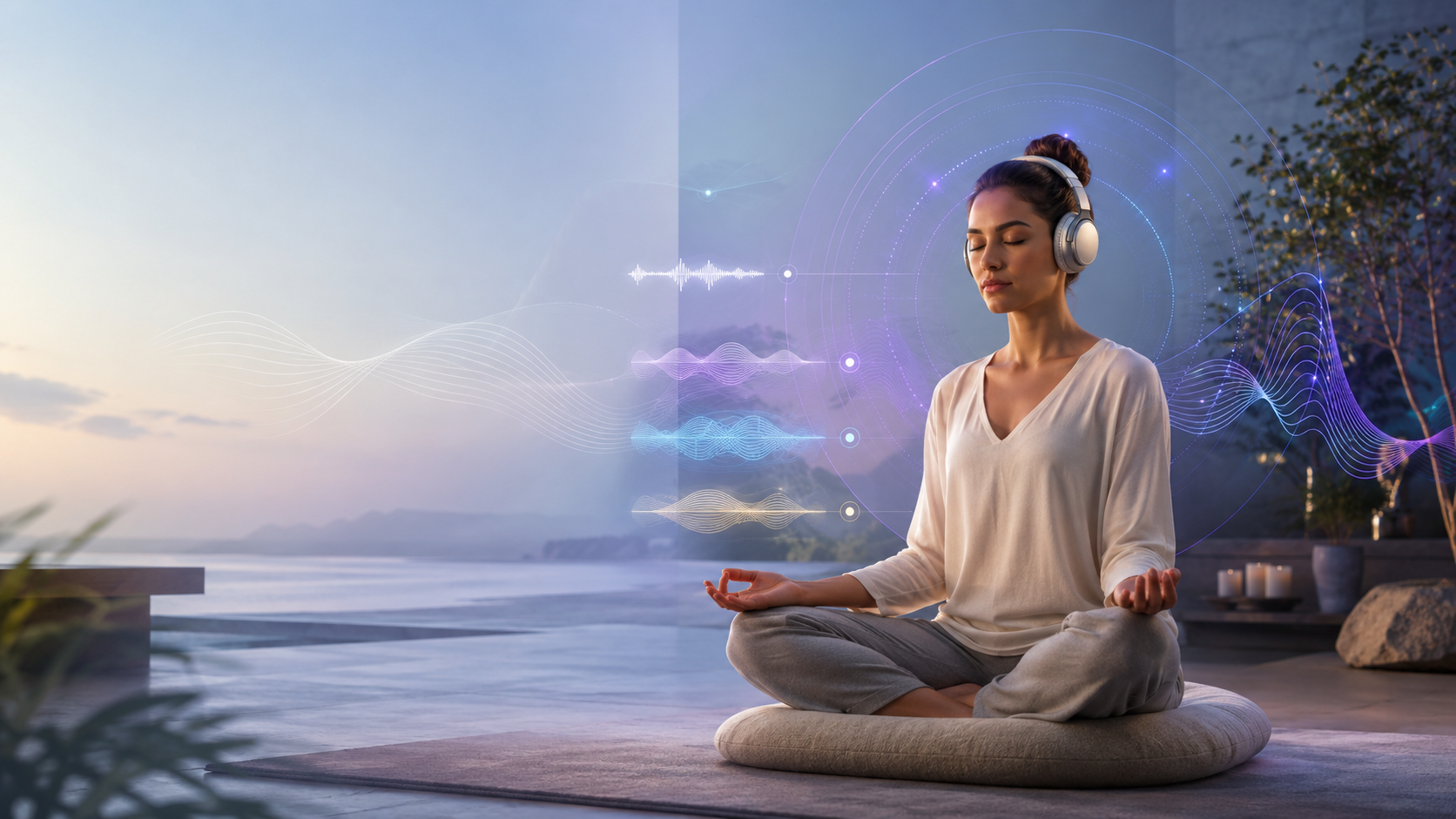
The app is not simply another library of generic meditation content. It is designed around a more personal state reset: AI-powered personalized meditation, frequency-based sound, and soundwear meditation through High Frequency Highway frequency headphones.
That combination matters.
The app can help shape the session around the user’s intention.
The frequency layer can support the desired state.
The headphones create a more immersive listening environment.
Together, they create a meditation experience that feels less like pressing play on a generic track and more like entering a session designed for the moment you are actually in.
This is the difference between content and relevance.
There is already more meditation content than most people could ever use. The issue is not supply. The issue is fit.
A user does not need a thousand sessions if none of them match their current state.
They need the right session at the right time.
That is why personalized meditation is the future.
Calm vs Headspace vs YouTube vs High Frequency Highway
This is not about saying one platform is useful and another is not. Calm, Headspace, and YouTube have helped millions of people build a relationship with meditation, sleep, and mindfulness.
But the market is changing.
Users are no longer only looking for content. They are looking for experiences that feel adaptive, personal, and easy to start.
| Platform | Typical User Experience | Main Strength | Limitation | Where High Frequency Highway Stands Apart |
|---|---|---|---|---|
| Calm | Choose from a large library of meditation, sleep, and relaxation content | Strong content library and familiar user experience | User still has to choose the right session from many options | Focuses on personalized frequency meditation built around state and intention |
| Headspace | Structured mindfulness and meditation programs | Strong education-led meditation experience | Often follows predefined paths and categories | Adds AI guided meditation and frequency-based state support |
| YouTube | Search for free meditation, sound, and frequency tracks | Huge volume and easy access | Quality, consistency, and personalization vary widely | Creates a more intentional app-led experience with guided personalization |
| High Frequency Highway | Personalized meditation plus frequency plus headphones | More adaptive, sensory, and state-aware | Best suited for users who want a deeper sound-based experience | Combines AI meditation app features, frequency meditation, and soundwear meditation |
The key difference is not just content type.
It is the operating model.
Traditional meditation platforms often start with libraries.
High Frequency Highway starts with the state.
That is a more useful entry point for the modern user.
Why This Matters Now
People are carrying more mental noise than they admit.
They are switching between work, family, screens, pressure, uncertainty, and constant stimulation. Their nervous systems are rarely entering a clean starting point.
This is why generic meditation can feel hard to stick with.
Not because the user lacks discipline.
Because the content does not always meet them where they are.
A stressed professional may open an app with only five minutes between calls. A spiritual user may want something deeper than basic relaxation. A busy parent may need a fast transition from overstimulation to presence. A creator may need clarity before deep work. A tired student may need sleep support, not another productivity tool.
The need is different every time.
So the meditation should not always be the same.
The best meditation experience is not the one with the largest library.
It is the one that creates the most relevant shift.
The Future Is State-Aware
The next generation of meditation apps will not win by adding more generic tracks.
They will win by understanding context.
What does the user need now?
Do they need calm, focus, sleep, clarity, emotional grounding, or meditative depth?
Do they need spoken guidance, frequency support, or both?
Do they need a short reset or a deeper session?
Do they need to come down, wake up, soften, focus, or release?
That is the future of an AI meditation app.
Not artificial-feeling content.
Not endless scrolling.
Not a one-size-fits-all voice telling everyone to breathe the same way.
The real value of AI guided meditation is relevance. It can help create an experience that feels closer to the user’s moment, instead of forcing the user to hunt through a content library and hope something works.
When that personalization is paired with frequency meditation, the experience becomes even more complete.
Words guide the mind.
Frequency supports the state.
Headphones create the container.
That is a stronger model for meditation because it respects how people actually live.
Better Meditation Is Better Relevance
The future of meditation is not more content.
It is better relevance.
A user should not have to force themselves into a generic meditation session that does not match their state. They should be able to open an app, choose the shift they need, and enter an experience designed around that moment.
That is what High Frequency Highway is building toward: personalized meditation, AI guided support, frequency-based sound, and immersive soundwear meditation through High Frequency Highway frequency headphones.
Because the best meditation is not the one that sounds peaceful to everyone.
It is the one that works for you, right now.
Try personalized frequency meditation with the High Frequency Highway app and High Frequency Highway frequency headphones.
Share:
Why 100,000+ People Downloaded a Frequency App Before Soundwear Went Mainstream
From Vyvanse to Frequency: The Athlete-Founder Story Behind High Frequency Highway