
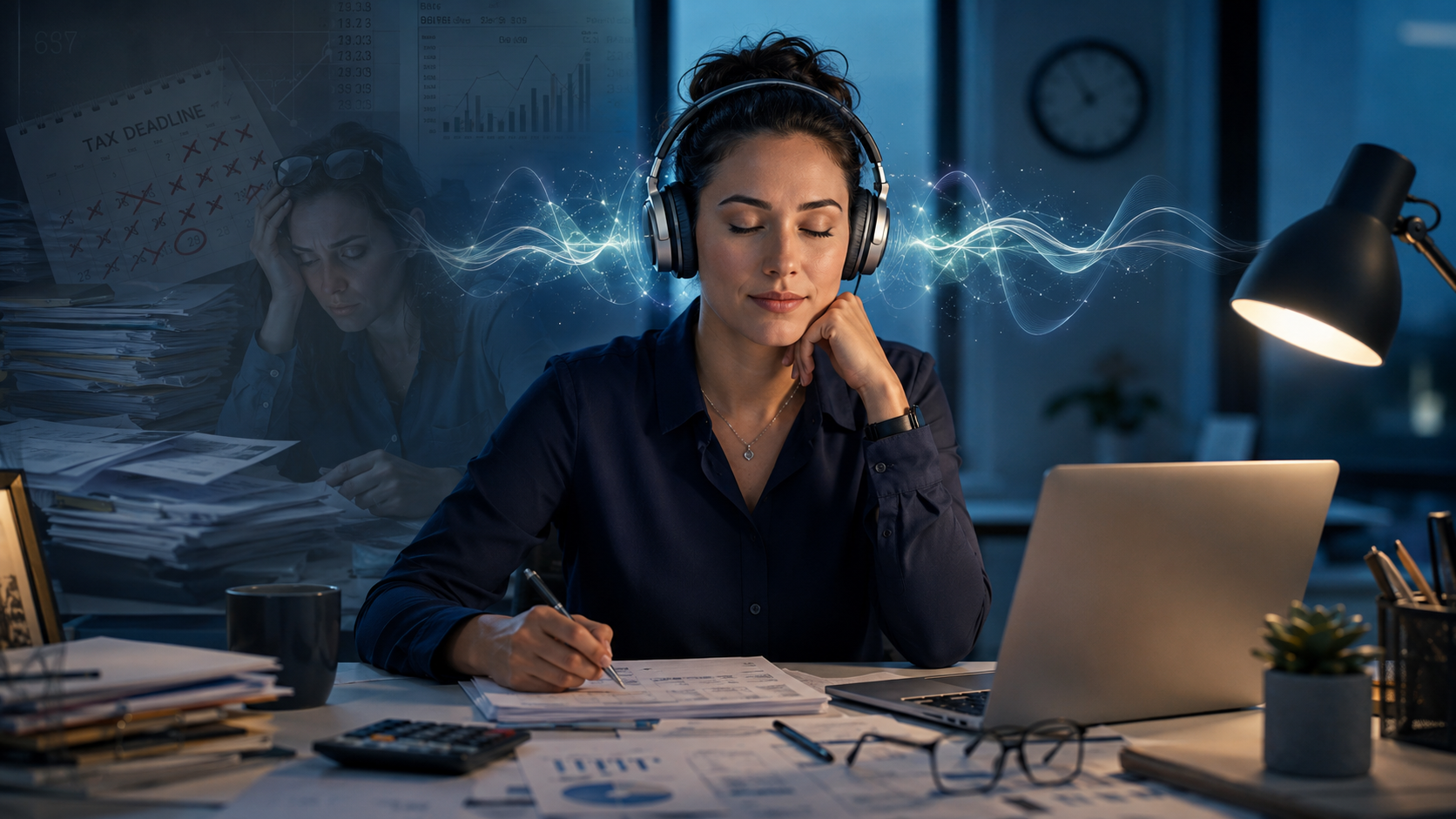
Tax season does something specific to the brain.
It is not just “being busy.”
It is hours of precision, client pressure, screen fatigue, rule recall, deadline anxiety, and the constant mental load of knowing one missed detail matters.
For accountants, bookkeepers, tax professionals, and finance teams, the pressure is not only volume. It is accuracy under time compression.
That is what makes tax season burnout feel different.
Your brain is not simply tired from working long hours. It is tired from staying alert, careful, responsive, and exact for weeks at a time.
And when the workday ends, the nervous system often does not get the memo.
You close the laptop, but your mind keeps scanning.
Did I miss that number?
Did I answer that client?
Did I finish that filing?
What is waiting tomorrow?
This is where sound can become useful.
Not as a cure.
Not as a performance promise.
Not as another productivity gimmick.
But as a practical transition tool: something that helps your brain move from focus mode into recovery mode with more intention.
Why tax season drains the brain differently
Most professionals deal with busy seasons.
Accountants deal with precision seasons.
During tax season, the brain has to manage several demands at once:
- Reading dense financial information
- Catching small errors
- Switching between clients
- Remembering rules, forms, deadlines, and exceptions
- Responding to urgent questions
- Managing long screen hours
- Staying calm when everyone else feels rushed
That kind of work taxes attention differently.
It is not loud stress all the time. Sometimes it is quiet, constant pressure.
The kind that builds slowly.
The kind where your body is sitting still, but your brain is running laps.
That is why stress relief for accountants needs to be more than “take a break” or “go for a walk.”
Breaks help, but tax professionals also need better transitions between states:
- From scattered to focused
- From pressure to calm
- From work mode to evening mode
- From mental overload to nervous system recovery
Sound can support those transitions by giving the brain a structured cue.
The cost of precision under pressure
Precision work takes energy.
Every number, rule, line item, and client question requires attention. Over time, that creates cognitive fatigue.
This is why tax professionals may feel:
- Mentally foggy after long work blocks
- Wired at night even when physically tired
- More reactive to small interruptions
- Less patient after repeated client questions
- Unable to fully switch off after work
- Tired in a way sleep alone does not immediately fix
This does not mean something is wrong with you.
It means your brain has been operating in a high-demand environment for too long without enough recovery cues.
During tax season, many accountants are not just working longer. They are spending more hours in states of high alert, tight focus, and decision fatigue.
That is a heavy load.
Why accountants struggle to switch off after work
One of the hardest parts of tax season is the mental carryover.
You may leave the office, but the work follows you internally.
That happens because deadline pressure keeps the nervous system activated. Your brain has been trained all day to check, solve, remember, answer, and anticipate.
So when the work stops, the internal momentum continues.
This is why you might feel tired but restless.
Your body wants to relax.
Your brain is still reviewing tabs you already closed.
Sound can help create a boundary.
A specific frequency session after work can act like a closing ritual. It gives your mind a signal: the work block is done, now we shift.
That shift matters.
Because recovery does not always happen automatically. Sometimes it needs to be invited.
Using beta and gamma for focused work blocks
During deep work, accountants often need structured attention.
Beta and gamma frequency ranges are commonly associated with active thinking, alertness, and cognitive engagement.
For tax professionals, these sessions may be useful before or during focused work blocks when the goal is to settle into a task and reduce mental wandering.
Best use cases:
- Reviewing client documents
- Preparing returns
- Organizing financial data
- Working through complex forms
- Starting a focused morning work block
- Getting back into flow after interruptions
The goal is not to force the brain into perfection.
The goal is to support a work environment that feels more intentional.
Instead of jumping straight into deadlines, emails, and client demands, a short sound session can become a mental warm-up.
A simple rhythm:
- Start with a 5 to 10 minute focus session
- Choose one defined task
- Work in a clean block
- Pause before switching clients or categories
This gives your brain fewer open loops and less friction.
Using alpha and theta for decompression after client deadlines
After a long day of tax work, the brain usually does not need more stimulation.
It needs downshifting.
Alpha and theta frequency ranges are commonly associated with relaxation, slower mental activity, and inward recovery states.
These may be useful after work, during evening decompression, or before sleep-adjacent routines.
Best use cases:
- After client-heavy days
- After long screen sessions
- After filing deadlines
- During evening wind-down
- Before journaling, stretching, or quiet rest
- When your mind feels tired but still “on”
This is where sound becomes less about productivity and more about recovery.
Not “do more.”
More like: come back to yourself.
Tax season can make every hour feel claimed by someone else’s urgency. A decompression session gives part of the day back to your own nervous system.
A tax season frequency schedule for accountants
Here is a simple sound rhythm accountants can use during deadline-heavy weeks.
Morning focus reset
Use before your first deep work block.
Best for:
- Starting the day with less mental noise
- Preparing for complex client work
- Creating a clear entry point into focused tasks
Suggested rhythm:
- 5 to 10 minutes of beta or gamma
- One priority task selected before starting
- Phone and inbox closed during the first work block
Midday screen fatigue break
Use between client work blocks.
Best for:
- Reducing mental clutter
- Creating a pause between task types
- Helping your brain reset before the next round of detail work
Suggested rhythm:
- 5 minutes of calming sound
- Step away from your screen
- Let your eyes rest
- Return to one defined task, not ten
Late afternoon pressure release
Use after the highest-pressure work has ended.
Best for:
- Closing open mental loops
- Moving out of urgency mode
- Preventing work stress from spilling into the evening
Suggested rhythm:
- 10 to 15 minutes of alpha
- No multitasking
- Let this be the transition between work and home
Evening decompression session
Use when your brain still feels active after work.
Best for:
- Wind-down
- Mental recovery
- Creating separation from deadline pressure
Suggested rhythm:
- 10 to 20 minutes of alpha or theta
- Low light
- No inbox
- No “one last thing” after the session
That last part matters.
A recovery ritual only works if it actually closes the workday.
Sound is not a replacement for rest
Frequency-based tools are not a substitute for sleep, movement, hydration, sunlight, boundaries, or real workload management.
Accountants still need the basics.
But during tax season, basics often get squeezed.
That is why the most useful wellness tools are the ones that fit into the workday without adding another complicated routine.
Sound works well because it is easy to attach to moments that already exist:
- Before deep work
- Between clients
- After long screen blocks
- At the end of the workday
- Before evening recovery
The goal is not to add more pressure.
The goal is to create better transitions.
How High Frequency Highway supports tax season recovery
High Frequency Highway gives tax professionals a practical way to use sound intentionally during demanding work seasons.
The app and Frequency Headphones are designed to make frequency-based listening easier to use throughout the day, whether you are preparing for focused work or trying to decompress after deadline pressure.
For accountants, the value is simple:
- Use sound to enter focus with more intention
- Use sound to create workday boundaries
- Use sound to support recovery after long screen-heavy days
- Use sound as a nervous system cue when pressure is high
Tax season may still be demanding.
But your brain should not have to stay in deadline mode all day and all night.
A better rhythm is possible.
Focus when it is time to focus.
Recover when the work is done.
Let sound help you make the shift.
FAQ
How do accountants manage stress during tax season?
Accountants can manage tax season stress by creating clearer work blocks, taking intentional breaks, reducing task switching, protecting sleep, and using simple recovery cues after work. Sound can be one of those cues, helping create a transition from deadline pressure into decompression.
Why is tax season so exhausting?
Tax season is exhausting because accountants are doing precision-heavy work under deadline pressure. The brain has to stay focused, catch details, answer client questions, manage changing priorities, and remain accurate across long hours. That creates cognitive fatigue and nervous system strain.
What frequency helps with focus?
Beta and gamma frequency ranges are commonly associated with alertness, active thinking, and focused cognitive work. Many people use these types of sound sessions before deep work blocks or mentally demanding tasks.
What frequency helps after long screen hours?
Alpha and theta frequency ranges are commonly associated with relaxation and decompression. These may be useful after long screen-heavy days, especially when the mind feels tired but still active.
Can sound prevent tax season burnout?
Sound should not be treated as a cure or prevention method for burnout. It can be used as a wellness support tool within a broader rhythm that includes sleep, boundaries, breaks, movement, nutrition, and workload management.
When should accountants use frequency sound during tax season?
The best times are before deep work, between client-heavy tasks, after long screen sessions, and at the end of the workday. The key is consistency. Sound works best as a repeatable cue that helps the brain shift states.
Tax season asks a lot from your brain.
High Frequency Highway frequency headphones give accountants and tax professionals a practical way to support focus during deep work and recovery after long, deadline-heavy days.
Use sound to build a better rhythm between precision and rest.
Share:
Why Customer Support Work Feels So Draining: A Sound-Based Reset for Emotional Overload
Postpartum Overstimulation Is Real: A Gentle Sound Ritual for New Moms Who Feel Touched Out