
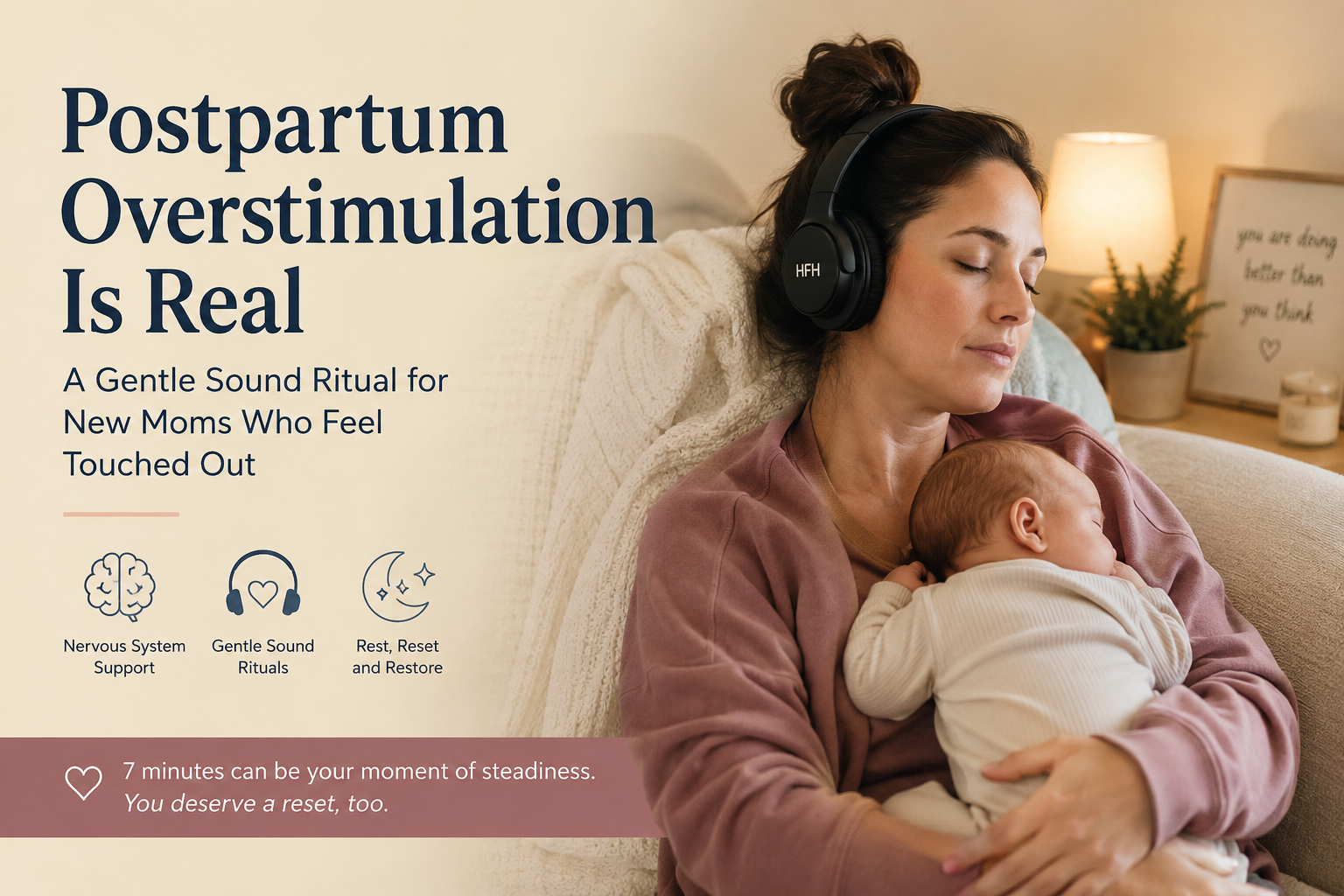
New motherhood is often described as beautiful.
It can be.
It can also be loud, relentless, physical, and overstimulating in a way many moms are not prepared for.
A baby cries.
The monitor buzzes.
Someone texts for an update.
Your shirt is damp.
Your body is healing.
Your sleep is broken.
Your brain is scanning for the next need before the current one is even finished.
Then someone touches your shoulder and your whole body wants to pull away.
Not because you do not love your baby.
Not because you are ungrateful.
Not because something is wrong with you.
Because your system has been asked to stay available for too long without a real pause.
That is postpartum overstimulation.
And for many new moms, it shows up as the feeling of being “touched out.”
Why being touched out is a nervous-system signal
Being touched out is not selfishness.
It is often a signal that your body has reached its sensory limit.
New moms are touched constantly. Feeding, rocking, holding, burping, soothing, changing, carrying, sleeping lightly beside a baby, staying alert to every sound. Even loving touch can become too much when there is no break between demands.
The nervous system is not only responding to one thing.
It is responding to the pileup.
Touch.
Noise.
Sleep loss.
Hormonal change.
Decision fatigue.
Crying.
Mental tabs.
The pressure to be calm while feeling anything but calm.
That is why postpartum overstimulation can feel so confusing.
You may want closeness and space at the same time.
You may love your baby deeply and still feel desperate for silence.
You may be exhausted but unable to fully relax.
That does not make you a bad mom.
It makes you a human being with a body that needs recovery.
Sleep disruption, sound sensitivity, and emotional reactivity
Sleep changes everything.
When sleep is fragmented, the body has less margin. Normal sounds feel sharper. Normal requests feel heavier. Small interruptions can trigger a bigger reaction than you expected.
This is one reason postpartum overstimulation can build quietly throughout the day.
By evening, it may not be one cry that overwhelms you.
It is the tenth cry after a night of broken sleep.
The third feeding after no real meal.
The fourth person asking how the baby is doing before anyone asks how you are doing.
Medical sources also note that postpartum emotional changes can range from temporary “baby blues” to more serious postpartum depression or anxiety symptoms. Mayo Clinic notes that baby blues may include mood swings, anxiety, sadness, irritability, feeling overwhelmed, crying, concentration issues, appetite problems, and sleep trouble, while postpartum depression symptoms are more intense and longer lasting. If symptoms persist, intensify, or include thoughts of harming yourself or your baby, professional support matters immediately.
High Frequency Highway should be understood in that context.
It is not a treatment for postpartum depression.
It is not a treatment for postpartum anxiety.
It is not a cure for insomnia, hormonal symptoms, or mental health conditions.
It is a wellness tool that may help create a small, repeatable ritual for calm, decompression, and nervous system support.
Why short rituals matter when time is limited
New moms are rarely short on advice.
They are short on time.
“Take a break” sounds simple until the baby only naps for 18 minutes.
“Get more sleep” sounds nice until feeding schedules, recovery, and night waking make sleep feel impossible.
“Ask for help” matters, but help is not always available right when your body hits its limit.
That is why short rituals matter.
Not because seven minutes fixes postpartum life.
Because seven minutes may be realistic.
A short reset gives the body a cue:
You are safe for this moment.
You do not have to solve everything right now.
You can come back to yourself before the next round of care.
High Frequency Highway already frames its headphones as a realistic way for overwhelmed parents to create a nervous system reset inside modern family life, not by escaping their responsibilities, but by building a calmer support ritual that fits real life.
For postpartum moms, that distinction matters.
This is not about disappearing from motherhood.
It is about finding one small place inside motherhood where your body can stop bracing.
A 7-minute sound reset while the baby naps
When the baby naps, the temptation is to rush.
Wash bottles.
Fold laundry.
Answer messages.
Clean the kitchen.
Catch up on everything.
Sometimes that is necessary.
But sometimes the most productive thing you can do is help your body come down.
Here is a simple 7-minute postpartum sound reset.
Minute 0 to 1: Lower the input
Put your phone on silent if you can.
Dim the room.
Sit or lie down somewhere safe and comfortable.
Let your shoulders drop.
You do not need a perfect meditation setup.
You need less input.
Minute 1 to 2: Name what is happening
Say quietly:
“I am overstimulated. I am not failing. My body needs a pause.”
This matters because shame increases the load.
Naming the state helps separate the feeling from your identity.
You are not an angry mom.
You are not a disconnected mom.
You are not a weak mom.
You are a touched out mom whose system needs care.
Minute 2 to 6: Use sound as the boundary
Put on your High Frequency Highway frequency headphones.
Choose a calming soundscape, gentle frequency session, theta-style wind-down, or another setting that feels soft instead of stimulating.
Do not force yourself to relax.
Just let the sound become the boundary between being needed and being returned to yourself.
Notice your jaw.
Notice your hands.
Notice your breath.
Notice the places where your body is still holding the day.
The goal is not to become perfectly calm.
The goal is to give your system a signal that it can loosen by one notch.
High Frequency Highway describes its app and headphones as using frequencies, binaural beats, and soundscapes to support states such as relaxation, focus, meditation, and sleep preparation. Its broader positioning is strongest when framed as a wellness ritual, not a medical intervention.
Minute 6 to 7: Re-enter slowly
Before you stand up, take one slower breath.
Ask:
“What is the next kind thing I can do for myself?”
Not the perfect thing.
Not the most productive thing.
The next kind thing.
Maybe it is water.
Maybe it is food.
Maybe it is asking your partner to take the baby for ten minutes.
Maybe it is letting the laundry wait.
Small steadiness counts.
Delta and theta for evening wind-down
For some moms, the hardest part is not the daytime overwhelm.
It is the evening crash.
The baby is finally asleep, but your body is still awake.
Your mind replays the day.
You feel wired and exhausted at the same time.
You want to sleep, but your system does not trust that the night is quiet yet.
This is where a gentle evening sound ritual may help.
A theta-style session may support the transition from active thinking into a softer, more inward state.
A delta-style session may be used as part of a pre-sleep wind-down routine.
Again, this is not a promise that sound will treat insomnia or postpartum anxiety.
It is a cue.
A repeatable signal that says:
The day is closing.
The baby is safe.
My body can soften now.
I can stop scanning for one moment.
High Frequency Highway has used similar framing for other high-stress audiences: frequency-based audio works best as a decompression routine, sleep-preparation cue, and nervous system support tool, not as a substitute for medical care.
That is the right frame for postpartum moms too.
When to ask for more support
A sound ritual can be supportive.
But it should never replace care when symptoms are persistent, intense, or frightening.
Please reach out to a healthcare provider, therapist, postpartum mental health specialist, or trusted support person if you are experiencing:
- Persistent sadness, hopelessness, or despair
- Severe anxiety or panic
- Rage that feels hard to control
- Trouble bonding with your baby
- Thoughts of harming yourself or your baby
- Hallucinations, paranoia, confusion, or feeling detached from reality
- Symptoms that make it hard to care for yourself or your baby
The CDC states that depression among women is common and treatable, and recommends seeking treatment from a healthcare provider as soon as possible if someone thinks they may have depression or postpartum depression.
Support is not failure.
It is care.
FAQ
Why do I feel touched out after having a baby?
You may feel touched out because your body has been receiving constant physical contact, sound, interruption, and responsibility without enough recovery time. Being touched out does not mean you do not love your baby. It often means your nervous system needs a sensory break.
Can sound help new moms relax?
Sound may help some new moms create a short relaxation ritual, especially when paired with quiet, breathing, and reduced stimulation. High Frequency Highway frequency headphones can be used as part of a wellness routine for calm, decompression, and evening wind-down. They are not a treatment for postpartum depression, postpartum anxiety, insomnia, or any medical condition.
Is High Frequency Highway safe postpartum?
High Frequency Highway frequency headphones are positioned as a wellness tool, not a medical device. If you have medical concerns, postpartum mental health symptoms, hearing concerns, neurological conditions, or any uncertainty about using sound-based wellness tools after birth, speak with your healthcare provider first.
What is a realistic reset for a new mom?
A realistic reset may be as short as seven minutes. Sit down, lower the input, put on a calming sound session, breathe, and give your body a clear signal that it can pause. The reset does not need to be perfect. It needs to be repeatable.
Can this help with postpartum anxiety?
High Frequency Highway should not be framed as a treatment for postpartum anxiety. It may support relaxation and routine as part of a broader wellness practice, but persistent anxiety, panic, intrusive thoughts, or emotional distress should be discussed with a healthcare professional.
A small moment of steadiness
New moms are asked to give constantly.
Their body.
Their attention.
Their sleep.
Their patience.
Their ability to respond, soothe, hold, feed, listen, and start again.
But even the most loving mom needs a place to come back to herself.
High Frequency Highway frequency headphones can become that small moment of steadiness.
Not a full break.
Not a cure.
Not a replacement for support.
A ritual.
Seven minutes while the baby naps.
A quiet evening wind-down.
A sound boundary when the day has been too loud.
A way to remind your nervous system that you are still here too.
Explore High Frequency Highway frequency headphones and create a gentle reset ritual for the moments when motherhood feels beautiful, overwhelming, and a little too loud.
Medical disclaimer: High Frequency Highway frequency headphones are a wellness tool, not a medical device. They are not intended to diagnose, treat, cure, or prevent postpartum depression, postpartum anxiety, insomnia, hormonal symptoms, or any medical condition. If you are experiencing persistent sadness, severe anxiety, panic, intrusive thoughts, hopelessness, thoughts of self-harm, thoughts of harming your baby, or symptoms that interfere with daily functioning, please contact a qualified healthcare professional immediately.
Share:
Tax Season Brain: How Accountants Can Use Sound to Recover From Deadline Pressure
Why Flight Attendants Feel Wired After Landing: Sound-Based Recovery for Travel Crew