
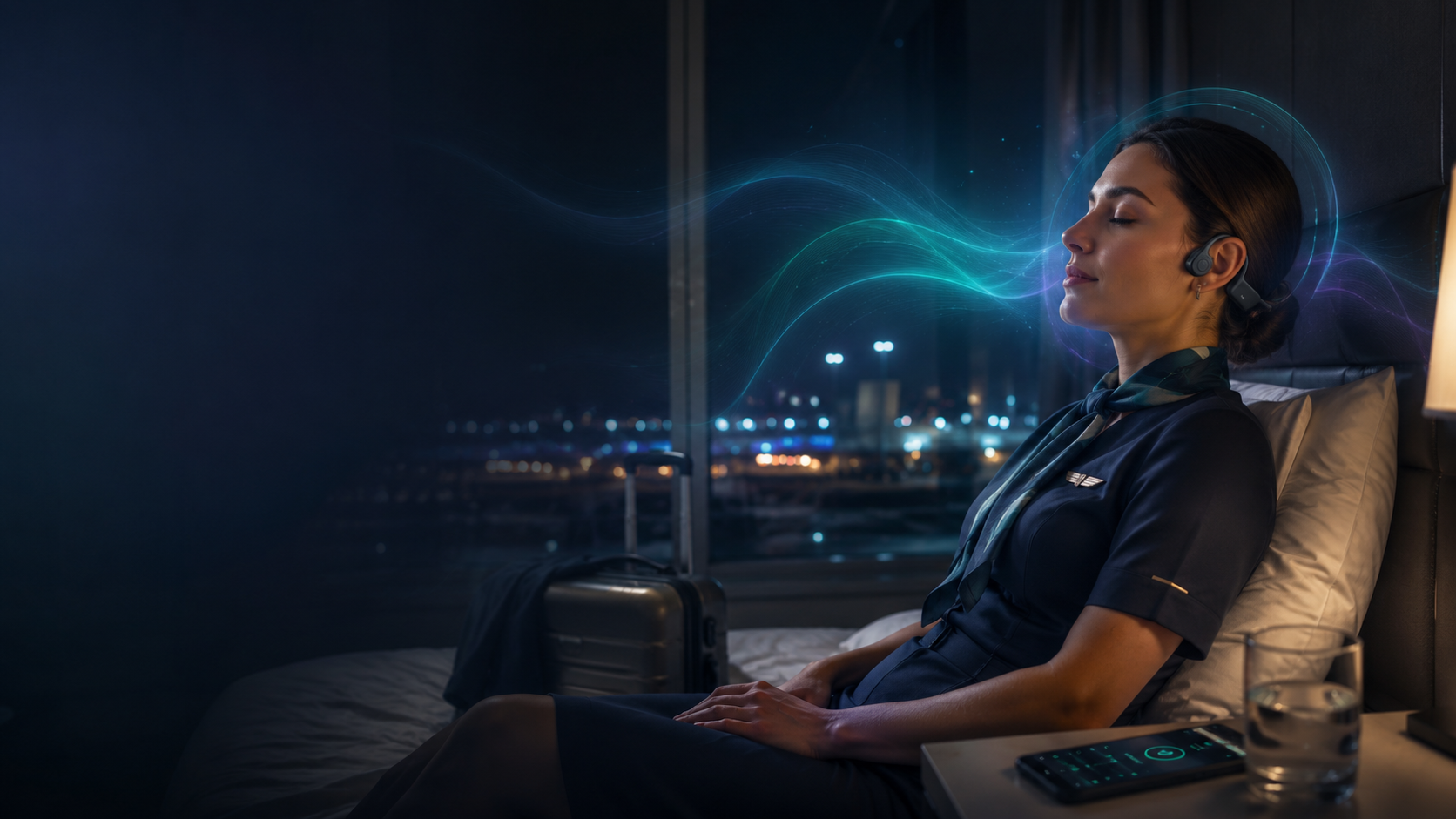
Flight attendants are trained to look calm.
That does not mean the body is calm.
A flight can look routine from the outside, but inside the cabin, the nervous system is tracking everything at once: passenger needs, safety cues, announcements, service timing, turbulence, conflict, noise, delays, and the constant pressure to stay composed in a compressed space.
That is the part many people miss.
The work is not only physical. It is emotional. It is sensory. It is social. It is regulatory.
You are expected to be warm, alert, helpful, professional, and steady, even when your body is tired, your sleep is off, and your environment keeps changing.
So when the plane lands, the job may be over.
But your nervous system may still be in flight mode.
CDC/NIOSH notes that aircrew can experience work-related circadian rhythm disruption, specifically jet lag, as sleep patterns and time zones shift across routes. It also recommends sleep-supportive habits like keeping consistent sleep and wake times when possible, reducing noise and light, limiting caffeine, and setting up a quiet, dark, cool hotel room when sleeping away from home.
Cabin noise, passenger tension, and schedule disruption add up
Flight attendants work inside a sensory-heavy environment.
There is engine noise. Airflow. Announcements. Cart movement. Service equipment. Passenger conversations. Boarding pressure. Deplaning pressure. Time changes. Early call times. Late arrivals. Hotel rooms that never feel quite like home.
CDC/NIOSH lists several in-flight and ground noise sources for aircrew, including aircraft engines, takeoff preparation, braking, turbulence over the fuselage, announcements, and food and beverage service noises. It also notes that NIOSH recommends occupational noise exposure be controlled below an equivalent of 85 dBA over eight hours to help reduce noise-induced hearing loss risk.
That matters because the body does not process a flight as one clean event.
It processes a thousand small signals.
Some are obvious: a delay, a difficult passenger, a long-haul route.
Others are subtle: bright cabin lighting, repeated announcements, compressed air, switching time zones, eating at strange hours, being “on” when your body wants to be off.
This is why flight attendant burnout can feel different from normal tiredness.
It is not only “I need a nap.”
It is often:
- “My body is exhausted, but my mind will not shut off.”
- “I landed hours ago, but I still feel activated.”
- “I know I need sleep, but I cannot downshift.”
- “Every city changes, so my routine disappears.”
- “I feel overstimulated and under-rested at the same time.”
That last line is the real issue.
Travel crew often need recovery before sleep.
Why landing does not mean your nervous system has landed
The body loves patterns.
Same room. Same light. Same bedtime. Same pillow. Same evening routine.
Flight attendants rarely get that luxury.
One night is a hotel near the airport. Another is a short layover. Another is a red-eye. Another is a time zone your body has not caught up to yet.
A 2023 scoping review on airline cabin crew fatigue found a high prevalence of fatigue and sleepiness, along with unsatisfactory sleep quality and elevated susceptibility to sleep disorders among cabin crew.
That does not mean every flight attendant has a sleep disorder.
It means the work environment creates repeated pressure on rest.
And here is where the nervous system piece matters.
Landing is a schedule event.
Recovery is a biological transition.
Your calendar may say the shift is done, but your body may still be scanning, responding, bracing, and replaying the day.
That is why a post-flight ritual matters.
Not because it magically erases jet lag.
Not because one sound fixes circadian disruption.
Because a familiar cue can help the body recognize: the workday is over now.
How sound can become a post-flight downshift cue
Sound is powerful because it travels with you.
You may not control the hotel room.
You may not control the layover length.
You may not control the time zone.
You may not control the noise outside your door.
But you can create one repeatable signal.
Same headphones.
Same app.
Same frequency session.
Same breath pattern.
Same 10-minute decompression window.
That repetition is what makes it useful.
High Frequency Highway is built around personalized frequency experiences, allowing users to generate frequency combinations, layer soundscapes, and create sessions for moments like calm, focus, recovery, or sleep preparation. The app also describes itself as a way to explore sound and frequencies for relaxation, focus, and meditation.
For flight attendants, that matters because the ritual can stay consistent even when the city changes.
A sound-based post-flight routine becomes a portable recovery anchor.
Not a cure.
A cue.
A way to tell the body:
You do not have to keep performing now.
You do not have to keep scanning the room.
You do not have to keep answering, solving, smiling, managing.
You can come down.
Alpha, theta, and delta: choosing the right state after a flight
Not every post-flight moment needs the same sound.
Sometimes you need to decompress before you can sleep.
Sometimes you need to settle your mind without becoming groggy.
Sometimes you need support for a full wind-down routine.
That is where different frequency states can be used intentionally.
Alpha-style sessions can be useful when you feel mentally busy but still need to stay gently awake. Think: unpacking, showering, stretching, journaling, or transitioning out of work mode.
Theta-style sessions can support deeper decompression. This is the “soft landing” zone: less doing, less thinking, less replaying the shift.
Delta-style sessions are better suited for sleep preparation. This is where the goal is not productivity. The goal is letting the body move toward rest.
Sleep Foundation explains that binaural beats are an auditory phenomenon created when each ear hears a slightly different frequency, and the brain perceives a third beat. It also notes that evidence around binaural beats for relaxation and sleep is still limited and results vary, which is why the strongest framing is support, not cure.
That distinction matters.
High Frequency Highway should not be positioned as something that “fixes jet lag.”
A better, cleaner claim:
It can support a repeatable wind-down ritual for travel crew who need help transitioning from work mode into recovery mode.
That is more credible.
And honestly, more useful.
A hotel-room recovery ritual for travel crew
Here is a simple post-flight ritual flight attendants can use after landing, especially on layovers.
1. Change the signal
Before anything else, change out of uniform if possible.
The body associates clothing with state.
Uniform means service, alertness, responsibility, performance.
Soft clothes tell the body something different.
You are off duty now.
2. Lower the room input
Make the room feel less like a transit space.
Dim the lights.
Close the curtains.
Lower the temperature.
Put your phone on quiet.
Use an eye mask if needed.
Reduce as much background stimulation as possible.
CDC/NIOSH specifically recommends that aircrew sleeping away from home set up a quiet, dark, comfortable, and cool hotel room, including blocking light from doorways, windows, and lighted clocks.
3. Start with decompression, not sleep
Do not force sleep immediately if your body is still wired.
Start with 5 to 10 minutes of downshifting.
Use High Frequency Highway frequency headphones with a calming soundscape or frequency session. Pair it with slow breathing. Let your body receive the same message several times:
The flight is done.
The cabin is gone.
The shift is over.
4. Move from alpha or theta into sleep support
If you are overstimulated, begin with alpha or theta-style decompression.
If you are already sleepy, move toward a delta-style sleep preparation session.
Keep the volume comfortable. More volume does not mean more benefit.
The ritual should feel like an exhale, not another input your body has to process.
5. Repeat the same sequence
The power is in consistency.
Flight attendants do not always get a consistent environment.
So the ritual becomes the consistency.
Same sound.
Same breath.
Same headphones.
Same transition.
Over time, that repetition can become a familiar cue your body recognizes, even when the hotel room, city, and schedule keep changing.
Why this matters for flight attendant burnout
Burnout does not always arrive dramatically.
Sometimes it looks like snapping faster.
Sleeping worse.
Feeling detached.
Needing longer to recover.
Getting irritated by small things.
Losing the ability to come down after work.
For flight attendants, the recovery window is often too short for the amount of regulation the job requires.
That is why stress relief for flight attendants cannot only be about “getting more rest.”
It has to include transition.
The body needs a bridge between cabin mode and recovery mode.
Sound can be part of that bridge.
Not because sound replaces sleep hygiene, medical care, scheduling support, hydration, nutrition, or real time off.
Because sound can help create a portable ritual when everything else is moving.
FAQ
Why do flight attendants feel exhausted after flying?
Flight attendants manage physical work, passenger interaction, cabin noise, time pressure, changing schedules, and circadian disruption. The exhaustion is not just from standing or walking. It is also from staying emotionally regulated and alert in a high-stimulation environment for hours.
How do flight attendants recover after long flights?
Recovery usually works best when it combines basics: hydration, food, light management, a quiet sleep environment, gentle movement, reduced screen exposure, and a consistent wind-down routine. A sound-based ritual can support the transition from work mode into rest mode, especially when travel crew are sleeping in different cities and hotel rooms.
Can sound help with jet lag?
Sound should not be framed as a jet lag cure. Jet lag involves circadian rhythm disruption, which is influenced by time zones, light exposure, sleep timing, and schedule demands. Sound can support a calming routine, reduce stimulation before sleep, and help create a familiar wind-down cue after flying.
What frequency is best after travel?
It depends on the state you want to enter. Alpha-style sessions may support calm alertness. Theta-style sessions may support decompression. Delta-style sessions are better suited for sleep preparation. The best choice after travel is usually the one that matches your immediate need: downshift first, then sleep.
What is the best sleep support for flight attendants?
The strongest sleep support is usually a repeatable routine: dark room, cool temperature, reduced noise, limited caffeine, less screen exposure before bed, and a calming cue your body can recognize. High Frequency Highway frequency headphones can help travel crew create that familiar recovery ritual, even when every city, room, and schedule changes.
Your schedule may change.
Your hotel room may change.
Your time zone may change.
Your recovery cue does not have to.
High Frequency Highway frequency headphones help travel crew create a familiar sound-based ritual for post-flight decompression, wind-down, and sleep preparation, wherever the next layover begins.
Share:
Postpartum Overstimulation Is Real: A Gentle Sound Ritual for New Moms Who Feel Touched Out
The Sales Nervous System: How to Reset After Rejection, Pressure, and Back-to-Back Calls