
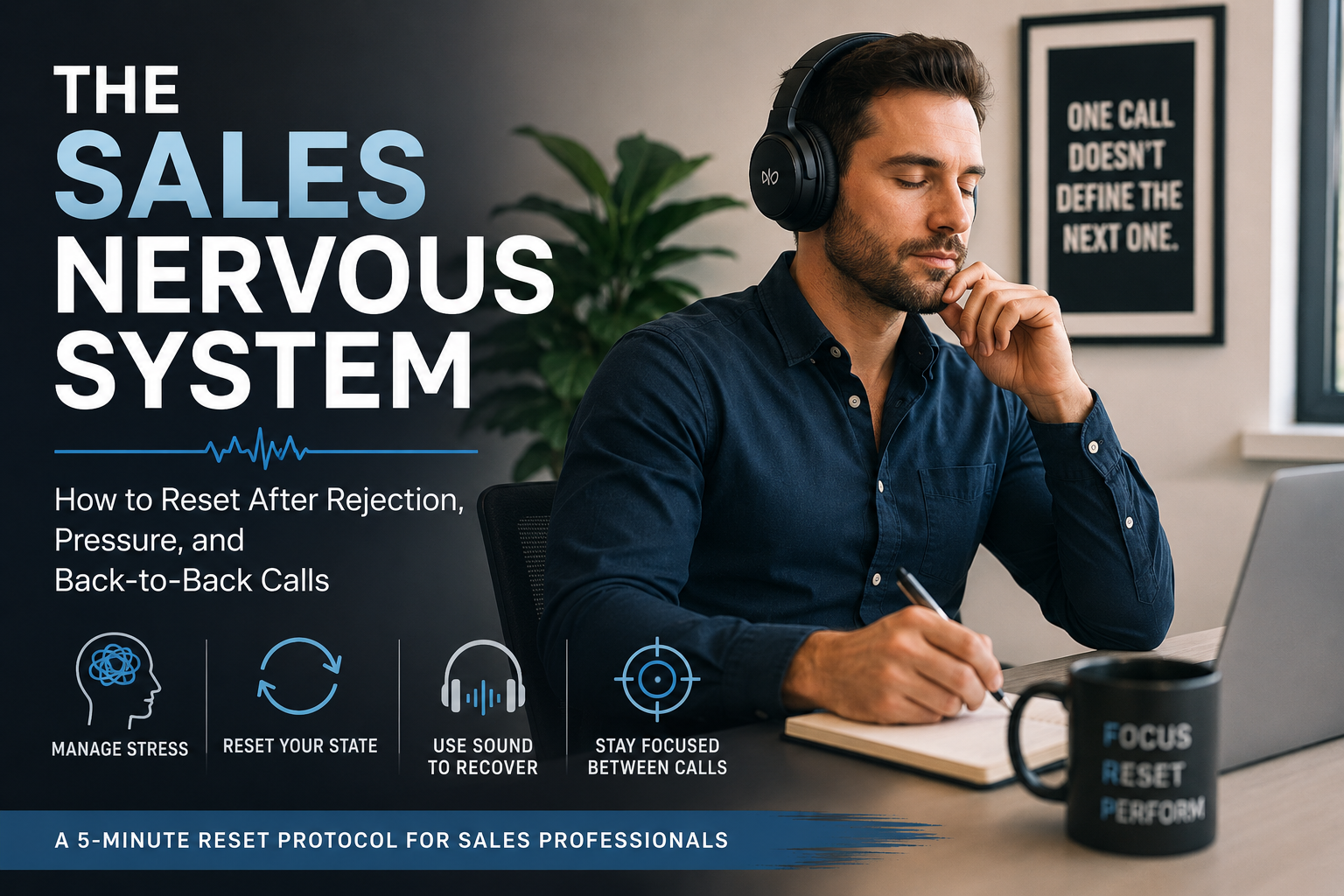
Sales is emotional labor dressed up as performance.
You are expected to stay sharp after rejection.
Stay calm when a prospect is cold.
Stay confident after hearing “not interested” for the fifth time before lunch.
Stay focused when your pipeline feels thin, your calendar is packed, and your quota is still staring at you.
That is not just a mindset challenge.
It is a nervous system challenge.
Salespeople are constantly switching states. One moment you are preparing. The next you are pitching. Then handling objections. Then recovering from rejection. Then jumping straight into the next call as if nothing happened.
But your body does not always move that fast.
A bad call can stay with you.
A sharp response can tighten your chest.
A missed opportunity can keep playing in your head.
A high-pressure meeting can leave your mind wired long after it ends.
That is why stress relief for salespeople needs to be practical, fast, and repeatable.
Not another complicated wellness routine.
Not a full hour away from work.
Not pretending rejection does not affect you.
A reset.
A short, intentional cue that helps your body close one conversation before entering the next.
Why Sales Work Hits the Nervous System So Hard
Sales looks like communication from the outside.
Inside the body, it can feel like constant activation.
You are reading tone.
Tracking objections.
Managing silence.
Regulating your own reaction.
Trying not to sound desperate.
Trying not to sound robotic.
Trying to stay present when you already know the last call went poorly.
This is why sales can feel mentally exhausting even when you are sitting at a desk.
Your nervous system is not only responding to the words being said. It is responding to uncertainty, evaluation, rejection, urgency, and pressure.
A sales call carries emotional stakes.
Will they answer?
Will they trust me?
Will they push back?
Will this deal move forward?
Will I hit my number?
Even when you love the work, your system is still processing a lot.
That constant pressure can create sales burnout over time. Not because salespeople are weak, but because they spend their day in repeated cycles of anticipation, performance, rejection, recovery, and re-engagement.
That is a demanding rhythm.
And without a reset, the body starts carrying one call into the next.
Rejection, Urgency, and Quota Pressure
Sales rejection is strange because it is both normal and personal.
Every salesperson knows rejection is part of the work. But the body still reacts.
A prospect cuts you off.
A deal goes quiet.
A follow-up gets ignored.
A strong pitch gets a flat response.
A call you prepared for ends in two minutes.
Your rational mind may understand it.
Your nervous system may still treat it like a threat.
That is where sales call anxiety begins for many professionals. Not always as panic. Sometimes it shows up more quietly.
You delay the next call.
You overthink your opener.
You refresh your inbox.
You check the CRM instead of dialing.
You become too careful.
You start bracing before the conversation even starts.
Then urgency adds another layer.
Quota pressure. Pipeline reviews. Public dashboards. End-of-month tension. The emotional math of “how many more conversations do I need to make this work?”
Salespeople are often trained on scripts, objection handling, discovery questions, and closing frameworks.
But far fewer are trained on state recovery.
That is the missing piece.
Because the person making the call is the instrument. If that instrument is tense, scattered, defensive, or emotionally overloaded, everything gets harder.
Why One Bad Call Can Affect the Next One
One bad call does not always end when the call ends.
Sometimes it lingers.
You carry the frustration into the next intro.
You sound slightly less open.
You rush the discovery.
You assume resistance before it appears.
You stop listening as cleanly.
You try to force energy you do not actually have.
This is not a character flaw.
It is residue.
The body keeps score of pressure. Without a clear transition, the nervous system may stay in the previous emotional state while your calendar moves forward.
That is why back-to-back sales calls can be so difficult.
Your schedule says: next call.
Your nervous system says: I am still processing the last one.
A reset cue gives your body a clean line.
That call is complete.
That response is not coming with me.
This next conversation gets a fresh version of me.
Sound as a Reset Between Emotional Spikes
Sound is one of the simplest ways to create a state shift because it gives the brain and body something immediate to follow.
A familiar sound ritual can signal transition.
Before prospecting: wake up, focus, prepare.
After rejection-heavy blocks: soften, breathe, release.
After work: close the sales day and return to yourself.
This is where High Frequency Highway can fit naturally into a sales professional’s day.
Not as a promise of better conversion rates.
Not as a shortcut to confidence.
Not as a replacement for rest, coaching, therapy, or healthy work boundaries.
As a practical focus and recovery tool.
High Frequency Highway Frequency Headphones can help sales professionals create a repeatable listening environment for different states: focus, calm, reset, creativity, and sleep.
For sales, the value is not magic.
It is rhythm.
You are giving your nervous system a cue it can recognize.
Before the call: enter.
Between calls: reset.
After the block: release.
At the end of the day: recover.
Beta and Gamma Before Prospecting
Before a prospecting block, many salespeople need alertness without panic.
You want energy, but not frantic energy.
Focus, but not tunnel vision.
Confidence, but not pressure.
This is where more activating sound states can be useful as part of a pre-call ritual.
Beta and gamma frequencies are often associated with alertness, cognitive engagement, and mental activation. In a sales routine, they can be used as a short preparation cue before outbound calls, discovery calls, demos, or follow-up blocks.
The goal is simple:
Clear the fog.
Bring attention forward.
Signal that it is time to engage.
Try using a short listening window before a focused sales session.
Not while scrambling between tabs.
Not while half-reading Slack.
Not while reacting to ten different inputs.
Five minutes. Headphones on. Breath steady. Calendar open. One clear intention.
“I am here for the next conversation.”
That is enough.
Alpha After Rejection-Heavy Blocks
After a difficult sales block, the body usually needs something different.
Not more intensity.
Not another motivational video.
Not forcing yourself into fake positivity.
It needs downshifting.
Alpha states are commonly associated with relaxed alertness. For a salesperson, that can be especially useful after a rejection-heavy block, an emotionally tense call, or a long stretch of high-output communication.
This is not about becoming sleepy.
It is about returning to center.
You are not trying to erase what happened. You are helping your system stop carrying it.
That matters because sales requires emotional availability. If every rejection hardens you a little more, the work becomes heavier than it needs to be.
A short alpha-based reset can create a bridge between pressure and recovery.
A 5-Minute Sales Call Reset Protocol
Use this between call blocks, after a difficult conversation, or before switching from sales mode into the rest of your life.
Minute 1: Step away from the screen
End the call. Close the tab. Put the phone down.
Do not immediately reread the notes.
Do not check the next email.
Do not open social media.
Give your body one clean signal: that conversation is complete.
Minute 2: Put on your Frequency Headphones
Use High Frequency Highway as the cue.
Your headphones become the boundary.
Not just sound.
A signal.
The sales block is done.
The reset has started.
Minute 3: Breathe lower and slower
Keep it simple.
Inhale through the nose.
Exhale longer than you inhale.
Let your shoulders drop.
Unclench your jaw.
Let your face soften.
You do not need to perform relaxation. You just need to stop bracing.
Minute 4: Choose the right state
Before prospecting: choose a focus-oriented track or frequency environment.
After rejection: choose a calming or reset-oriented sound.
After work: choose something that supports decompression and wind-down.
Match the sound to the state you actually need.
Do not use activation when you need recovery.
Do not use recovery when you need clean focus.
Sales is state management. Choose accordingly.
Minute 5: Name the next action
Before you return, name one next step.
“Update the CRM.”
“Send the follow-up.”
“Prepare for the next call.”
“Close the laptop for ten minutes.”
“Walk before the next block.”
This prevents the reset from becoming avoidance.
The goal is not to escape the work.
The goal is to return to it cleaner.
Focus Tools for Sales Professionals Should Be Simple
The best focus tools for sales professionals are not the ones that require a new personality.
They fit inside the actual day.
Between calls.
Before demos.
After rejection.
Before pipeline reviews.
After work.
A salesperson does not need another complex routine to fail at.
They need fast state support they can actually use.
That is why sound works well as a ritual. It is immediate. It is sensory. It creates a clear before and after.
Especially when paired with a physical cue like Frequency Headphones.
Your brain starts to learn:
This is the sound of focus.
This is the sound of reset.
This is the sound of leaving the workday behind.
How to Recover From Rejection in Sales
Recovering from rejection in sales does not mean pretending it did not affect you.
It means not letting one moment define the next one.
A healthy sales reset sounds like this:
“That call was hard.”
“That prospect was not ready.”
“That response was uncomfortable.”
“That does not get to shape my next conversation.”
You acknowledge it.
You release the charge.
You return to the work.
That is emotional regulation in action.
Not hype.
Not fake confidence.
Not forcing positivity.
A grounded return.
FAQ: Can Sound Help With Confidence Before Sales Calls?
Sound should not be positioned as a confidence cure.
Confidence is built through preparation, repetition, skill, recovery, and self-trust.
But sound can support the state you bring into the call.
If you are scattered, it can help you create a focus cue.
If you are wired, it can help you slow down.
If you are carrying rejection, it can help you transition.
If you are mentally overloaded, it can give your attention one place to land.
That can make the pre-call ritual feel more intentional.
And sometimes, that is what confidence needs: not a pep talk, but a steadier body.
FAQ: What Helps Before Sales Calls?
Before sales calls, keep the routine simple.
Review the prospect.
Clarify the goal.
Choose the right sound state.
Take a few slower breaths.
Remove distractions.
Start from presence, not pressure.
Avoid cramming. Avoid rushing. Avoid trying to manufacture a personality.
The best sales conversations usually come from clarity, curiosity, and clean attention.
Give yourself a cue that helps you get there.
FAQ: How Do Salespeople Handle Rejection Stress?
The healthiest salespeople do not avoid rejection. They build recovery into the job.
They do not let every “no” become a story.
They do not carry every call into the next one.
They do not confuse resilience with emotional numbness.
They create habits that help them reset.
A walk.
A breath pattern.
A short sound ritual.
A quick note.
A clean transition before the next call.
Rejection is part of sales.
Residue does not have to be.
A Better Way to Move Between Calls
Sales asks you to keep showing up.
Again and again.
Call after call.
Prospect after prospect.
Follow-up after follow-up.
That kind of work needs more than motivation.
It needs recovery built into the rhythm.
High Frequency Highway Frequency Headphones give sales professionals a simple way to reset their state before the next conversation, after a rejection-heavy block, or at the end of a long day of calls.
Not to guarantee performance.
Not to force confidence.
Not to make pressure disappear.
To support the part of you that has to keep returning.
Clearer.
Calmer.
More present.
Because in sales, the next conversation deserves more than the leftovers of the last one.
Explore High Frequency Highway Frequency Headphones and create your own between-call reset ritual for focus, calm, and recovery.
Wellness note: High Frequency Highway is a wellness tool, not a medical device. It is not intended to diagnose, treat, cure, or prevent anxiety, burnout, depression, sleep disorders, or any medical condition. If sales stress feels persistent, overwhelming, or difficult to manage, consider speaking with a qualified healthcare professional.
Share:
Why Flight Attendants Feel Wired After Landing: Sound-Based Recovery for Travel Crew
The Dentist’s Nervous System: Why Dental Work Is More Overstimulating Than People Realize