
Dental work looks calm from the outside.
A clean room.
A reclining chair.
A steady hand.
A patient being guided through a procedure.
But for the dentist, hygienist, or dental assistant, the nervous system is doing far more than most people realize.
It is tracking sound.
Posture.
Fine motor control.
Patient anxiety.
Clinical precision.
Time pressure.
Infection control.
Conversation.
Judgment.
Responsibility.
All at once.
That is why stress relief for dentists needs to be understood differently. This is not just “a busy day at work.” Dental professionals spend hours inside a high-sensory environment where the body is expected to stay calm, focused, and precise while surrounded by sound, tension, and constant micro-decisions.
Research on occupational stress in dentists has linked patient-related factors and clinical responsibility with depression, anxiety, and sleep quality, which reinforces what many dental professionals already know from experience: the emotional and cognitive load of dentistry does not always switch off when the last patient leaves.
The sensory load of dental work
Dentistry is a full-body attention job.
The eyes stay locked into a small field.
The hands make tiny controlled movements.
The spine holds awkward positions.
The ears process drills, suction, ultrasonic scalers, patient sounds, and room noise.
The brain keeps scanning for accuracy, safety, comfort, and timing.
In one study discussion, dentistry was described as stressful partly because dentists work in a narrow surgical field, hold bent postures for long periods, and are exposed to procedural noise and clinical smells that stimulate the senses.
That combination matters.
A dentist is not only performing a task.
They are regulating themselves inside a sensory field that rarely gives them a clean pause.
And for dental hygienists, the load can be just as real.
Scaling, suction, patient education, time pressure, repetitive movement, and constant chairside communication can create a quiet accumulation of stress. The body may look professional and composed, but underneath, the nervous system may be running at a higher speed all day.
That is the part people miss.
Dental work does not always feel dramatic.
It feels constant.
Why patient anxiety affects the provider too
A nervous patient changes the room.
Their breathing shifts.
Their jaw tightens.
Their questions increase.
Their body language changes.
Their fear becomes something the provider has to manage while still doing precise clinical work.
Dental professionals are trained for this. But being trained for something does not mean the body absorbs no cost.
Patient anxiety can pull the provider into a higher-alert state. The dentist has to remain steady enough to reassure the patient, skilled enough to perform the procedure, and emotionally aware enough to keep the experience from escalating.
That is a lot of regulation.
A 2024 study noted that the sound of high-speed dental handpieces can provoke anxiety in patients and affect heart rate. For the provider, that means sound is not only background noise. It can become part of the emotional atmosphere of the room.
The drill does not just stimulate the patient.
It shapes the whole clinical environment.
The cost of precision plus noise
Precision work already demands a lot from the brain.
Add clinical noise, time pressure, patient fear, and posture strain, and the nervous system has fewer chances to soften during the day.
This is one reason dentist burnout and dental hygienist stress should not be reduced to “too many appointments.” The issue is more layered than workload alone.
It is sensory input plus emotional management.
It is responsibility plus repetition.
It is fine motor control plus background noise.
It is professional calm plus internal tension.
Dental handpieces and other clinical tools can generate hazardous noise exposure, and recent research continues to examine the occupational risks of sound levels in dental settings.
To be clear, this article is not claiming sound therapy treats hearing problems, tinnitus, burnout, or any medical condition.
But it is saying something practical:
After spending all day in a sound-heavy clinical environment, dental professionals may benefit from an intentional auditory reset that feels calmer, slower, and more controlled.
Not more noise.
A different kind of sound.
Why the nervous system needs a clean off-ramp
A lot of dentists finish the day and go straight into life.
Charting.
Commute.
Family.
Dinner.
Messages.
Tomorrow’s schedule.
More decisions.
But the nervous system may still be back in the operatory.
Still holding the patient’s tension.
Still bracing from the noise.
Still replaying the difficult procedure.
Still carrying the weight of responsibility.
That is where a decompression ritual becomes useful.
Not as therapy.
Not as treatment.
Not as a cure for burnout.
As a boundary.
A clean off-ramp tells the body: the clinical day is over now.
For healthcare workers, that transition matters. The nervous system often needs a cue that it can move from precision mode into recovery mode. A short ritual gives the brain and body something repeatable to recognize.
Work is complete.
The room is gone.
The sound is different now.
The body can release one layer.
Alpha and theta after clinical hours
After a long clinical day, many dental professionals do not need more stimulation.
They need downshifting.
Alpha and theta-style sound experiences are often associated with calmer, more inward states. The research around binaural beats is still developing, and a 2023 systematic review found mixed evidence on whether binaural beat stimulation reliably entrains brain activity.
That is why the strongest, most honest frame is simple:
Sound can be used as a supportive wellness cue.
A ritual.
A transition.
A way to stop carrying the pace of the clinic into the rest of the evening.
Research on sound interventions more broadly continues to explore how music, natural sounds, and other audio experiences affect the adult stress response.
For dentists and hygienists, the goal is not to force relaxation.
The goal is to create a consistent signal that helps the body move away from clinical intensity and toward a steadier state.
A 15-minute decompression ritual for dentists and hygienists
This ritual is designed for after clinical hours, before walking into the next part of your life.
Use it after a full day of patients, after a difficult procedure, or anytime your body feels wired but tired.
Minute 0 to 2: Close the clinical loop
Before you do anything else, take two minutes to mark the end of the workday.
Wash your hands slowly.
Change out of clinic mode.
Put your phone down.
Let the room be quiet for a moment.
Then say to yourself:
“The clinical day is complete. I do not need to carry the room with me.”
Simple.
Direct.
No performance.
The point is to tell your nervous system that the precision phase of the day is over.
Minute 2 to 5: Release the body first
Dental stress often lives in the body before it becomes a thought.
Check the places that carried the day:
Jaw.
Neck.
Shoulders.
Lower back.
Hands.
Eyes.
Feet.
Do not try to fix anything.
Just notice what is still gripping.
Then take three slower breaths, with a longer exhale than inhale.
This is not a breathing performance.
It is a small signal of safety.
Minute 5 to 12: Use sound as the transition
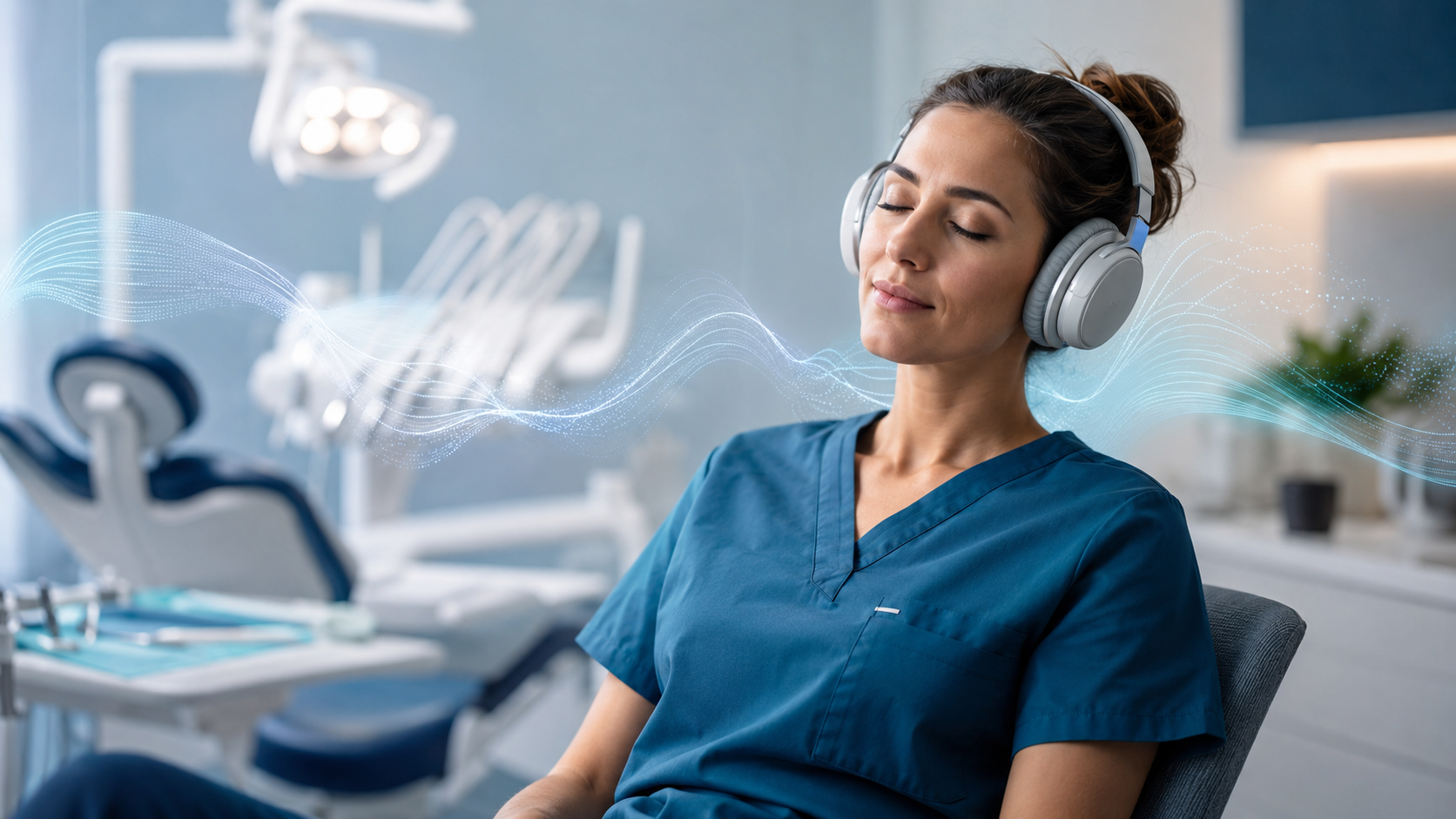
Put on your High Frequency Highway frequency headphones.
Choose a calming soundscape, alpha-style session, theta-style wind-down, or any frequency experience that feels steady rather than stimulating.
High Frequency Highway’s headphones are designed to pair with the app and use binaural beats and soundscapes to support states like focus, calm, and flow.
Let the sound become the line between clinic and home.
Not another task.
Not another productivity tool.
Not another thing to optimize.
Just a different environment for your nervous system.
Let your attention move away from analysis and toward sensation.
Notice:
The sound.
The breath.
The weight of your body.
The unclenching of your hands.
The quiet after the drills, suction, and patient management.
If your mind replays the day, do not fight it.
Just return to the sound.
Minute 12 to 15: Re-enter slowly
Before you take the headphones off, ask one question:
“What do I need before I re-enter the evening?”
Not what the practice needs.
Not what tomorrow needs.
Not what the inbox needs.
What you need.
Water.
Food.
A walk.
A quiet drive.
Five minutes alone.
A slower conversation.
No more input for a while.
Then choose one small action that supports that answer.
That is the ritual.
Fifteen minutes.
No overthinking.
No medical claim.
Just a cleaner transition after a high-sensory day.
Why sound can be useful for dental professionals
Sound is already part of the dental workday.
But in the clinic, sound often means alertness.
The drill.
The scaler.
The suction.
The timer.
The patient’s voice.
The room tone.
A sound-based decompression ritual changes the role of audio.
Instead of sound being something the nervous system has to manage, it becomes something the nervous system can follow.
This is where High Frequency Highway fits best for dental professionals.
Not as a cure.
Not as a treatment for clinical burnout.
Not as a promise of medical relief.
As a repeatable wellness cue after hours of precision, noise, and patient care.
The headphones and app can help create a calmer transition between “I am responsible for everyone in the room” and “I am allowed to come back to myself now.”
That transition matters.
Because dentists and hygienists are not machines with steady hands.
They are humans doing precise work inside a demanding sensory field.
And humans need recovery cues.
FAQ
Why is dentistry so stressful?
Dentistry combines precision work, patient anxiety, posture strain, time pressure, clinical responsibility, and sensory input. Dentists often work in small visual fields while managing patient comfort, procedural accuracy, and constant noise.
How do dental hygienists decompress after work?
Many dental hygienists benefit from a simple end-of-day decompression ritual: quiet time, stretching, hydration, low-stimulation sound, breathwork, walking, or a short transition before going home. The key is consistency. The nervous system responds well to repeatable cues.
Can sound help after a stressful clinical day?
Sound may help create a calming transition after work, especially when used as part of a consistent wellness ritual. The research around binaural beats is still developing, so it should be framed as supportive, not medical treatment.
Is High Frequency Highway a treatment for dentist burnout?
No. High Frequency Highway is not a treatment for burnout, anxiety, tinnitus, hearing issues, or any medical condition. It is a wellness tool that can support relaxation, focus, meditation, sleep preparation, and decompression rituals.
What is the best stress relief for dentists after work?
The best stress relief for dentists is usually simple and repeatable: reduce input, release physical tension, create a quiet transition, use calming sound if helpful, and give the body a clear signal that the clinical day is over.
Final thought
Dental professionals spend their days helping other people stay calm through discomfort.
But their own nervous systems are working too.
Every sound.
Every procedure.
Every anxious patient.
Every precise movement.
Every hour spent in clinical focus.
It all adds up.
That is why recovery does not need to be dramatic.
It needs to be intentional.
A calmer sound.
A quieter transition.
A few minutes where nobody needs anything from you.
High Frequency Highway frequency headphones can help dental professionals create that after-hours reset point: a simple way to move from noise, focus, and patient care back into their own body, their own evening, and their own frequency.
Share:
The Sales Nervous System: How to Reset After Rejection, Pressure, and Back-to-Back Calls
Your Brain on Sound: Why Frequency May Be More Personal Than You Think