Most people think of sound as something they hear.
A song.
A tone.
A meditation track.
A playlist running in the background while they work, sleep, breathe, or reset.
But your brain does not treat sound like background noise only.
It tracks rhythm.
It responds to frequency.
It organizes around patterns.
And in some cases, its electrical activity may shift in response to the sound it receives.
That is the idea behind binaural beats.
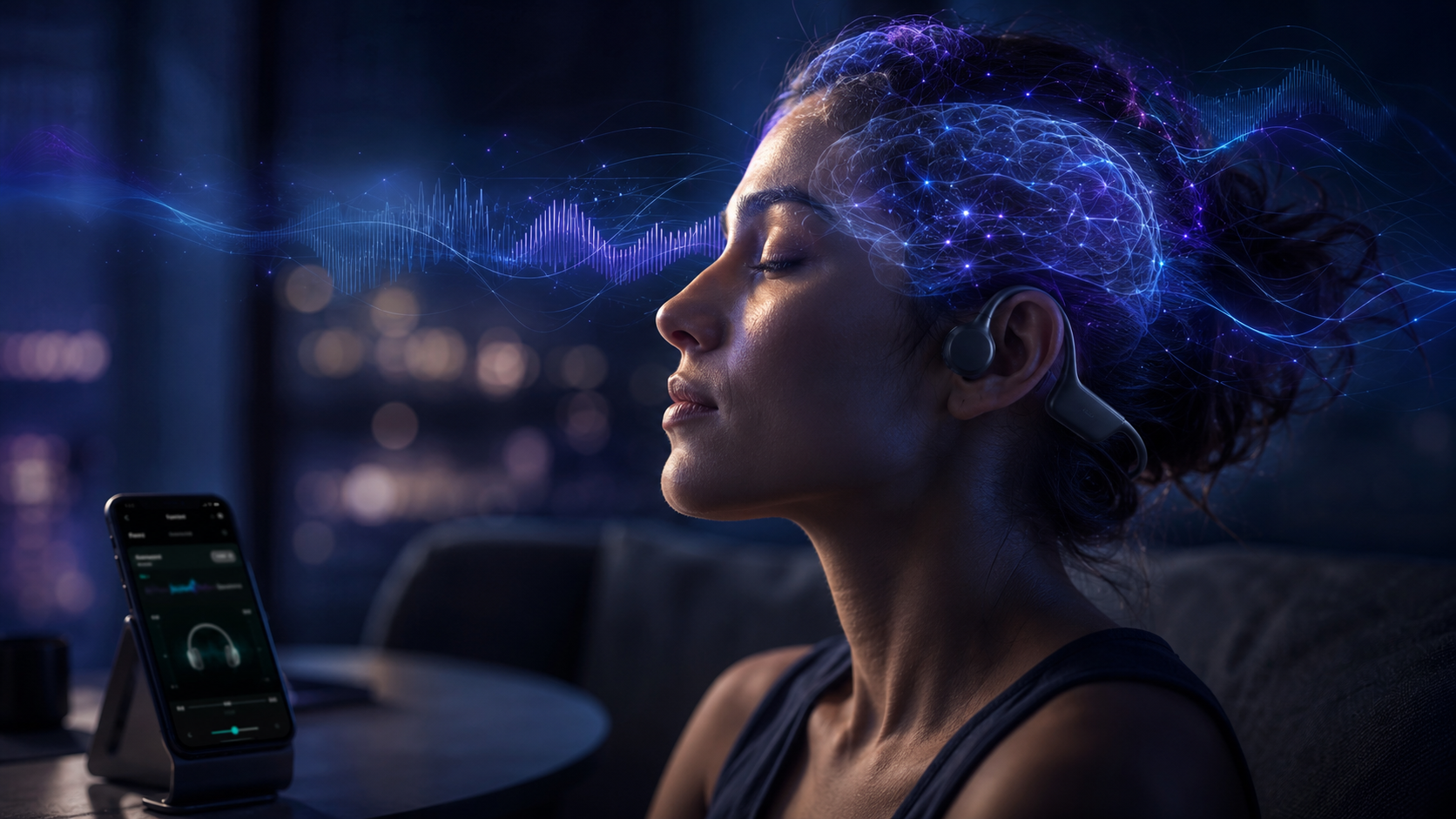
Binaural beats happen when each ear receives a slightly different tone. The brain perceives the difference between those tones as a third rhythmic pulse. Researchers have explored whether this kind of auditory stimulation can influence brainwave activity connected to states like relaxation, readiness, focus, and meditation.
One study looked at personalized theta and beta binaural beats using EEG.
Theta is commonly associated with deep relaxation and meditative states.
Beta is commonly associated with alertness, attention, and mental readiness.
The researchers personalized the binaural beats using each participant’s heart rate, then measured brain activity during theta stimulation, beta stimulation, and resting state. The study involved 20 healthy volunteers and used 22 EEG channels to track brain activity.
Here is the part that matters.
The brain responded.
The researchers found larger power differences during binaural beat sessions compared with resting state, especially in temporal and parietal brain regions connected with auditory perception and sound location.
But the results were not as simple as “theta relaxes you” and “beta makes you focused.”
The study did not find significant differences between the theta and beta sessions in the way researchers expected. The sound appeared to influence brain activity, but it did not create two clean, predictable mental states on command.
That is an important distinction.
The nervous system is not a light switch.
You do not press “theta” and instantly become calm.
You do not press “beta” and instantly become productive.
You do not force the brain into a state like changing a channel.
Your body is more personal than that.
Your stress level matters.
Your sleep matters.
Your environment matters.
Your nervous system history matters.
Your emotional state matters.
Even your body rhythm may influence how you respond.
This is why frequency work should be approached with curiosity, not exaggeration.
The better question is not:
“Can one frequency fix everything?”
The better question is:
“What kind of sound helps my system shift into the state I need right now?”
That is where High Frequency Highway fits in.
The High Frequency Highway app was built to make frequency-based listening simple, practical, and accessible. The app includes a library of sounds, sleep sounds, melodies, and a binaural beat frequency generator designed for use cases like sleep, focus, relaxation, meditation, and emotional well-being.
So instead of searching random videos and hoping the sound matches your state, you can choose a more intentional listening experience.
Need to wind down?
Choose a sound that supports relaxation.
Need to concentrate?
Use a frequency session built around focus.
Need to reset after a long day?
Create a listening ritual that tells your nervous system it is safe to slow down.
For a deeper experience, High Frequency Headphones are designed to pair with the High Frequency Highway app. The product page describes them as bone conduction headphones that deliver sound through gentle vibrations and connect with the app for binaural beats and soundscapes aimed at focus, calm, and flow.
That makes the experience more physical.
You are not just listening to sound in the usual way.
You are creating a full-body cue.
A pattern.
A rhythm.
A signal your system can follow.
That is the practical power of frequency.
Not as a cure.
Not as a shortcut.
Not as a promise that one sound will work the same way for everyone.
But as a daily tool.
A way to support your mind when it feels scattered.
A way to create calm when your body feels overloaded.
A way to prepare for focus without forcing yourself into it.
A way to turn sound into a ritual your brain can recognize.
The research is still evolving, and no single frequency should be treated like magic.
But one thing is clear:
Sound is not passive.
It can shape the environment inside your mind.
And when used with intention, it can become one of the simplest ways to help your brain and body move from noise to rhythm, from tension to steadiness, and from scattered energy to a more coherent state.
Share:
The Dentist’s Nervous System: Why Dental Work Is More Overstimulating Than People Realize
Event Planner Burnout: How to Reset After Managing Everyone Else’s Chaos