
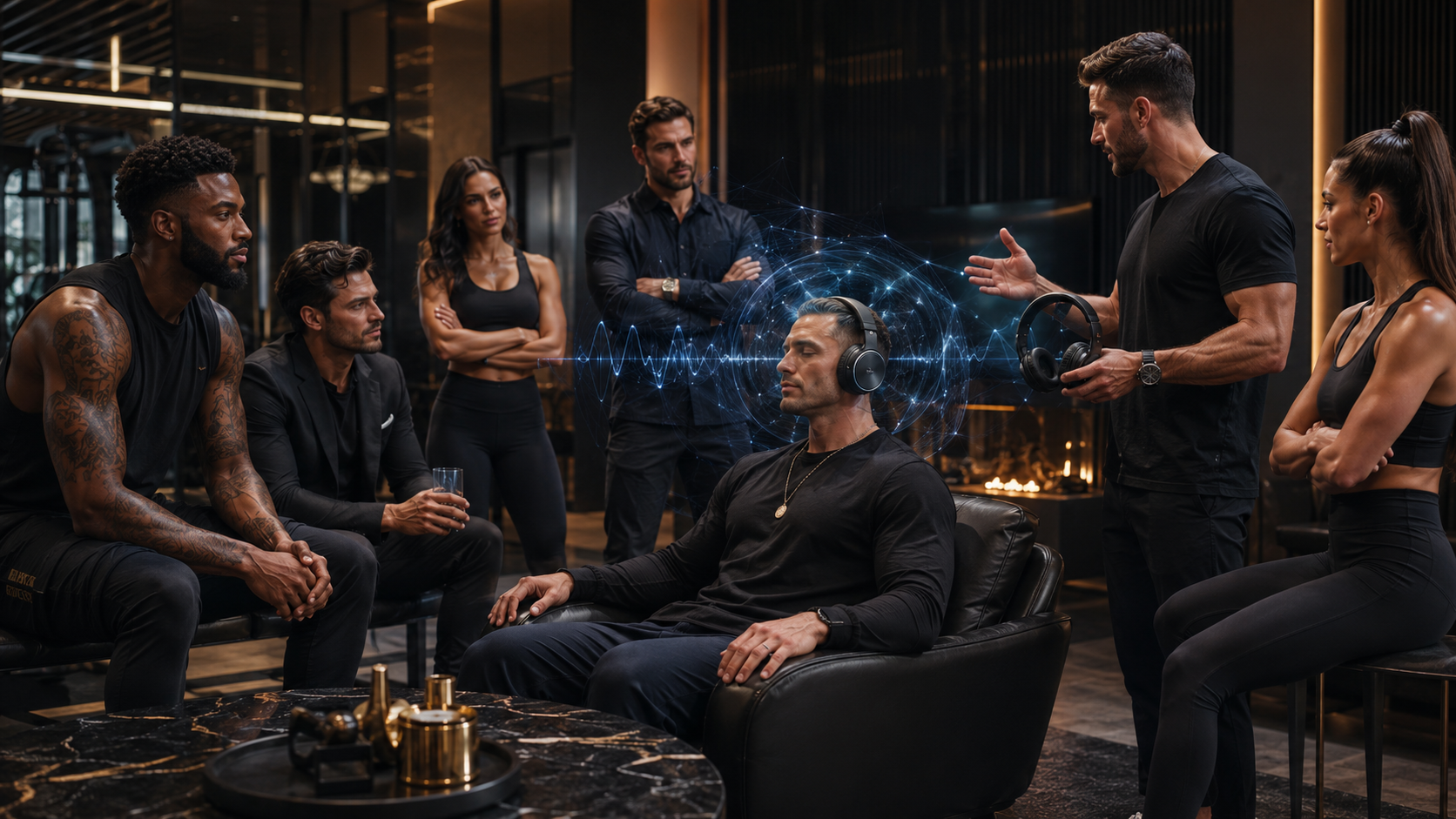
HFH live demos are bringing frequency technology into rooms filled with athletes, founders, and high performers. Here is why it matters.
Some products need a long explanation.
Others need a room.
When Mike Rashid introduced High Frequency Highway at a Jalen Brown event, the setting mattered as much as the product. This was not a quiet showroom. It was not a staged wellness booth with soft lighting and scripted testimonials.
It was a high-performance room.
Fitness. Wealth. Athletes. Entrepreneurs. Biohackers. People who live close to pressure and make decisions fast. People who have tried the supplements, the recovery tools, the ice baths, the breathwork, the devices, the apps, and the routines.
In a room like that, theory does not carry much weight.
The product has to speak for itself.
That is what makes a live HFH demo different. Frequency technology is easy to overexplain, but the real question is simpler:
What happens when someone actually puts on the headphones?
High Performers Trust Experience More Than Theory
High performers are not short on information.
They have access to coaches, trainers, chefs, performance labs, health trackers, recovery tools, and private networks. The problem is not finding another product. The problem is knowing what is worth paying attention to.
That is why experience wins.
A founder does not need another promise about focus. They need to feel their mind settle before a decision-heavy day.
An athlete does not need another recovery claim. They need something that helps them come down after training, competition, travel, and adrenaline.
A fitness influencer does not need another wellness trend. They need something they can test immediately and understand without a complicated onboarding process.
That is where frequency technology for fitness becomes interesting.
Because fitness is not only about muscle output anymore. It is about the whole system behind the output: sleep, focus, stress response, recovery, emotional regulation, and nervous system readiness.
Your muscles can be trained.
Your nervous system also needs recovery.
Live Demos Compress Trust
A good live demo does something no sales page can do.
It removes distance.
There is no waiting for a follow-up email. No abstract feature list. No overproduced explanation. No “you’ll understand once you read the research.”
The person tries it.
The room watches.
The reaction is immediate.
That matters because wellness tech has a trust problem. People have heard too many big claims. They have seen too many products promise transformation without giving them a clear reason to believe.
HFH has an advantage because the product is simple to try.
Put on the frequency headphones. Choose the state you want to support. Listen. Notice what changes.
That simplicity makes it powerful in high-performance rooms. The experience does not require a lecture. It does not require someone to believe in the product before trying it. It invites the body to respond first.
That is the difference between selling an idea and demonstrating a state shift.
Fitness Recovery Is Nervous System Recovery
Most recovery conversations still focus on the visible body.
Sore muscles. Tight hips. Inflammation. Hydration. Protein. Sleep duration. Mobility. Cold exposure. Heat exposure.
All of that matters.
But it misses the system running underneath everything.
The nervous system determines whether you can downshift after intensity. It shapes how quickly you recover from pressure. It affects how ready you feel the next day. It influences whether your body is actually resting or just lying still with the mind still running.
That is why biohacking frequency is becoming part of the fitness recovery conversation.
Not as a replacement for training, sleep, nutrition, or medical care.
As a state-support tool.
HFH is built around the idea that different states require different signals.
Alpha can support a post-training reset.
Gamma can support focused work sessions.
Theta can support recovery, reflection, and mental decompression.
Delta can support deeper rest and sleep routines.
The point is not to use one generic sound for everything.
The point is to choose the right frequency for the state you are trying to reach.
That makes HFH relevant to athletes, founders, creators, coaches, and anyone who performs under pressure. Because performance is not only about turning on.
It is also about knowing how to come back down.
Why This Matters for Fitness, Wealth, and Wellness Culture
The room matters because adoption often starts with proximity.
When high performers try something in front of other high performers, the product enters a different category. It is no longer just an app, a headphone, or a wellness accessory.
It becomes a tool people can see themselves using.
Before training.
After training.
Before a deep work block.
After a stressful meeting.
During travel.
Before sleep.
In the few minutes between demands when the body needs a reset and the mind needs a cleaner signal.
That is why the HFH demo environment matters. A product built for state control belongs in rooms where state control is valuable.
Luxury wellness buyers already understand this. They are not only buying products. They are buying access to better rituals, better recovery, better attention, and better control over how they move through their day.
Entrepreneurs understand it too. Their work depends on clarity, energy, and recovery. A fried nervous system makes every decision heavier.
Athletes understand it fastest. The body cannot perform at a high level if recovery stays shallow.
HFH sits at the intersection of all three.
Fitness wants recovery.
Wealth wants performance.
Frequency offers a new way to think about both.
What To Expect During Your First HFH Demo
A first HFH demo should feel simple.
You do not need to understand every frequency before you start. You do not need to know the science of brainwaves in detail. You do not need to turn the experience into a complicated ritual.
Start with the state you want.
If you are coming out of a workout, choose a reset-focused experience.
If you are preparing for focused work, choose a focus-oriented frequency.
If your mind feels overloaded, choose something that supports recovery and reflection.
If you are building a sleep routine, choose a deeper rest track.
Then pay attention.
Not in a forced way. Just notice.
Do you feel more settled?
Does your breathing change?
Does your mind feel less scattered?
Does your body feel like it has permission to come down from intensity?
That is the purpose of the demo.
Not to convince you with language.
To let you feel the product for yourself.
The Future of Wellness Tech Will Be Felt First
The next wave of wellness technology will not win because it sounds impressive.
It will win because it fits into real life.
HFH works in that direction because it is easy to explain, easy to try, and easy to place inside an existing performance routine.
Before training.
After training.
Before focus.
After stress.
Before sleep.
Between the moments where your nervous system needs a signal, not another stimulant.
That is why the Mike Rashid demo matters.
It showed HFH in the kind of room where performance is already the culture. A room where people do not need to be convinced that recovery matters. They already know.
The bigger question is what kind of recovery they are giving their nervous system.
Frequency technology for fitness is not about replacing discipline.
It is about supporting the state discipline depends on.
A product built for state control belongs wherever performance is taken seriously.
Try High Frequency Highway frequency headphones and feel the product instead of only reading about it.
Share:
Why Fighters and High-Adrenaline Performers Need Better State Control
High Frequency Highway on National TV: Why Frequency Technology Is Moving Into the Mainstream