
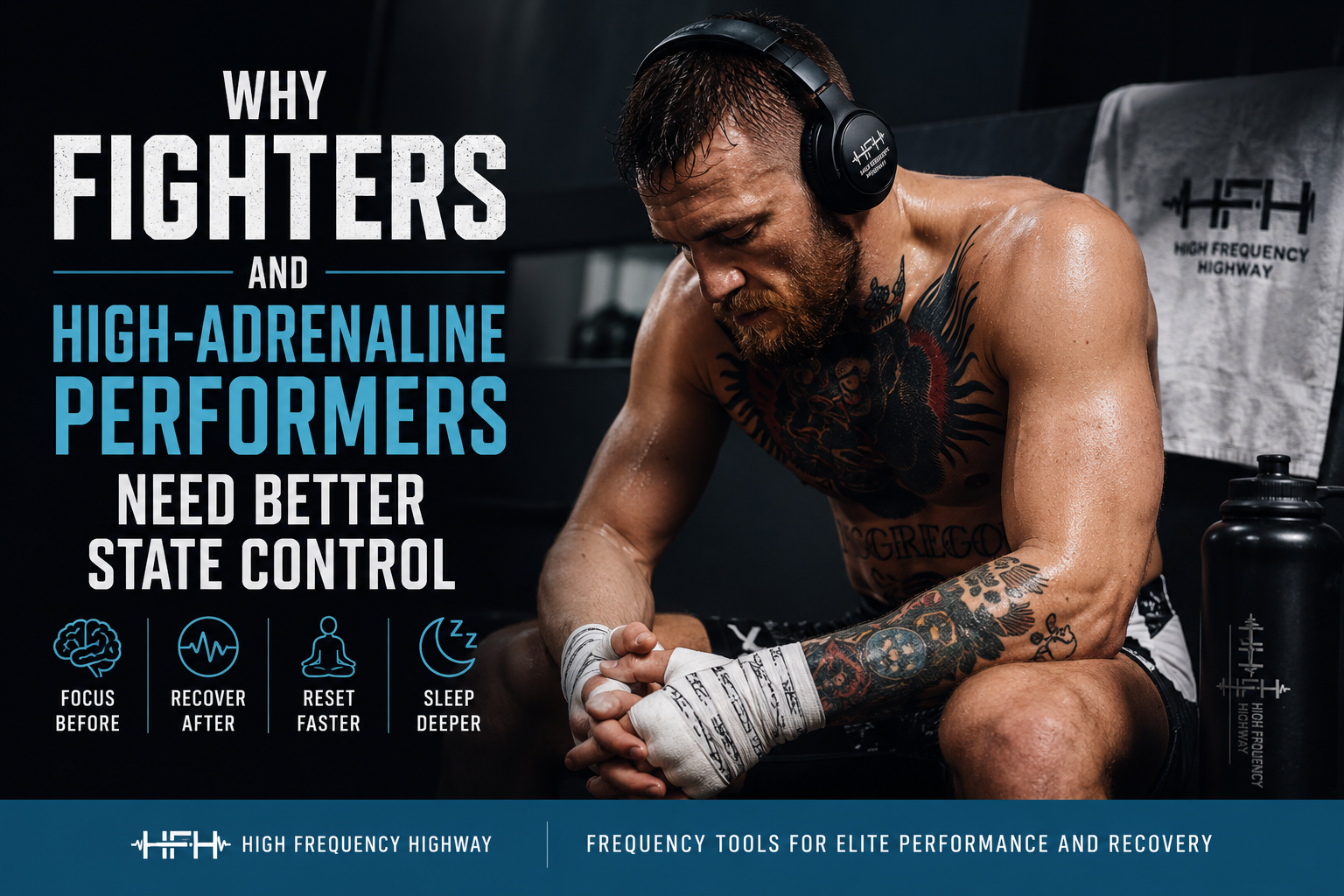
High-adrenaline performers need more than intensity. Learn why state control for athletes, fighter recovery, and frequency tools matter after high-pressure performance.
The fight ends before the body believes it is over.
The bell rings. The crowd fades. The cameras move on. The gloves come off. But inside the athlete, the nervous system may still be acting like the threat is alive.
Heart rate elevated. Jaw tight. Mind replaying moments. Sleep delayed. Hunger off. Mood sharp. Body exhausted, brain still hunting.
That is the part most people miss about high performance.
The hard part is not always turning intensity on. Fighters, athletes, founders, performers, and high-pressure professionals spend years learning how to activate. They train aggression. Speed. Focus. Pain tolerance. Emotional containment. They learn how to enter the moment and stay there.
But elite control is not only the ability to shift up.
It is the ability to shift back down.
That is why state control for athletes matters. Not as a wellness trend. Not as a soft recovery idea. As a performance skill.
Because if your nervous system cannot recover, your body never fully leaves the fight.
Adrenaline Is Useful in the Moment
Adrenaline is not the enemy.
It is one of the reasons high-adrenaline performers can do what they do.
Before a fight, a lift, a sprint, a pitch, a performance, or a critical decision, the body prepares for output. Attention narrows. Energy rises. Reaction speed sharpens. Pain becomes less important. The system prioritizes survival and execution.
That is useful when the moment demands it.
A fighter does not need to feel deeply relaxed walking into a cage. A sprinter does not need sleepy calm at the starting line. A founder does not need full-body softness before a room full of investors.
They need access.
Access to focus. Access to intensity. Access to power under pressure.
But the same system that helps you perform can become expensive when it stays switched on too long.
Adrenaline is a tool. It was never meant to be a lifestyle.
When the body keeps living in high alert, recovery gets harder. Sleep becomes lighter. Small problems feel louder. Irritability rises. Patience drops. The mind keeps scanning even when the event is finished.
That is not weakness.
That is an activated nervous system doing what it has been trained to do.
The problem is that many high performers only train the upshift. They know how to push. They know how to lock in. They know how to override discomfort.
They do not always have a clean protocol for coming down.
The Hidden Cost of Staying Activated
A fighter’s body takes visible damage.
Bruises. Swelling. Cuts. Soreness. Fatigue.
But the nervous system carries invisible load.
After competition or intense training, the system may still be processing impact, threat, speed, crowd noise, emotional pressure, and outcome. Even when the athlete is physically still, the body can remain internally charged.
That state can show up as:
Poor sleep after competition
Restlessness even when tired
Short temper after hard training
Mental fatigue that feels different from muscle fatigue
Low motivation after a major performance
Difficulty relaxing without alcohol, scrolling, food, or distraction
A feeling of being “wired but drained”
This is where fighter recovery becomes more than ice baths and protein.
Recovery is not only tissue repair. It is nervous system regulation.
Sleep research in athletes consistently points to sleep as central to regeneration, adaptation, and performance, while sleep deprivation is associated with increased sympathetic nervous system activity and reduced parasympathetic recovery. Heart rate variability is also widely used in strength and conditioning as a non-invasive marker connected to training status, adaptability, and recovery.
In plain language: the body performs better when it can move between gears.
High output requires activation.
Recovery requires downshifting.
The issue is not intensity. The issue is getting stuck there.
State Control Is the Missing Recovery Skill
Most athletes already understand physical programming.
Train hard. Recover. Adapt. Repeat.
But fewer athletes apply the same logic to mental and nervous system states.
They leave state control to chance.
They hope sleep happens. They hope the mind settles. They hope the post-fight charge fades on its own. They hope the next morning feels normal.
That is not a protocol.
That is gambling with recovery.
State control for athletes means learning how to shift the body and brain toward the state the moment requires.
Before performance, the goal may be readiness.
After performance, the goal may be decompression.
Before sleep, the goal may be deeper restoration.
During stress, the goal may be stability without collapse.
This is where frequency tools can become useful as part of a larger recovery system.
Not instead of training.
Not instead of nutrition.
Not instead of sleep.
Not instead of breathwork, mobility, therapy, coaching, medical care, or real rest.
Frequency belongs inside the toolkit as a state cue.
High Frequency Highway positions its app and headphones around customizable binaural beats, soundscapes, and AI-guided sessions designed to help users move toward calm, focus, or flow. The brand’s headphone system is described as connecting with the High Frequency Highway app to guide mental states through binaural beats and soundscapes.
For high-adrenaline performers, that matters because the nervous system responds well to signals.
A locker room has signals.
Walkout music is a signal.
Crowd noise is a signal.
A coach’s voice is a signal.
A pre-fight playlist is a signal.
A dark room is a signal.
A repeated soundscape can become a signal too.
The more consistently you pair a certain frequency range with a certain state, the more your body starts to recognize the transition.
That is the practical value.
Not magic. Not hype.
A repeatable cue.
Frequency Is Not Generic
One of the biggest mistakes in wellness is treating sound like one category.
“Calming music.”
“Focus sounds.”
“Sleep audio.”
That is too vague.
Different states require different inputs.
A fighter preparing to perform does not need the same signal as a fighter trying to sleep after a five-round war. A founder heading into a negotiation does not need the same signal as a founder trying to decompress after three days of high-stakes decisions.
The nervous system does not want generic input.
It wants the right signal for the state you are trying to enter.
That is the entire point of frequency work.
Beta and gamma ranges are typically associated with alertness, focus, and higher cognitive processing.
Alpha is commonly connected with relaxed awareness.
Theta is associated with deeper inward attention, meditation, and decompression.
Delta is associated with deep sleep.
Binaural beat research is still developing, and results vary by protocol, duration, frequency, and individual response. A 2023 systematic review examined binaural beat stimulation and its effects on brain oscillatory activity, while meta-analytic work has reported effects across cognition, anxiety, and pain perception.
The practical takeaway is simple: frequency should be used intentionally.
Not “put something on and hope.”
Choose the state first.
Then choose the signal.
A Practical Frequency Protocol for Fighters and High-Adrenaline Performers
This is not medical advice. It is a practical state-control framework athletes can test and adjust.
Pre-performance: focus and readiness
Use before training, sparring, competition, lifting, pitching, presenting, or stepping into a high-pressure environment.
Goal: alert, ready, focused.
Frequency direction: beta or gamma.
How to use it:
Set aside 5 to 10 minutes before the performance window. Put on High Frequency Highway frequency headphones. Choose a focus-oriented frequency or soundscape. Sit still or move lightly. Let the body sharpen without forcing extra tension.
The goal is not to hype yourself into chaos.
The goal is clean activation.
Ready body. Clear mind. Controlled intensity.
Post-performance: decompression
Use after competition, intense training, public performance, major presentations, hard negotiations, or emotionally charged events.
Goal: downshift the nervous system.
Frequency direction: alpha or theta.
How to use it:
After cooldown, hydration, and basic recovery steps, take 10 minutes away from noise. Use alpha for relaxed awareness or theta for deeper decompression. Let the body receive a clear signal that the event is complete.
This is especially useful when the mind keeps replaying what happened.
The session becomes a line in the sand.
The fight is over.
The pitch is over.
The performance is over.
Now the body can come down.
Sleep transition: full recovery
Use when the body is tired but the mind is still active.
Goal: deeper sleep preparation.
Frequency direction: delta.
How to use it:
Use a lower-frequency sleep session before bed. Keep the environment dark. Avoid turning the session into another task. The purpose is to reduce stimulation and create a predictable sleep cue.
Athletes do not adapt from training during the hype.
They adapt during recovery.
Sleep is where much of the repair happens.
Why Fighters Need This More Than Most
Fighters are not just athletes.
They are high-adrenaline problem solvers under threat.
They must stay calm while someone is trying to hurt them. They must read movement under pressure. They must manage fear, aggression, pain, fatigue, and public expectation.
That creates a specific recovery challenge.
The body may be done fighting long before the nervous system feels safe.
This is why fighter recovery needs more than “take a rest day.”
A rest day does not guarantee recovery if the system stays activated.
A night off does not guarantee downregulation if the brain keeps replaying danger.
A quiet room does not always feel quiet to a charged nervous system.
High performers need tools that help the body recognize transition.
From threat to safety.
From output to repair.
From aggression to calm.
From performance to sleep.
That is state control.
The Same Problem Shows Up Outside the Cage
This is not only about fighters.
High-adrenaline professionals face the same pattern in different environments.
The surgeon after a high-risk case.
The founder after a board meeting.
The salesperson after a make-or-break pitch.
The first responder after a critical call.
The performer after stepping off stage.
The executive after carrying a week of decisions.
Different arenas. Same nervous system problem.
The moment ends.
The body stays charged.
That is why state control for athletes is also relevant for anyone who performs under pressure.
Modern life rewards activation. Move faster. Respond faster. Decide faster. Stay available. Stay ready. Stay sharp.
But the body still needs recovery.
You cannot build elite output on a nervous system that never gets to stand down.
Elite Control Means Shifting Both Ways
The next evolution of performance is not more intensity.
Most high performers already know how to push.
The next evolution is control.
Can you activate without spiraling?
Can you focus without becoming rigid?
Can you compete without staying in threat mode all night?
Can you recover without needing to numb yourself?
Can you sleep after your biggest moments?
That is the standard.
Elite performers do not just train the body.
They train the transition.
High Frequency Highway frequency headphones give athletes and high-adrenaline performers a simple way to build that transition into their routine: beta or gamma before performance, alpha after intensity, theta for decompression, delta for sleep.
The goal is not to escape pressure.
The goal is to move through pressure and come back to yourself faster.
Because the future of performance is not just who can turn it on.
It is who can turn it off when the work is done.
Use High Frequency Highway frequency headphones to support recovery, focus, and state control after high-intensity performance.
Share:
Why DJs, Producers, and Music Creators Understand Frequency Before Everyone Else
What Happens When Fitness, Wealth, and Frequency Meet in One Room